Custom Street Light Design: A Practical Guide to Non-Standard Lighting Poles and Architectural Street Lighting
Custom Street Light Design: How to Plan Non-Standard Lighting Poles and Architectural Street Lighting for Public Projects
Custom street light design is the process of adapting outdoor lighting hardware—luminaire appearance, pole height, arm structure, finish, optical distribution, and control functions—to the specific visual, environmental, and engineering requirements of a public or commercial project. For town centers, waterfronts, cultural districts, and municipal road upgrades, off-the-shelf street lighting often fails to satisfy both architectural intent and site constraints. This guide explains what a custom street lighting project actually involves, what parameters can be changed, how to evaluate a manufacturer, and which decision criteria matter at the procurement stage.
Why Standard Street Lights Are Not Enough
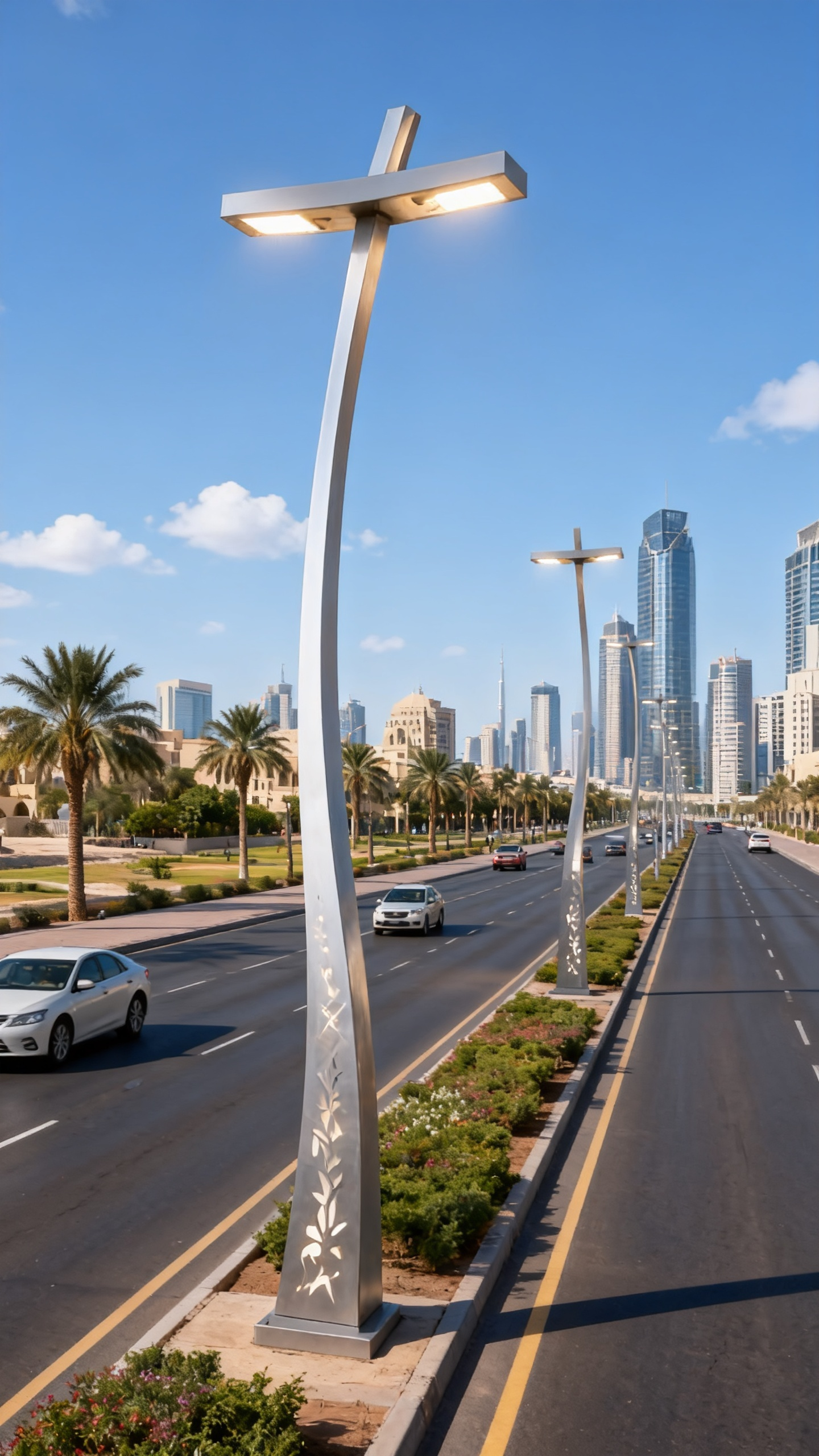
Standard catalogue street lights are designed around generic road widths, mounting heights, and installation conditions. They are efficient to produce and simple to specify, but many urban projects carry constraints that a standard luminaire cannot address.
- Architectural identity: City entrances, heritage districts, waterfront promenades, and cultural tourism areas usually require decorative or themed lighting rather than purely functional luminaires.
- Site conditions: Coastal environments, high-wind regions, desert climates, and cold-weather zones place different demands on corrosion resistance, wind loading, operating temperature range, and sealing.
- Project-specific layouts: Pole height, bracket style, number of arms, lighting distribution, and control systems must match each road cross-section, plaza layout, or landscape plan.
- OEM/ODM requirements: Contractors, developers, and distributors often need a manufacturer to work from drawings, design intent, or a reference image rather than from a fixed catalogue.
The practical response is a non-standard customized lighting approach: engineering the luminaire, pole, and electrical configuration around project requirements while keeping production reliable.
What Does Custom Street Light Design Actually Cover?
Most buyers assume customization means changing the color of a housing. In project lighting supply, customization spans at least six areas:
1. Luminaire Appearance and Structure
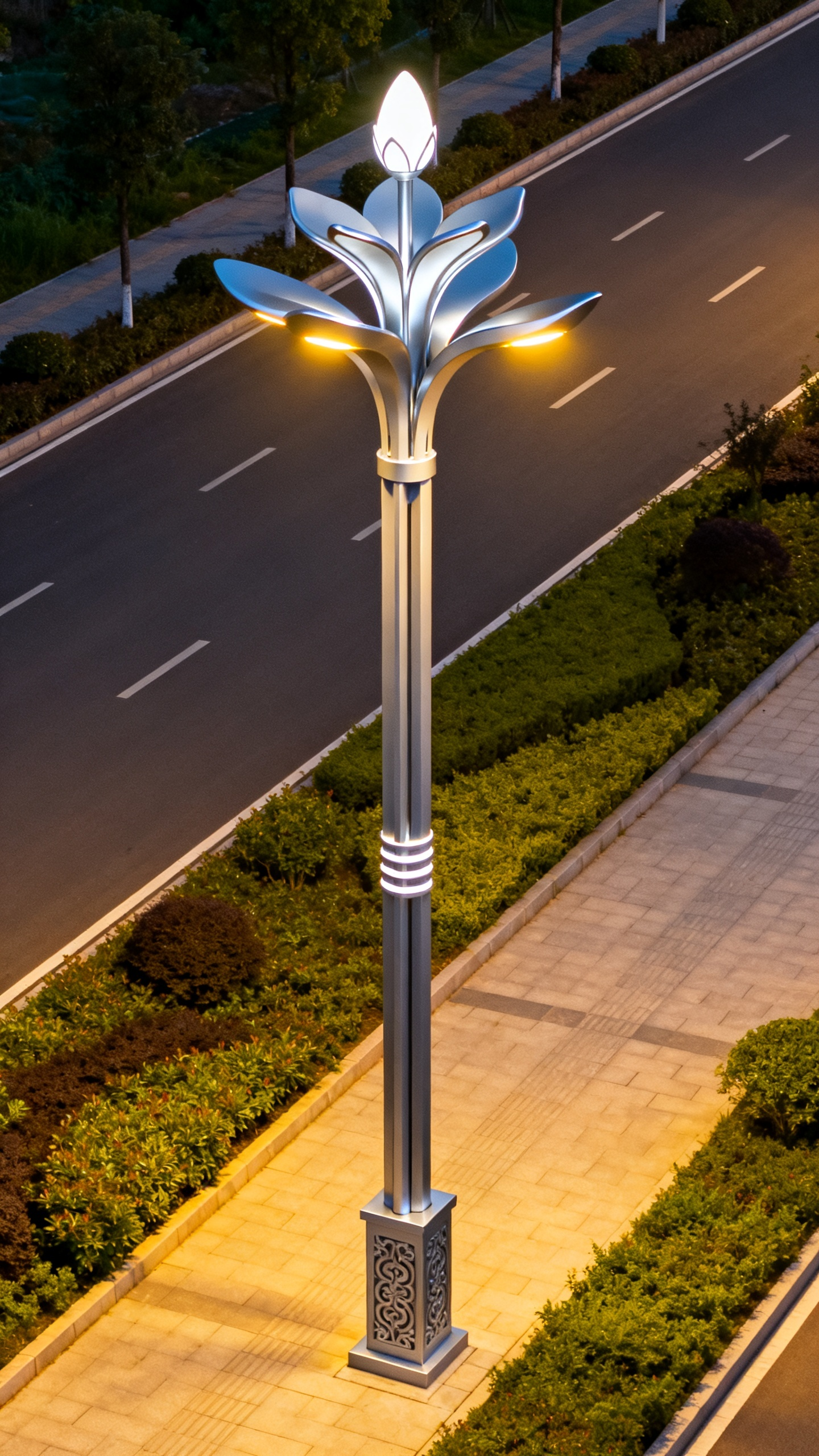
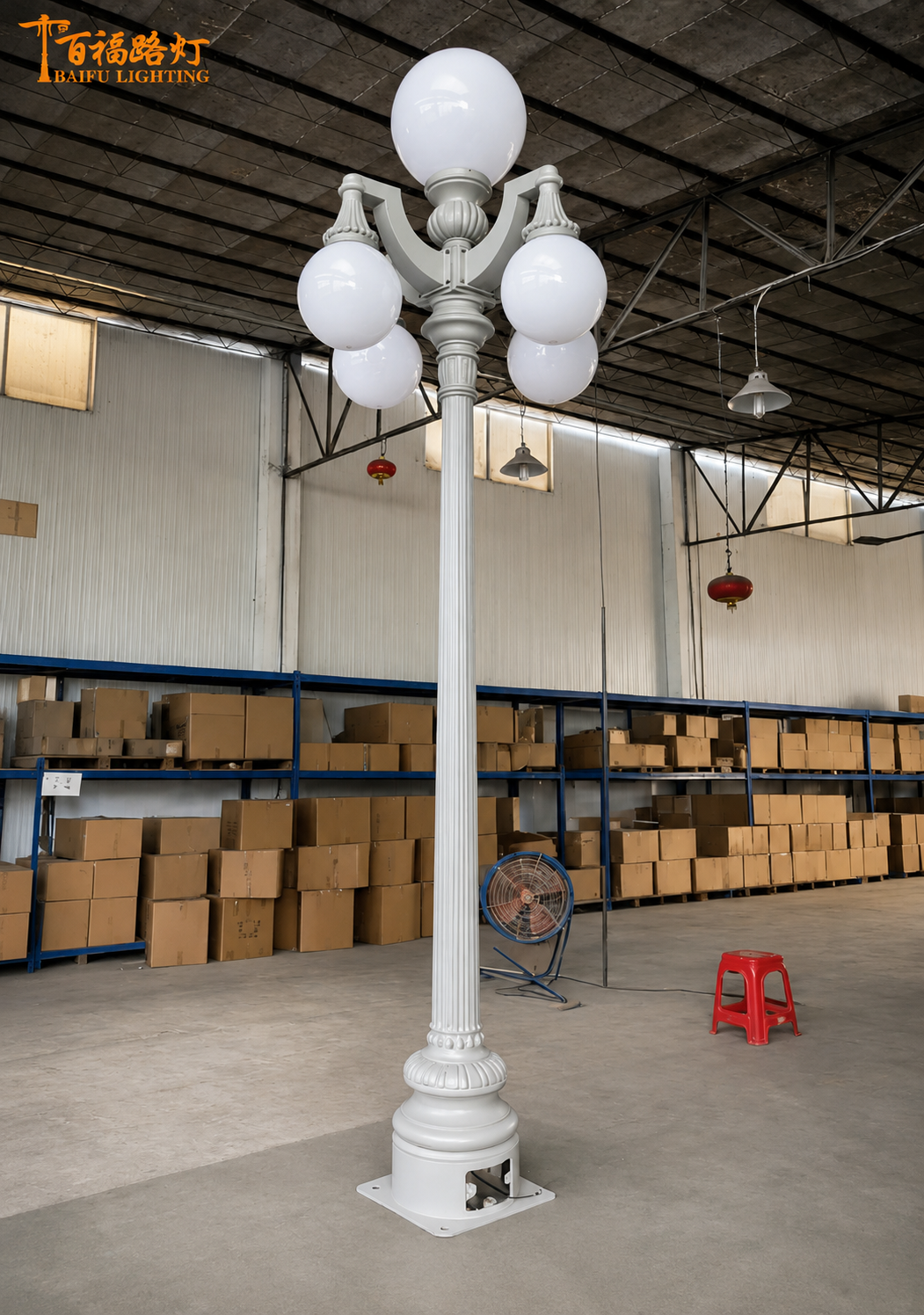
Lamp head design can be adapted to different visual styles—simple geometric forms, magnolia or lotus-inspired shapes, hollow decorative patterns, luminous elements, cultural motifs, or city logos. Materials usually include die-cast aluminum housings, Q235 hot-dip galvanized steel, 304 stainless steel, high-transmittance tempered glass, and stainless steel fasteners.
2. Pole Design and Bracket Structure
Poles can be conical, square, special-shaped, or artistic structures. Bracket options include single arms, double arms, multi-arm arrangements, and combined high-low lamp heads. This flexibility matters for roads with trees, medians, pedestrian zones, or mixed vehicle/pedestrian areas.
3. Optical Performance and Light Distribution
Custom lighting projects can specify lamp power, luminous efficacy, color temperature, color rendering index, and light distribution type. Typical choices include road lighting distribution, plaza distribution, and decorative landscape distribution.
4. Surface Treatment and Color
Most outdoor projects use a hot-dip galvanized base with outdoor electrostatic powder coating. Standard colors such as dark grey, black, silver grey, and bronze can be adjusted to a RAL color card when the design requires a specific architectural finish.
5. Electrical and Control Configuration
Beyond fixed mains supply, solar hybrid and fully solar configurations can be integrated. Control options include standard on/off, photocell, timer, 0–10V dimming, DALI, and smart city lighting controls for remote monitoring and adaptive operation.
6. Installation and Wind Resistance
Structural design is tailored to pole height and the local wind speed at the project site. Installation is usually fixed with a flange base and pre-embedded anchor bolts.
Mapping Custom Street Light Types to Project Scenarios
There is no single custom design that fits all sites. The table below compares common custom street light categories and the project contexts they suit.
| Type | Typical Mounting Height | LED Power Range | Best-Fit Scenarios |
|---|---|---|---|
| Custom Decorative Landscape Street Lights | 6m / 8m / 10m / 12m (customizable) | 60W to 200W | Urban roads, parks, plazas, commercial streets, large-scale landscape projects |
| Aluminum/Steel Cast Courtyard Lamps | 3–4m (customizable) | 30W to 80W | Residential communities, villa courtyards, hotels, pedestrian streets, garden landscapes |
| Split-Type Solar LED Street Lights | 8m (customizable) | 100W (with 200W solar panel) | Municipal roads, rural roads, industrial parks, parking lots, overseas infrastructure |
For example, a coastal promenade project may combine a decorative cast-aluminum lantern with a corrosion-resistant Q235 hot-dip galvanized pole and IP65/IP66 protection. A municipal road in a remote area may prefer a split-type solar street light with light control, time control, and intelligent dimming to reduce grid dependence.
From Design Brief to Factory Production: A Step-by-Step Breakdown
Understanding the production workflow helps buyers plan better, communicate more clearly, and avoid delays. A typical custom outdoor lighting order follows these stages:
Step 1: Project Requirement Definition
The buyer provides road or site dimensions, mounting height, desired visual style, color, lighting performance targets, environmental conditions, and any reference images or drawings. This stage should also confirm whether the project needs mains power, solar power, or smart control.
Step 2: CAD Drawing and Configuration Proposal
The manufacturer translates the requirements into CAD drawings and a lighting configuration recommendation. This usually covers pole structure, arm arrangement, luminaire appearance, optical distribution, surface treatment, and installation details.
Step 3: Appearance Evaluation and Sample Development
Before mass production, appearance design is reviewed against project expectations. Sample development helps verify the shape, finish, and assembly feasibility. This step is especially important for non-standard poles and decorative luminaires.
Step 4: Production and In-House Quality Control
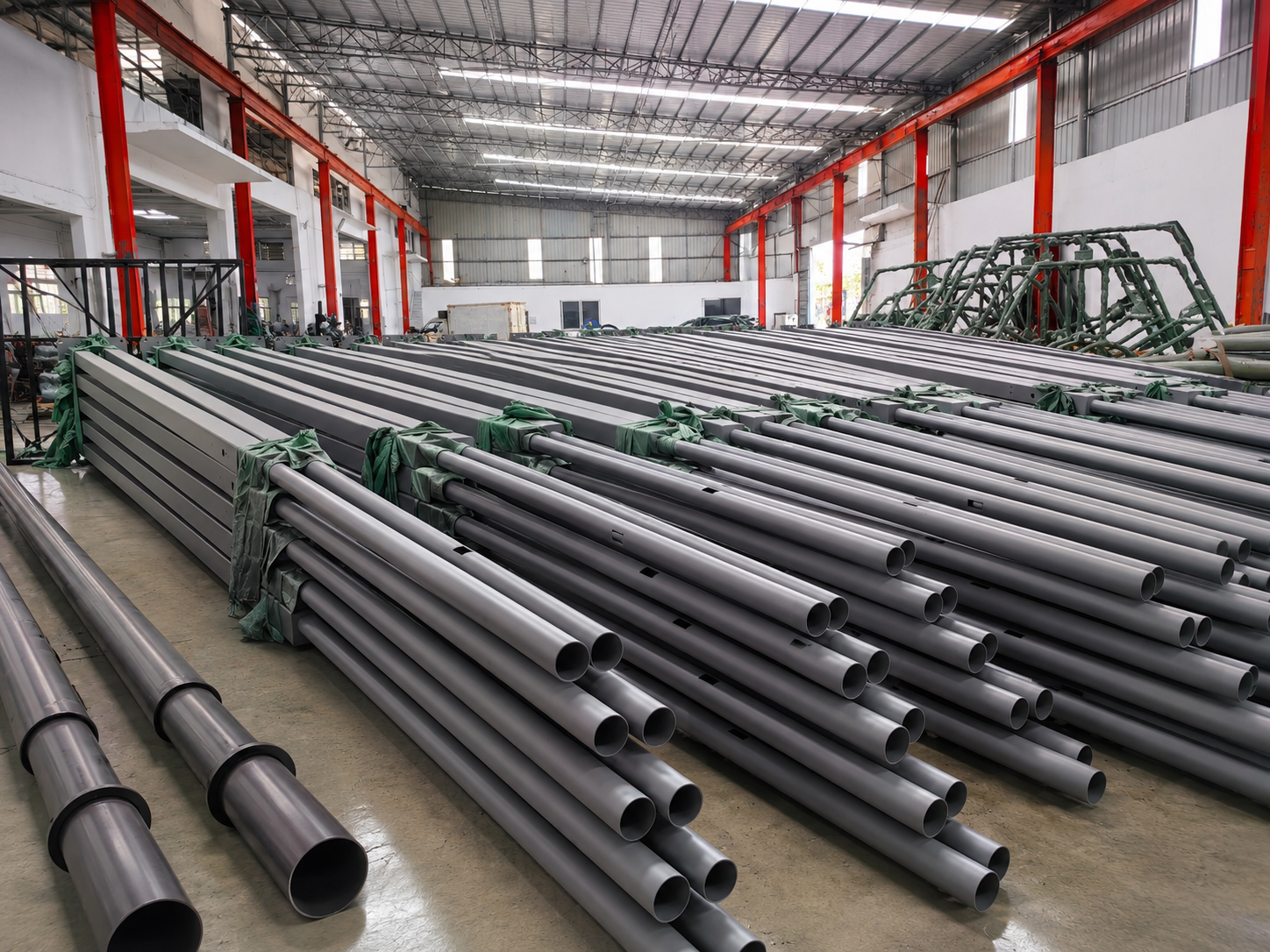
Manufacturing covers metal fabrication, cutting, forming, welding, structural assembly, surface treatment, outdoor powder coating, electrical assembly, product inspection, and aging testing. Products generally pass appearance inspection, electrical performance testing, and protection level testing.
Step 5: Packaging and Export Delivery
International project shipments include proper packaging, export documentation, and shipment coordination. A manufacturer with export experience can support municipal contractors, engineering companies, developers, and procurement firms more smoothly.
Reference Project: Coastal Municipal Lighting
A municipal engineering client used 35 custom decorative street lamps for coastal roads, port areas, city squares, and public recreational areas. The project required nighttime road lighting, pedestrian guidance, and coastal landscape decoration.
Because the site was a coastal environment, the luminaires were designed with waterproof, anti-corrosion, and weather-resistant properties. After completion, the lamps were installed along the coastal roads and public areas, providing stable and uniform nighttime illumination. The design was coordinated with local coastal buildings and the port environment, supporting the overall image of the urban waterfront.
This case illustrates a recurring principle: custom lighting is not only about appearance. The protective requirements of the installation environment directly affect material selection, sealing class, and surface treatment.
Another Reference Project: Urban Road Landscape Lighting
In a second municipal project, 68 customized landscape street lamps were supplied for urban roads, characteristic streets, and road landscape lighting. The installation delivered uniform road brightness and coordinated visually with roadside greenery and the surrounding urban environment.
The project demonstrated how customization can address brightness, road safety, weather resistance, and landscape effect simultaneously. For buyers, this is an example of one-stop support that runs from design and production through overseas engineering coordination.
Solar Custom Street Lighting: Configuration and Compliance
Solar street lights are increasingly requested for municipal, rural, and infrastructure projects. A representative configuration is the 8-meter split-type solar LED street lamp (BF-SL-8M-100W), which includes a 100W LED lamp, 200W monocrystalline silicon solar panel, 12V 80Ah maintenance-free lead-acid battery, and a single-arm conical pole.
Its optical performance includes luminous efficacy ≥150 lm/W, color temperature options of 3000K, 4000K, 5000K, and 6000K, and color rendering index Ra≥70. The protection level is IP65/IP66. The control method supports light control plus time control and intelligent dimming.
For buyers, the key point is that solar lighting is also customizable. Height, power, color, battery capacity, solar panel, and pole design can be adjusted to project conditions. Rainy-day autonomy can be configured, typically supporting 2–3 days depending on the project specification.
Certification and Compliance in Custom Street Lighting
For international projects, compliance documentation is often a bid requirement. BAIFU LIGHTING holds ISO 9001 certification (certificate number 52824Q10676R0S, issued under GB/T19001-2016/ISO9001:2015) for production of road and street lighting lamps. This certification is mutually recognized domestically and internationally and is relevant for government bidding and overseas trade projects.
For the Chinese market, the company also holds a China Compulsory Product Certification (CCC) under certificate number 2017011001975444, valid through 2027, covering fixed luminaires for incandescent lamps (ground-mounted garden lamps) with Class I protection and IP44 ingress protection.
Buyers should always confirm which certifications apply to the specific product and target market. ISO 9001 is a quality management system certification; it is not a substitute for a product-safety certification required by the destination country.
How to Evaluate a Custom Street Light Manufacturer
When choosing a supplier for non-standard street lights, the evaluation criteria differ from a standard catalogue purchase. The following checklist covers the practical decision points.
1. Real Manufacturing Capability
Check whether the factory controls metal fabrication, cutting, forming, welding, assembly, surface treatment, coating, electrical assembly, inspection, and aging testing in-house. A vertically integrated workshop generally reduces quality variation and improves lead-time control.
2. OEM/ODM and Engineering Support
Confirm that the manufacturer can support CAD drawing development, lighting configuration recommendations, appearance design evaluation, sample development, and project quotation. These services determine how smoothly design intent becomes manufacturable hardware.
3. Customization Limits
Ask which parameters are customizable and which are fixed. A capable supplier should clarify pole height, arm structures, lamp design, decorative patterns, colors, surface finishes, LED power, solar configuration, and smart functions.
4. MOQ and Lead Time
MOQ and lead time affect project planning. In the case of BAIFU LIGHTING, standard-style orders require a minimum of 20 sets, custom-style orders require a minimum of 5 sets, regular production lead time is 15 to 18 days, and monthly production capacity is roughly 3,000 to 5,000 units for regular orders.
5. Export Experience and After-Sales Support
International buyers should verify export packaging, documentation, and shipment coordination. After-sales support should include installation instructions, remote technical support, fault diagnosis, accessory supply, and contract-based repair or replacement for quality issues.
Manufacturer Comparison: Large Global Brands vs. Project-Focused Custom Manufacturers
The lighting market is fragmented. According to CSIL, the top 10 lighting manufacturers account for just over 20% of the global lighting fixtures market. This means most projects are supplied by specialized and regional manufacturers rather than a single dominant brand.
Large global companies such as Signify bring scale, brand recognition, and smart lighting ecosystems. Schréder is known for architectural street lighting and smart city solutions, and Sentry Electric is recognized in the United States for custom and historic decorative street lighting poles and luminaires. These companies are appropriate references for architectural quality and market positioning.
For buyers managing international projects, a project-focused Chinese manufacturer may offer stronger flexibility in non-standard geometry, cost structure, and production turnaround. The right choice depends on project complexity, certification requirements, budget, and required customization depth.
| Selection Criterion | Global / Architectural Brands | Project-Focused Custom Manufacturer |
|---|---|---|
| Best-known strength | Brand recognition, smart lighting ecosystem, architectural reputation | Non-standard customization, OEM/ODM flexibility, integrated production |
| Typical focus | Architectural and smart city lighting | Custom poles, decorative luminaires, solar and municipal lighting |
| Documentation/support | Strong technical documentation | CAD drawings, sample development, export documentation, remote technical support |
| Consider when | Project requires global brand specification or enterprise-level smart platform | Project needs unique shapes, specific RAL finishes, special poles, or cost-effective OEM/ODM delivery |
Design and Procurement Checklist for Custom Street Light Projects
- Define the visual role of lighting: functional road lighting, decorative landscape lighting, or both.
- Record site environment: coastal, dusty, rainy, snowy, high-temperature, or high-wind.
- Confirm pole height, arm style, luminaire style, and mounting method.
- Select optical parameters: wattage, luminous efficacy, color temperature, CRI, and light distribution.
- Choose protection level: IP65 or IP66 are common outdoor options for custom municipal lights.
- Specify surface treatment and RAL color before production.
- Decide control method: standard on/off, photocell, timer, 0–10V, DALI, or smart control.
- For solar projects, define battery capacity, panel power, rainy-day backup, and dimming schedule.
- Confirm certification requirements for the destination market and project tender.
- Review MOQ, lead time, sampling process, packaging, and after-sales terms.
Frequently Asked Questions
What certifications should custom street lights meet?
Certification requirements depend on the target market and the project type. For international bids, ISO 9001 demonstrates that the manufacturer operates a certified quality management system. Product-specific electrical safety and ingress protection certifications may be required in the destination country. As an example, BAIFU LIGHTING's ISO 9001 certification (certificate number 52824Q10676R0S) covers the production of road and street lighting lamps and is mutually recognized domestically and internationally for government bidding and overseas trade projects.
What parameters can be customized in a non-standard street light?
A project-specific street light can be customized in pole height, lamp power, color temperature, color rendering index, light distribution, pole shape, bracket structure, decorative patterns, surface finish, RAL color, solar configuration, and control system. The BF-LSL-4000-120W landscape street light, for example, supports mounting heights from 6m to 12m, LED power from 60W to 200W, IP65/IP66 protection, and optional smart lighting control.
What is the minimum order quantity for custom street lights?
MOQ depends on whether the design is standard or fully custom. Under BAIFU LIGHTING's production policy, a standard style requires a minimum order of 20 sets, while a custom style requires a minimum order of 5 sets. Production lead time for regular orders is 15 to 18 days, with monthly production capacity of approximately 3,000 to 5,000 units.
Can you provide a custom street light sample before mass production?
Yes. Sample development is a standard part of the engineering support process. The manufacturer can provide product selection, CAD drawing development, lighting configuration recommendations, appearance design evaluation, and sample development before mass production. For international projects, engineering support also includes English specifications, quotations, packaging information, export documentation, and shipment coordination.
How long does a custom street lighting project take from design to delivery?
For regular orders, BAIFU LIGHTING's production lead time is 15 to 18 days. Total project time depends on design revisions, sample approval, order quantity, and shipping schedule. Buyers should add time for drawing confirmation and sample evaluation when the project requires unique pole shapes, decorative patterns, or smart control integration.
Planning a custom street light or lighting pole project?
Download the BAIFU LIGHTING customized product catalog to review sample configurations, model references, and engineering capabilities.
View the Customized Lighting Album →
For a project-specific quotation or CAD support, contact Jack Chen at chenyingjie@baifulamp.com or WhatsApp +86 195 8242 2595.
Have Questions or Need More Details?
Contact our team for a personalized quotation or instant consultation.
Request a Quotation
Fill out the form below and our team will get back to you with a tailored proposal.
WhatsApp Direct Chat
Prefer to chat in real-time? Message us on WhatsApp for instant assistance & quick answers.
- Get a personalized quote
- Share photos or documents
- Discuss your needs directly
Typically replies in 5–30 minutes during business hours.