
Custom Street Light 101: Solar, Courtyard & Landscape Categories
Custom Street Light 101: Solar, Courtyard & Landscape Categories
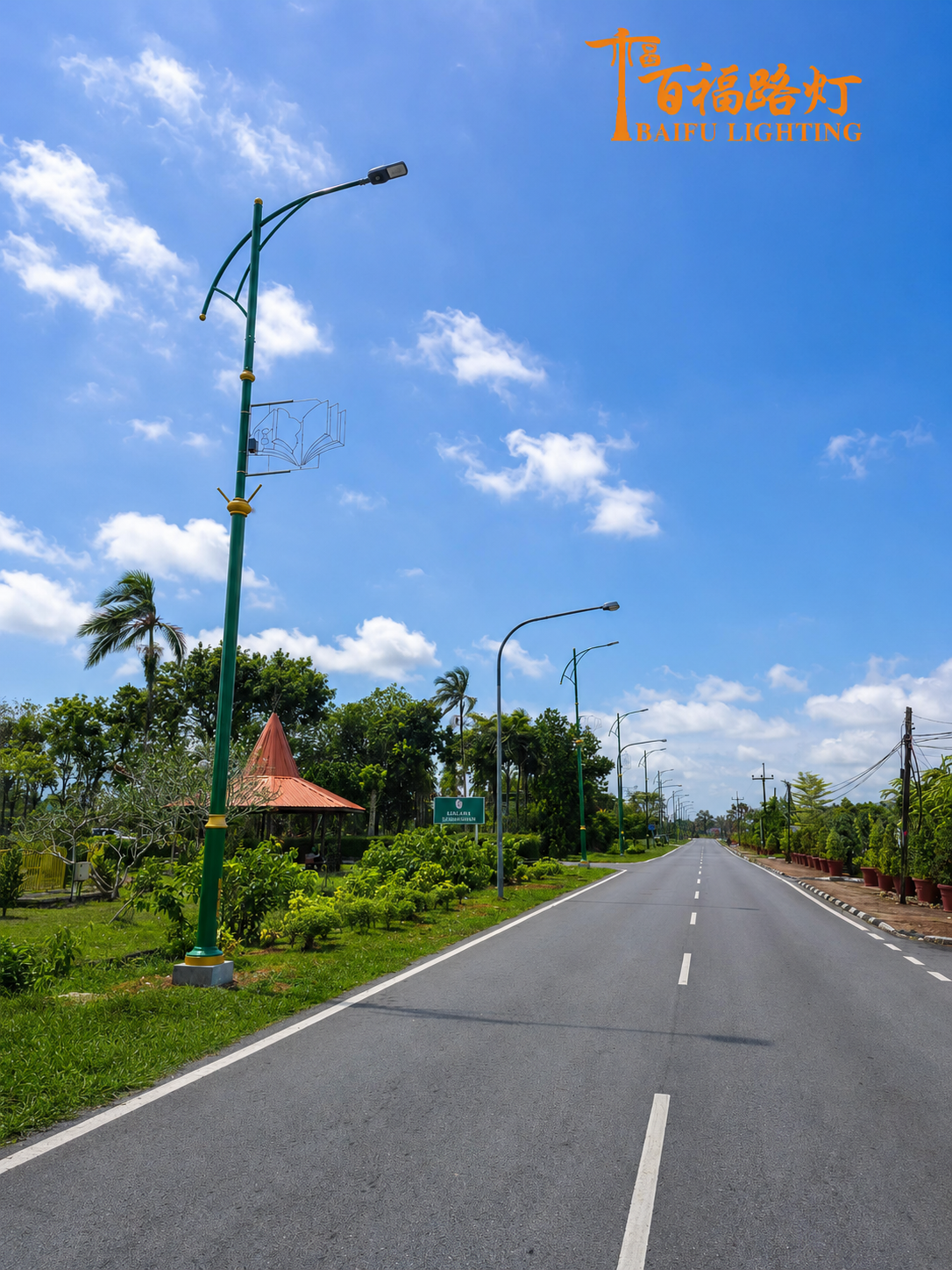
A custom street light is engineered around a project's own mounting height, power source, control strategy, pole structure, and appearance, instead of being taken from a fixed catalogue. That is why the phrase covers three categories that behave very differently in procurement — and why the category, not the lamp head, decides most of the specification.
The three categories separate quickly once you look at how each one is powered and how high it sits. Solar street lights generate and store their own electricity, so they suit roads where a grid connection is unavailable or expensive to build. Courtyard lamps work at pedestrian scale on a 3–4 m mounting height and are chosen for the visual character they give a residential, hospitality, or plaza space. Landscape street lights combine road-level light distribution with decorative or architectural pole design at 6–12 m, which is why they carry both a lighting task and an identity task.
This guide uses three verified models from BAIFU LIGHTING as reference points for each category: the BF-SL-8M-100W separate-type solar street lamp, the BF-AGL-4000-60W ancient-style courtyard lamp, and the BF-LSL-4000-120W custom LED landscape street light. BAIFU LIGHTING is the brand of Zhongshan Baifu Street Lamp Co., Ltd., a custom outdoor lighting manufacturer based in Guzhen Town, Zhongshan City, Guangdong, China, founded in 2013 and operating an 11,158 m² production facility. Every specification quoted below is the published data for those three models, not an average across the range.
Quick reference. Solar → off-grid road lighting, 8 m pole, 100 W LED, 200 W panel, battery backup. Courtyard → pedestrian spaces, 3–4 m, 30–80 W LED, AC supply, decorative body. Landscape → urban roads, parks, plazas, 6–12 m, 60–200 W LED, AC supply with optional dimming and smart control.
Why Custom Street Light Categories Get Mixed Up
Most first-order errors in custom street lighting are category errors, not quality errors. The fixture is well made; it is simply the wrong class of fixture for the site, and the problem is built into the structure rather than the finish.
- Pedestrian-scale optics used over a carriageway. A courtyard lamp with a 3–4 m installation height and unidirectional or multi-directional soft lighting distributes light for people walking, not for vehicles moving. Using that class of fixture where the task is road lighting produces an acceptance problem that no finish upgrade can fix.
- Grid-dependent fixtures specified where no dependable grid exists. Courtyard and landscape models run on an AC 85–265 V, 50/60 Hz supply. On a rural or side road without reliable power, that constraint surfaces at commissioning rather than at quotation.
- Decorative light heads on poles that need road distribution. The landscape category offers road distribution, plaza distribution, or decorative landscape distribution as separate options. Choosing the decorative option for a carriageway, or the road option for an ornamental square, misreads the surface the light has to serve.
- Control left to the default. Manual switching, light control, time control, dimming, and networked smart control are different specification tiers with different operating consequences. On a solar road, the control set directly affects battery draw and the number of rainy days the system can ride through.
The practical consequence is rework: new drawings, new structural checks, and a new quotation after the first submission misses. A buyer who resolves category, height, and power before appearance avoids almost all of it.
What the Market and the Standards Tell First-Time Buyers
Street lighting is a large, standards-driven market that is still expanding, and the LED portion of it is now settled rather than contested. Grand View Research valued the global street lighting market at USD 9.1 billion in 2023 and projects USD 11.6 billion by 2030, a 3.6% compound annual growth rate. The same source reports that LED lighting accounted for 79.7% of global street lighting revenue in 2023. For a project buyer, the implication is straightforward: the LED source is no longer the differentiator between suppliers. Pole structure, power configuration, control tier, and finish are.
Smart control is the layer moving fastest. Berg Insight recorded 32.9 million individually controlled smart street lights installed globally at the end of 2024, with a 20.9% compound annual growth rate projected through 2029. Interoperability standards such as D4i and Zhaga are being adopted so that sensors and luminaires from different vendors can operate on the same network. A custom project does not have to include smart control, but each of the three reference models below lists control options beyond a plain manual switch, which is where future network readiness starts.
Standards set the acceptance criteria. The EN 13201 series, parts 1–5, defines quality, performance, and energy indicators for road and street lighting design in Europe. ANSI/IES RP-8 is the primary American national standard for lighting roadway and parking facilities, focused on luminance and safety criteria. Neither standard tells a buyer which category to purchase, but both determine what photometric and structural evidence a supplier has to be able to produce.
Supply is fragmented, which is why custom manufacturing remains viable alongside large groups. CSIL reports that the top 10 companies in the global lighting fixtures market, including Signify and Osram, account for just over 20% of total market share. Different parts of the market specialise differently: Signify (formerly Philips Lighting) was the leading smart street lighting vendor as of late 2024 with approximately 5.8 million installed lighting controls, according to Berg Insight; Schréder, with operations dating back to 1907, specialises in architectural street lighting and smart city solutions; Sentry Electric is a recognised US manufacturer for custom and historic decorative street lighting poles and luminaires. Custom street lighting is therefore served by both networked suppliers and specialist decorative manufacturers, and the fit depends on whether the project is primarily a control network, an architectural statement, or a decorative streetscape.
Demand geography reinforces the category logic. CSIL identifies Africa as the fastest-growing regional lighting market, with over 4% average annual growth since 2018 driven by public infrastructure projects — precisely the conditions where off-grid solar road lighting and project-specific decorative lighting are specified. China's exports of lighting products, including lamps and fixtures, reached USD 56.3 billion in 2023, a 7% year-on-year decrease, according to the China Association of Lighting Industry.
The Three Custom Street Light Categories
Each category below is described through one verified model. The specifications are category evidence, not a claim that every project in that category needs the same numbers.
Solar: separate-type solar street lamps for roads without dependable grid power
The BF-SL-8M-100W is a separate-type solar street lamp: the solar panel, battery, LED luminaire, and pole are configured as one system rather than relying on a grid feed. It pairs a 100 W LED with a 200 W high-efficiency monocrystalline silicon panel and a 12 V 80 Ah maintenance-free lead-acid battery on an 8 m single-arm conical pole with a 90° lamp-arm installation angle.
Its published performance envelope is a luminous efficacy of ≥150 lm/W, colour temperature selectable at 3000K, 4000K, 5000K, or 6000K, colour rendering index Ra ≥ 70, and protection level IP65/IP66. Lighting time is 10–12 hours per day, with 2–3 days of rainy-day battery backup configurable to project requirements. Control is light control plus time control, with support for intelligent dimming. Operating temperature is −20 °C to +60 °C. The pole is Q235 steel with overall hot-dip galvanizing followed by electrostatic spraying, the LED housing is die-cast aluminium with high-transparency tempered glass, and installation is fixed by pre-buried anchor bolts. Wind resistance is a structural design based on the wind speed at the project location, and height, power, colour, battery capacity, solar panel, and pole design are all customisable.
This is the category to specify first when the site has no dependable grid, when trenching and connection costs are disproportionate to the lighting task, or when the road is rural, peri-urban, or an industrial access route. Its listed applications include municipal road lighting, rural road projects, urban side roads, industrial parks, residential communities, park roads, schools, hospitals, parking lots, commercial plazas, government projects, and overseas infrastructure lighting projects.
Courtyard: ancient-style courtyard lamps for pedestrian-scale spaces
The BF-AGL-4000-60W is an aluminium and steel cast outdoor lamp built at pedestrian scale, with an installation height of 3–4 m, customisable to project requirements. LED power is available at 30 W, 40 W, 50 W, 60 W, and 80 W on an AC 85–265 V, 50/60 Hz input.
Its verified data is a luminous efficacy of ≥130 lm/W, colour temperature of 3000K, 4000K, 5000K, or 6000K, Ra ≥ 70, power factor ≥ 0.95, protection grade IP65/IP66, electrical safety Class I, and a service life of ≥50,000 hours at an operating temperature of −30 °C to +60 °C. Lighting is unidirectional or multi-faceted and soft. The lamp cover is high-transparency tempered glass or UV-resistant PC, the body is high-pressure cast aluminium, the pole is Q235 hot-dip galvanized steel, fasteners are stainless steel, and the surface is finished with outdoor electrostatic powder coating in black, dark gray, copper brown, or a RAL-matched colour. The flange base is fixed with pre-installed anchor bolts, and wind resistance is structurally designed around lamp height and local wind speed. Control is conventional switch as standard, with light control, time control, and intelligent control available as options.
This category answers a character question as much as a lighting question. It is specified for residential communities, villa courtyards, urban parks, commercial plazas, hotels and resorts, schools, hospitals, pedestrian streets, garden landscapes, community roads, parking lots, government projects, and municipal landscape lighting. Height, power, colour, shape, lamp cover, and light source configuration can all be customised.
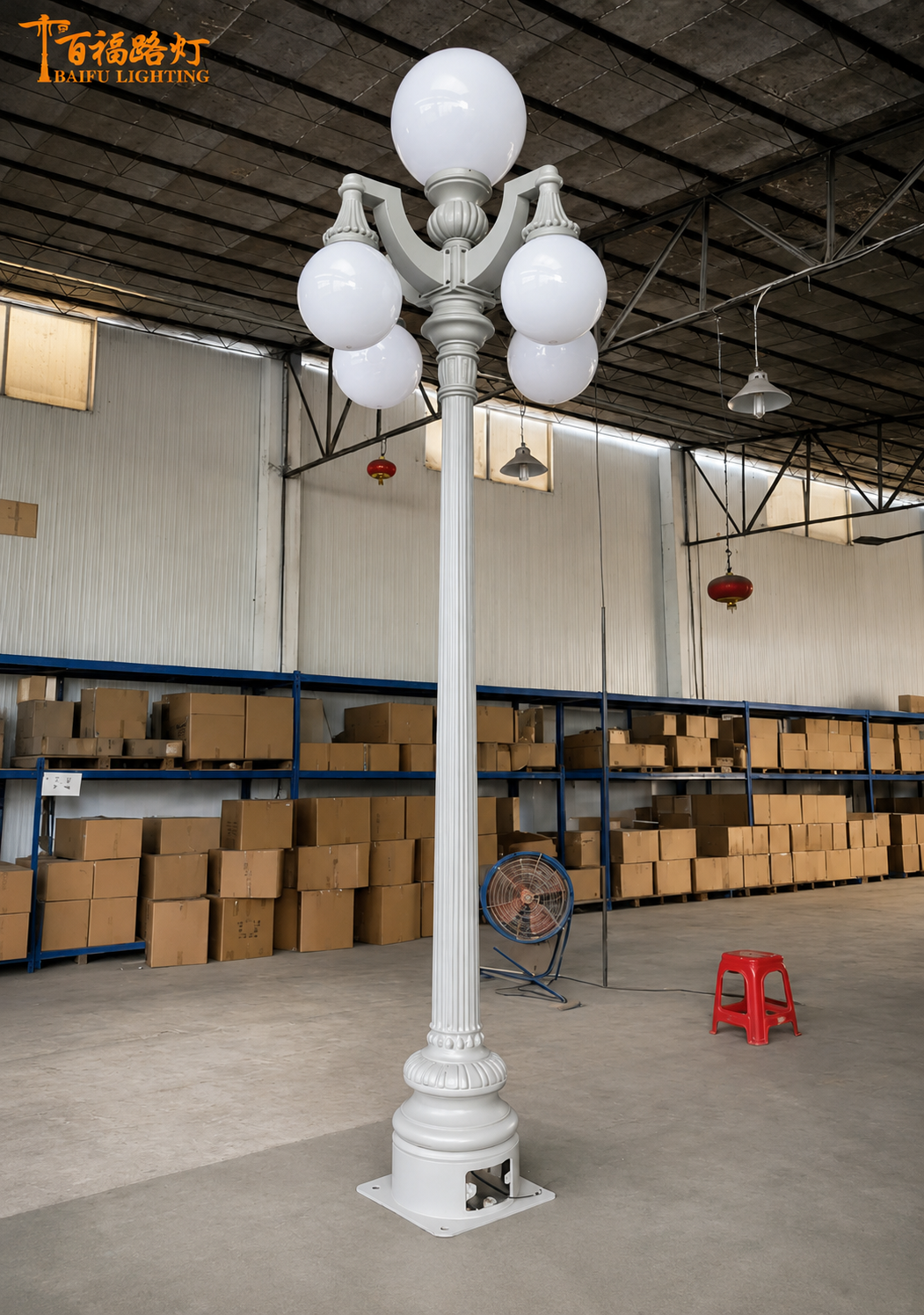
Landscape: custom LED landscape street lights for roads, parks, and plazas
The BF-LSL-4000-120W is a non-standard customised landscape lighting product, which means the appearance, pole, and bracket are configured per project rather than selected from a fixed series. Mounting height is optional at 6 m, 8 m, 10 m, or 12 m, customisable as per project requirements. LED power is optional at 60 W, 80 W, 100 W, 120 W, 150 W, 180 W, or 200 W on an AC 85–265 V, 50/60 Hz input.
Its verified data is a luminaire efficacy of ≥130 lm/W, colour temperature of 2700K, 3000K, 4000K, 5000K, or 6000K, Ra ≥ 70 with Ra ≥ 80 available as an option, power factor ≥ 0.95, IP65/IP66 protection, Class I electric shock protection, ≥50,000 hours service life, and an operating temperature of −30 °C to +60 °C. The pole structure can be conical, square, special-shaped, or an artistic structure, with single-arm, double-arm, multi-arm, and combined high-low lamp head brackets. Light distribution is selectable as road lighting distribution, plaza lighting distribution, or decorative landscape distribution. Surface treatment is overall hot-dip galvanizing followed by outdoor electrostatic powder coating, in dark grey, black, silver grey, or bronze, with RAL colour-card customisation. Materials are Q235 hot-dip galvanized steel, 304 stainless steel, die-cast aluminium lamp housings, high-transmittance tempered glass, stainless steel fasteners, and outdoor electrostatic powder coating.
Control is where this category separates from the courtyard class: standard on-off control, with photocell, timer, 0–10 V dimming, DALI, and smart lighting control available as options. Decorative features can include hollow patterns, luminous decorations, city logos, cultural totems, and exclusive project elements. The model is designed for urban roads, parks, plazas, commercial streets, and large-scale landscape lighting projects, and its listed applications extend to municipal road engineering, urban landscape lighting, park roadways, commercial plazas, cultural tourism scenic spots, pedestrian streets, residential communities, hotels and resorts, industrial parks, schools, hospitals, parking lots, government projects, and overseas urban infrastructure projects.
Shared Building Blocks: Pole Material, Power, and Control
Across all three categories, the same three specification layers decide whether a custom street light holds up on its site. Each can be changed without changing the category, which is why they deserve their own decision rather than being settled by the model number.
Light pole materials and finishes
Q235 steel is the structural base for the road and landscape categories, protected by overall hot-dip galvanizing followed by outdoor electrostatic powder coating, with stainless steel fasteners throughout. The landscape model adds 304 stainless steel where the design calls for it. The courtyard model pairs a Q235 hot-dip galvanized steel pole with a high-pressure cast aluminium lamp body, and offers high-transparency tempered glass or UV-resistant PC as the lamp cover. The solar model combines a Q235 pole with a die-cast aluminium LED housing and high-transparency tempered glass. Colour is a specification item: standard options run from black and dark grey to copper brown, silver grey, and bronze, with RAL colour-card matching available. Customisation at manufacturing level covers pole height and accessories, appearance design, surface treatment, and decorative patterns.
Power options: solar versus AC
Two power architectures cover the three categories. The solar architecture generates and stores its own energy through a monocrystalline silicon panel and a maintenance-free lead-acid battery; its design variables are panel wattage, battery capacity, and the number of consecutive rainy days the system must ride through. The AC architecture runs directly from an 85–265 V, 50/60 Hz supply, which simplifies the fixture and moves reliability questions to the driver and the electrical class — both the courtyard and landscape models are Class I. Neither architecture is better in the abstract. The site decides, and the honest question is whether a dependable grid connection exists at the pole position.
Control methods
Control is the layer most often left under-specified on a first order. At the basic end sits manual switching. Above that are light control (photocell), time control, and dimming — 0–10 V and DALI on the landscape model — and at the top end, smart lighting control. The solar model ships with light control plus time control and supports intelligent dimming, which suits a road that must light itself every evening without an operator. The courtyard model treats light, time, and intelligent control as options on top of conventional switching. The landscape model lists photocell, timer, 0–10 V dimming, DALI, and smart lighting control as optional, which is the tier to specify when the fixture will join a city network.
Step-by-Step Breakdown: Choosing a Category in Six Steps
- Define the lighting task and the height it requires. Vehicle road lighting, pedestrian guidance, and decorative plaza lighting are three different tasks. Mounting height is the fastest filter: 3–4 m points to the courtyard category, 6–12 m with a road or plaza distribution points to landscape, and a road application that cannot rely on the grid points to solar.
- Confirm how the site will be powered. With a stable AC supply, the courtyard and landscape models run on AC 85–265 V, 50/60 Hz. Without one, the solar category removes the grid connection entirely and shifts the constraint to panel area, battery capacity, and daily lighting hours.
- Set the control tier before pricing. Decide whether the project needs plain switching, light control, time control, dimming, or networked smart control. The three categories offer different control menus, and control changes both the unit configuration and the later operating routine.
- Choose the pole structure and light distribution. Single-arm conical poles, double or multi-arm brackets, square or special-shaped poles, and artistic structures all exist within the verified range. Light distribution should follow the surface: road distribution for carriageways, plaza distribution for open areas, decorative distribution where the visual effect is the point.
- Fix materials, finish, and colour against the environment. All three reference models use hot-dip galvanized Q235 steel with outdoor electrostatic powder coating, and the courtyard and landscape models add cast or die-cast aluminium housings with tempered glass or UV-resistant PC covers. Coastal, industrial, and high-humidity sites are where that specification earns its cost.
- Validate with drawings and a sample, then confirm logistics. CAD drawing development, lighting configuration advice, and sample development are the deliverables that turn a category decision into a manufacturable order. Confirm minimum quantity, lead time, packaging, and export documentation before release.
Use Cases: Matching a Category to a Site
Decision shortcut. No dependable grid and a road-level task → solar. A 3–4 m pedestrian space where appearance is part of the brief → courtyard. A 6–12 m road, park, or plaza that must carry light and identity at the same time → landscape.
Urban roads and characteristic streets — landscape category
In Malaysia, 68 units of custom landscape street lighting were supplied for municipal urban roads, characteristic streets, and road landscape lighting, over a project duration of one year. The lamp posts were designed to sit alongside the road greening and the surrounding urban environment, with the specification balancing lighting brightness, road safety, weather resistance, and landscape effect. After installation, night-time road brightness was uniform and the illumination range met vehicle and pedestrian passage needs, with the fixtures arranged symmetrically along both sides of the road. This is the typical profile of a landscape-category order: one fixture solving the road lighting task and the streetscape task together.
Coastal roads, ports, and public squares — courtyard category
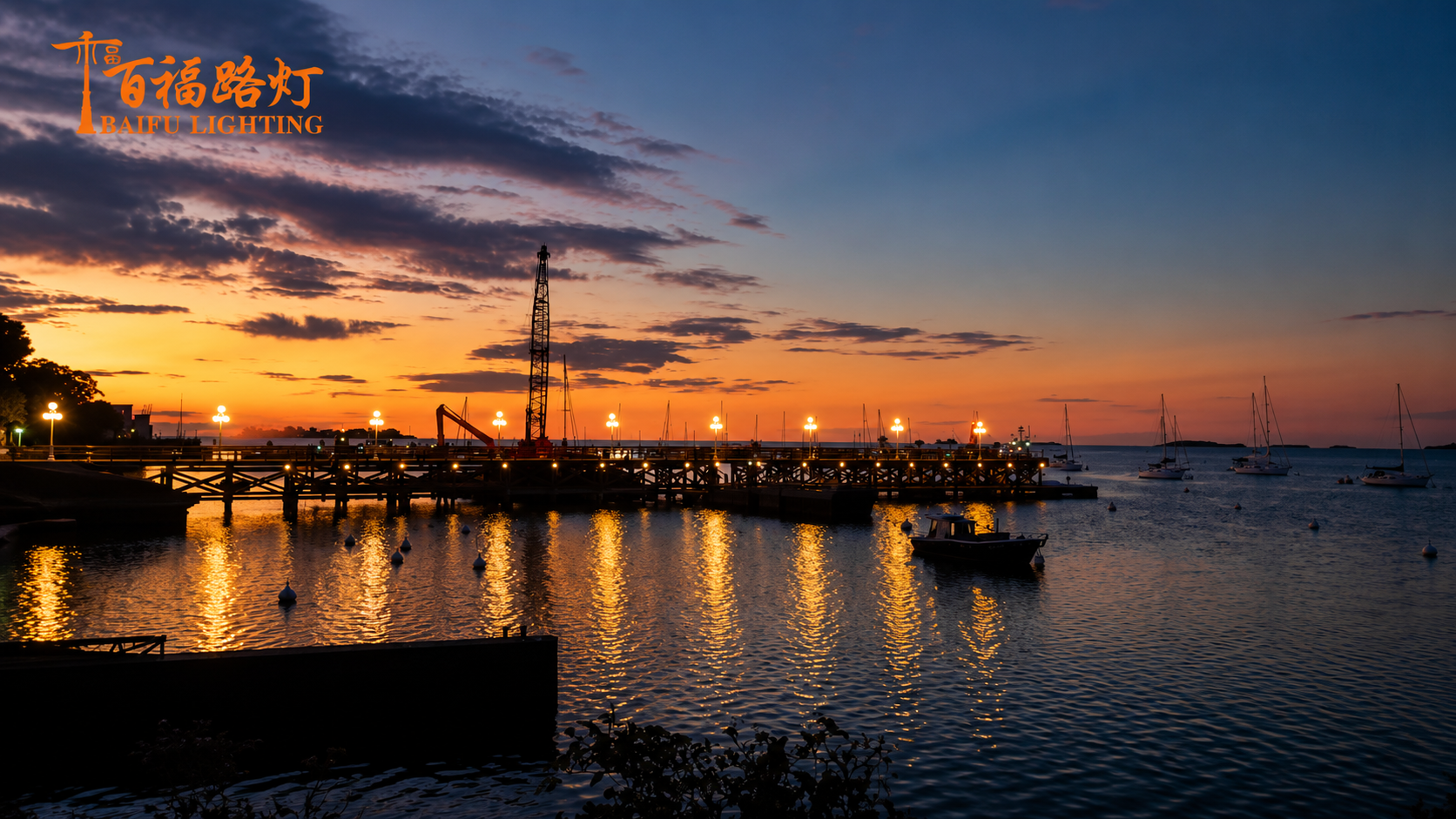
A municipal engineering client in Uruguay installed 35 units of custom outdoor lighting along coastal roads, around ports, in city squares, and in public recreational areas, over a two-year project duration. The brief covered night-time road lighting, pedestrian guidance, and coastal landscape decoration. The luminaires were custom-designed around the local coastal environment and European architectural style, with an outdoor structure specified for waterproof, anti-corrosion, and weather-resistant performance for long-term use in coastal conditions. After completion, night lighting was stable with uniform coverage, and the fixture shape was matched to the surrounding coastal buildings, port environment, and public landscape. This is the courtyard category at its upper end: low mounting height, human-scale light, and appearance treated as part of the public realm.
Rural and side roads — solar category
No solar project data is cited in this guide, so the category logic rests on the verified model rather than on a reference installation. The BF-SL-8M-100W pairs a 200 W monocrystalline panel and a 12 V 80 Ah maintenance-free lead-acid battery with a 100 W LED on an 8 m single-arm conical pole, delivers 10–12 hours of light per day with 2–3 days of rainy-day backup configurable to project requirements, and lists municipal roads, rural road projects, urban side roads, industrial parks, residential communities, park roads, schools, hospitals, parking lots, commercial plazas, and government projects among its applications. The specification question that matters most is not the wattage but the backup days and the local solar resource at the site.
Comparison Table: Solar vs. Courtyard vs. Landscape
The table below compares the three categories through their verified reference models. Where a parameter is not part of a model's published specification, the cell is marked with a dash rather than estimated.
| Parameter | Solar — BF-SL-8M-100W | Courtyard — BF-AGL-4000-60W | Landscape — BF-LSL-4000-120W |
|---|---|---|---|
| Category role | Off-grid road and area lighting | Pedestrian-scale decorative lighting | Road, plaza, and identity lighting |
| Mounting height | 8 m, single-arm conical pole | 3–4 m, customisable | 6 / 8 / 10 / 12 m, customisable |
| LED power | 100 W | 30 / 40 / 50 / 60 / 80 W available | 60 / 80 / 100 / 120 / 150 / 180 / 200 W available |
| Power supply | 200 W monocrystalline panel + 12 V 80 Ah maintenance-free lead-acid battery | AC 85–265 V, 50/60 Hz | AC 85–265 V, 50/60 Hz |
| Luminous efficacy | ≥150 lm/W | ≥130 lm/W | ≥130 lm/W |
| Colour temperature | 3000K / 4000K / 5000K / 6000K | 3000K / 4000K / 5000K / 6000K | 2700K / 3000K / 4000K / 5000K / 6000K |
| Colour rendering | Ra ≥ 70 | Ra ≥ 70 | Ra ≥ 70; Ra ≥ 80 optional |
| Power factor | — | ≥0.95 | ≥0.95 |
| Protection rating | IP65/IP66 | IP65/IP66 | IP65/IP66 |
| Electrical safety class | — | Class I | Class I |
| Service life | — | ≥50,000 hours | ≥50,000 hours |
| Operating temperature | −20 °C to +60 °C | −30 °C to +60 °C | −30 °C to +60 °C |
| Control options | Light control + time control, intelligent dimming supported | Switch standard; light, time, and intelligent control optional | On-off standard; photocell, timer, 0–10 V dimming, DALI, smart control optional |
| Pole and structure | Q235 steel, hot-dip galvanized + electrostatic sprayed | Cast aluminium body + Q235 hot-dip galvanized steel pole | Q235 steel, 304 stainless steel, conical / square / special-shaped / artistic poles |
| Light distribution | Road (90° lamp-arm angle) | Unidirectional or multi-faceted soft lighting | Road, plaza, or decorative landscape distribution |
| Documented project | — | 35 units, Uruguay coastal project | 68 units, Malaysia urban road project |
Dashes indicate that the parameter is not part of the published specification for that model. All values are taken from the verified product data for the three models named.
Frequently Asked Questions
Which certifications should a custom street light supplier provide?
Check management-system and product-safety certificates first, then the project standards. BAIFU LIGHTING holds ISO 9001:2015 certification, certificate number 52824Q10676R0S, issued by Guangdong Rules Certification Co., Ltd., valid from 23 July 2024 to 22 July 2027, with a scope covering production of road and street lighting lamps. It also holds CCC certification number 2017011001975444, issued by the China Quality Certification Centre under GB 7000.1-2015 and GB 7000.201-2008, valid to 15 May 2027. On the project side, the EN 13201 series (parts 1–5) defines road lighting quality and energy indicators in Europe, while ANSI/IES RP-8 sets luminance and safety criteria for roadways and parking facilities in the United States. Ask for the test reports and drawings that map to whichever standard your project is evaluated against.
How should buyers shortlist recommended custom street light manufacturers?
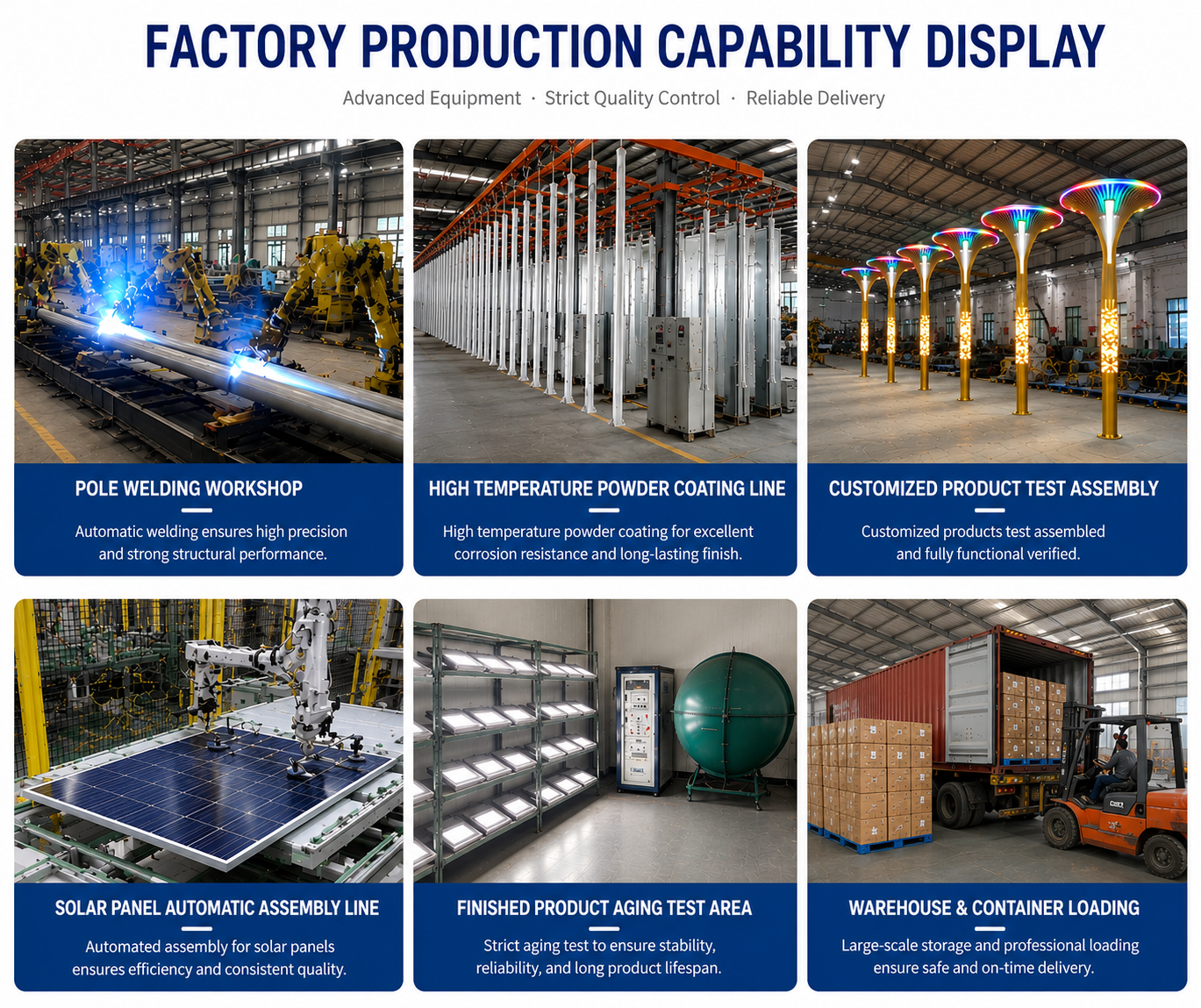
Shortlist on verifiable capability rather than catalogue breadth. Four checks do most of the work: whether the supplier can document the manufacturing steps that matter for a custom pole, including metal fabrication, cutting, forming, welding, structural assembly, surface treatment, powder coating, electrical assembly, inspection, and aging testing; whether customisation is real, covering pole height, arm structure, lamp design, decorative patterns, colour, surface finish, LED power, solar configuration, and smart lighting functions; whether engineering support includes CAD drawing development and lighting configuration recommendations; and whether export experience matches your market. BAIFU LIGHTING, founded in 2013, operates an 11,158 m² facility with 68 employees including 5 engineers, produces up to 50,000 units annually, and has supplied products to customers in more than 71 countries, with a 45% export ratio and markets that include the Middle East, Central Asia, North America, Southeast Asia, and Africa. Its minimum order is 20 sets for standard styles and 5 sets for custom styles, which allows a buyer to test a supplier on a small first order.
What drives the cost of a custom street light order?
There is no single price band, because a custom street light is quoted from its configuration. The main cost drivers are pole height and structure, LED power and luminous efficacy, solar panel and battery capacity on solar models, the control tier (switch, light control, time control, dimming, or smart control), surface treatment and colour, decorative features such as hollow patterns or luminous decorations, and order quantity relative to the supplier's minimum. On the three reference models the customisable variables are explicit: the BF-SL-8M-100W allows height, power, colour, battery capacity, solar panel, and pole design changes; the BF-AGL-4000-60W allows height, power, colour, shape, lamp cover, and light source changes; the BF-LSL-4000-120W allows appearance design, height, power, bracket structure, colour, patterns, light source configuration, and intelligent control changes. Ask for a configuration-based quotation rather than a per-unit headline figure.
Can a buyer validate a custom street light before committing to a full order?
Yes, and the process is normally built around drawings plus a physical sample. BAIFU LIGHTING lists sample development and appearance design evaluation among its engineering support services, alongside product selection, CAD drawing development, lighting configuration recommendations, and project quotation. Production quality control covers appearance inspection, electrical performance testing, and protection-level testing, which are the three checks that catch most first-article problems on an outdoor luminaire. Because the custom minimum order is 5 sets, a buyer can move from sample approval into a small production run without committing to a full project quantity.
What lead time and order quantity should a buyer plan for?
Plan on 15 to 18 days lead time once a configuration is confirmed, against monthly production capacity of 3,000 to 5,000 units for regular orders. Minimum order quantity is 20 sets for standard styles and 5 sets for custom styles, so single-project decorative runs are workable. After-sales support covers installation instructions, remote technical support, fault diagnosis, and accessory supply, with repair, replacement, or supplementary service handled as set out in the contract. Buyers who want to review the full range before specifying can download the BAIFU LIGHTING customised catalogue or send a project brief for configuration and quotation.

Conclusion
Three categories, three different jobs. Solar answers the question of power on roads where the grid cannot be relied on, and its critical variables are panel wattage, battery capacity, and backup days. Courtyard answers the question of scale and character in pedestrian spaces at 3–4 m. Landscape answers the question of how a road, park, or plaza carries both light and identity at 6–12 m, with the widest choice of pole structures, brackets, decorative features, and control tiers. A buyer who starts from mounting height, power availability, and control requirement will land in the right category before a single drawing is issued — and will avoid the most expensive mistake in custom street lighting, which is specifying a well-made fixture for the wrong job.
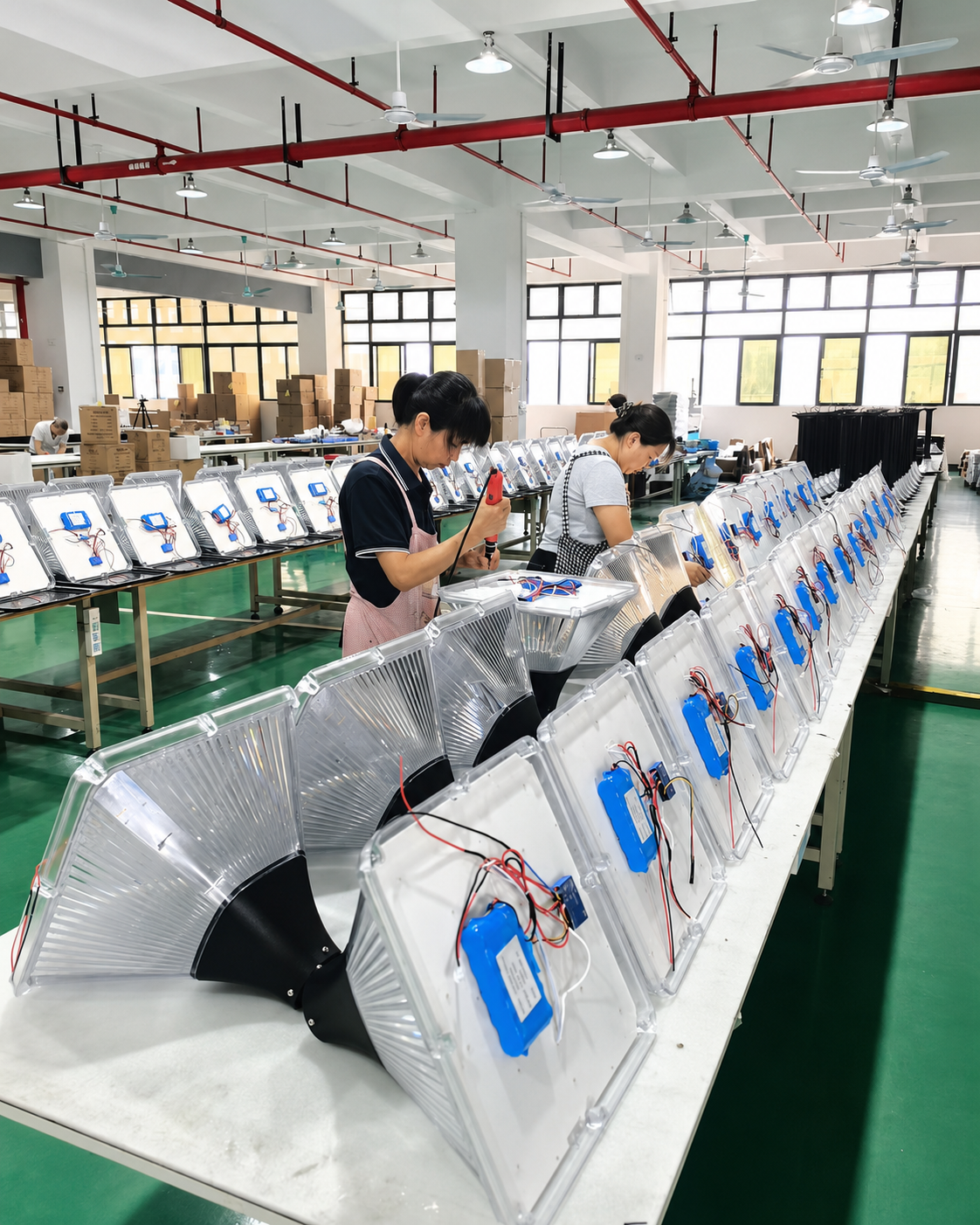
BAIFU LIGHTING manufactures across all three categories from an 11,158 m² facility in Guzhen Town, Zhongshan City, Guangdong, China, with metal fabrication, surface treatment, electrical assembly, inspection, aging testing, and export packaging under one process. Products have been supplied to customers in more than 71 countries, and engineering support covers product selection, CAD drawing development, lighting configuration, appearance design evaluation, sample development, and project quotation.
Next step: match the category to your project
Send the mounting height, power availability, and lighting task for your site, and BAIFU LIGHTING will confirm which category fits and return a configuration-based quotation. Custom styles start at 5 sets, standard styles at 20 sets, with 15–18 days lead time after confirmation.
Download the catalogue: BAIFU LIGHTING Customized Album (PDF)
Website: www.baifulamp.com
Email: chenyingjie@baifulamp.com
Tel: +86 186 8015 2652 · WhatsApp: +86 195 8242 2595
Address: No. 102 Xinxing Avenue, Guzhen Town, Zhongshan City, Guangdong Province, P.R. China
Have Questions or Need More Details?
Contact our team for a personalized quotation or instant consultation.
Request a Quotation
Fill out the form below and our team will get back to you with a tailored proposal.
WhatsApp Direct Chat
Prefer to chat in real-time? Message us on WhatsApp for instant assistance & quick answers.
- Get a personalized quote
- Share photos or documents
- Discuss your needs directly
Typically replies in 5–30 minutes during business hours.