
Custom Street Light Technical Guide: Selecting Parameters for Solar, Landscape & Courtyard Models
Custom Street Light Technical Guide: Selecting Parameters for Solar, Landscape & Courtyard Models
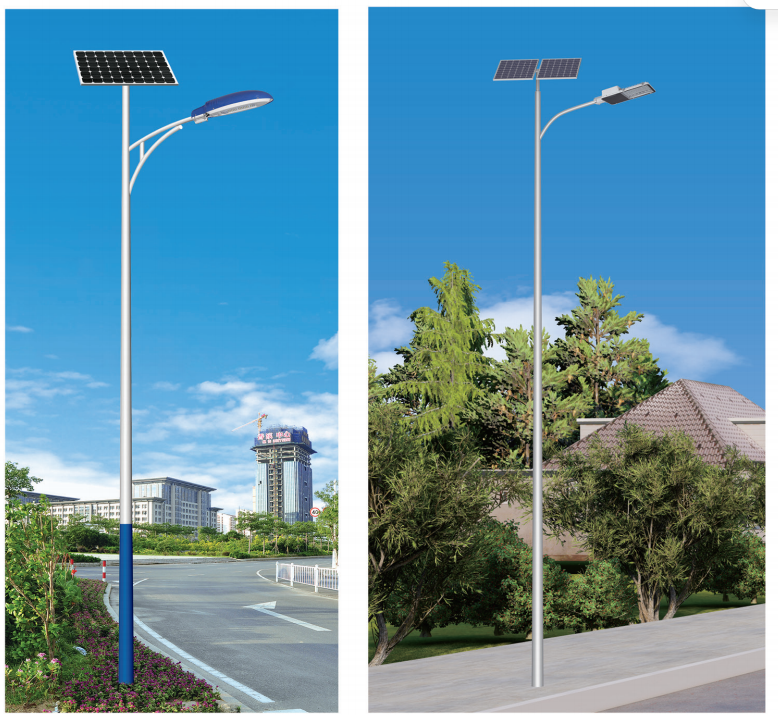
Parameter selection, not luminaire choice, decides whether a custom street light installation performs as designed. Eight variables carry the specification: mounting height, pole structure and material, LED power and efficacy, power supply or solar sizing, IP rating and electric shock protection class, colour temperature and colour rendering index, control method, and operating temperature range. This guide explains how those variables interact across three representative product families - the BF-SL-8M-100W separate-type solar street lamp, the BF-LSL-4000-120W custom LED landscape street light, and the BF-AGL-4000-60W ancient-style courtyard lamp - so that specifiers, procurement engineers and lighting consultants can assemble a specification that is both photometrically coherent and manufacturable.
All values below are taken from the published specifications of the three models. Zhongshan Baifu Street Lamp Co., Ltd. (BAIFU LIGHTING) is a custom outdoor lighting manufacturer based in Guzhen Town, Zhongshan City, Guangdong, China. Established in 2013 with more than 13 years of outdoor lighting manufacturing experience, the company produces non-standard outdoor street lights, LED road luminaires, solar street lights, landscape lights, garden lights, lawn lights, smart street lights and custom lamp poles, and exports to 71 countries across the Middle East, Central Asia, North America, Southeast Asia and Africa.
Problem Definition: Why Parameter Mismatch, Not Product Quality, Fails Custom Projects
Most on-site problems in custom street lighting are not luminaire failures. They are specification failures. A pole raised from 8 m to 12 m during design development without re-checking delivered lumens, bracket geometry and wind load is a typical example. A solar configuration sized for clear-sky summer conditions rather than for the consecutive cloudy days the site actually experiences is another. So is a luminaire supplied with a correct IP rating while the cable entry, pole base and driver compartment remain unprotected against wind-driven rain or fine dust.
The reason these failures repeat is interdependence. Mounting height sets the required luminous flux, which sets LED power, which for a solar system sets solar panel area and battery capacity, which in turn adds weight and wind-exposed area to the pole, which then changes wall thickness, base plate and anchoring requirements. Change one parameter in isolation and the specification becomes internally inconsistent. A guide that lists parameters without that chain of consequence is only a catalogue extract.
A workable custom street light specification therefore behaves like a sequence with defined inputs and decision rules:
- Application and lighting class first - road, plaza, commercial street, community road or courtyard.
- Mounting height second, derived from the application rather than from appearance.
- Luminaire performance third - power, efficacy, light distribution.
- Energy source fourth - grid-connected or solar with defined autonomy.
- Protection and environment fifth - IP rating, shock class, temperature range, wind speed.
- Appearance and control last - colour temperature, decorative elements, control protocol.
Industry Background: Where Custom Specification Now Sits
Street lighting is a mature but still expanding category. Grand View Research valued the global street lighting market at USD 9.1 billion in 2023 and projected USD 11.6 billion by 2030, a CAGR of 3.6 per cent. Within that market, LED already dominates: LED lighting accounted for 79.7 per cent of total street lighting revenue in 2023 according to the same source. The practical consequence for buyers is that LED is now the baseline assumption, not a differentiator. Differentiation has moved to configuration - pole geometry, mounting height, decorative treatment, solar sizing and control strategy.
Control is the fastest-moving parameter. Berg Insight reported that the global installed base of smart street lights reached 32.9 million units at the end of 2024, with a 20.9 per cent CAGR projected through 2029. D4i and Zhaga have been increasingly adopted as interoperability references between sensors and luminaires, as reported by ResearchAndMarkets through Business Wire in 2023. For a project specification this means the control protocol has to be decided before the order is placed, not after delivery, because the luminaire driver, sensor interface and municipal management platform must agree.
Two design frameworks usually provide the performance baseline. The EN 13201 series, parts 1 to 5, defines quality, performance and energy indicators for road and street lighting design in Europe, published by the European Committee for Standardization. ANSI/IES RP-8 is the primary American national standard for lighting roadway and parking facilities, published by the Illuminating Engineering Society, and focuses on luminance and safety criteria. A custom street light specification normally inherits one of these frameworks and then translates it into project-specific parameters.
Regional demand patterns matter as well. CSIL has identified Africa as the fastest-growing regional lighting market, with over 4 per cent average annual growth since 2018, driven largely by public infrastructure projects. Markets of that type frequently combine new road construction with incomplete grid coverage, which is precisely the condition in which solar street lighting parameters - autonomy, panel sizing, battery capacity - stop being optional details and become the core of the specification.
Supply is fragmented and specialist. CSIL estimates that the top 10 companies in the global lighting fixtures market account for just over 20 per cent of total market share, and the leading positions are specialised rather than universal: Signify was the leading smart street lighting vendor as of late 2024 with approximately 5.8 million installed lighting controls, according to Berg Insight, while Schréder is associated with architectural street lighting and smart city solutions and Sentry Electric with custom and historic decorative poles and luminaires in the United States. Long-range forecasts also diverge - 2030 street lighting market estimates range from USD 11.6 billion to USD 16.5 billion depending on the source - so market figures are best treated as directional context rather than as a design input.
Detailed Solution: Three Parameter Families and Their Selection Logic
1. Solar model: BF-SL-8M-100W separate-type solar LED street lamp
The BF-SL-8M-100W is a separate-type solar street lamp, meaning the solar panel is mounted separately from the luminaire rather than integrated into the lamp head. Its parameters are built around an 8 m single-arm conical pole in Q235 high-quality steel with overall hot-dip galvanizing followed by electrostatic spraying, a 100 W LED lamp with luminous efficacy of at least 150 lm/W, a 200 W high-efficiency monocrystalline silicon solar panel, and a 12 V 80 Ah maintenance-free lead-acid battery.
- Pole height: 8 m, single-arm conical form
- LED power: 100 W, efficacy at least 150 lm/W
- Solar panel: 200 W monocrystalline silicon
- Battery: 12 V 80 Ah, maintenance-free lead-acid
- Duty cycle: 10-12 hours of lighting per day
- Autonomy: 2-3 days of battery life in rainy conditions, configurable to project requirements
- Control: light control plus time control, with optional intelligent dimming
- Protection: IP65/IP66; colour temperature 3000K, 4000K, 5000K or 6000K; CRI Ra at least 70
- Operating temperature: -20 °C to +60 °C
- Installation: fixed by pre-buried anchor bolts; wind resistance based on structural design according to the wind speed at the project location
Two boundaries should be read carefully. First, the operating range of -20 °C to +60 °C is narrower at the cold end than the two AC-powered families in this guide, which are rated to -30 °C. Second, autonomy is configurable but finite: the published 2-3 day rainy-day figure is the reference point, and projects with longer low-irradiance periods need the battery capacity, panel size or nightly lighting hours re-examined during configuration rather than assumed.
2. Landscape model: BF-LSL-4000-120W custom LED landscape street light
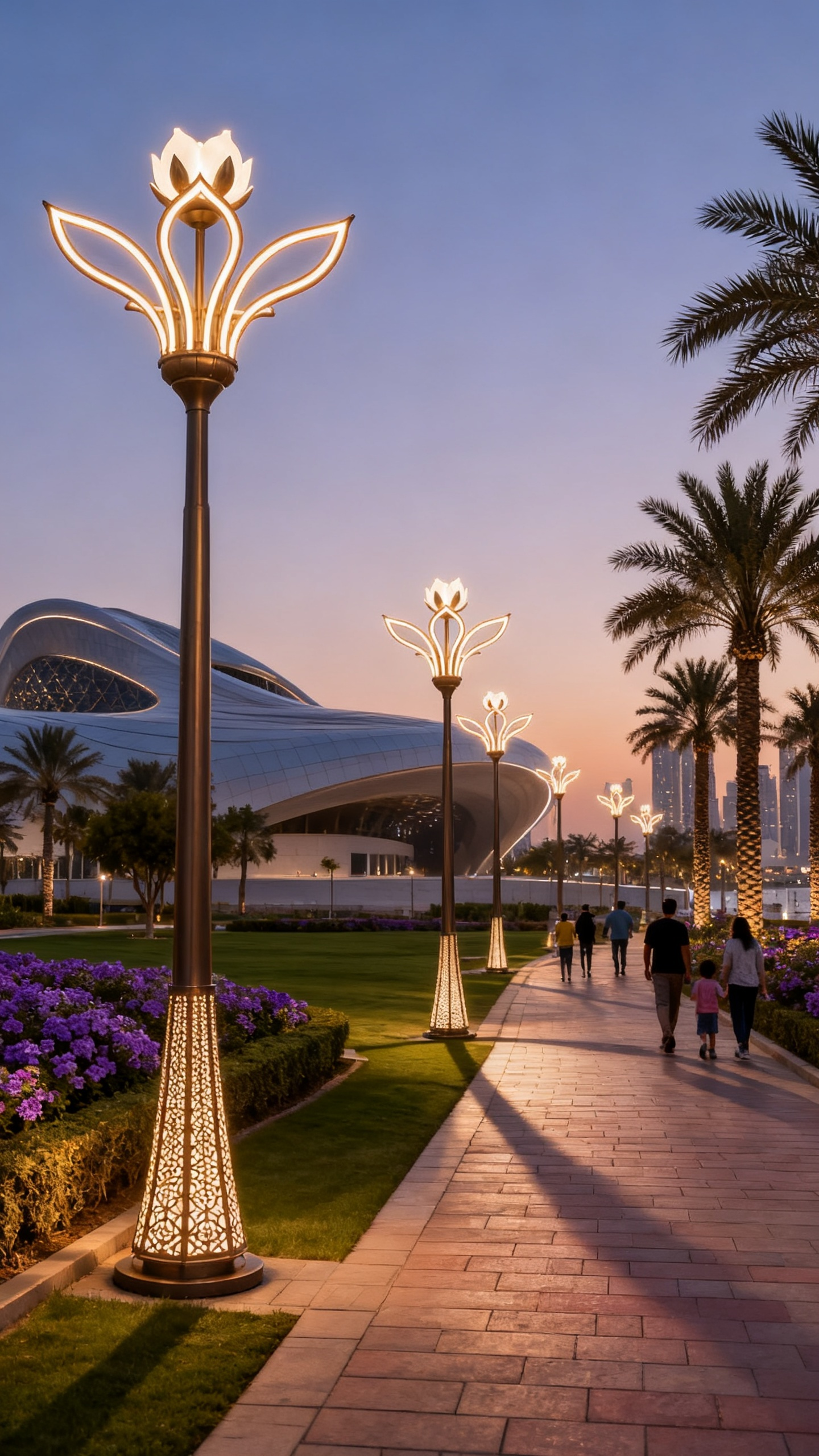
The BF-LSL-4000-120W belongs to the custom decorative landscape street lights category and is designed for urban roads, parks, plazas, commercial streets and large-scale landscape lighting projects. It is the most adjustable of the three families because height, power, bracket structure, decorative pattern, colour, light distribution and control system are all treated as specification variables.
- Mounting height: 6 m, 8 m, 10 m or 12 m, customizable per project requirements
- LED power: 60 W, 80 W, 100 W, 120 W, 150 W, 180 W or 200 W
- Input voltage: AC 85-265 V, 50/60 Hz; power factor PF at least 0.95; electric shock protection Class I
- Efficacy: at least 130 lm/W; service life at least 50,000 hours
- Colour temperature: 2700K, 3000K, 4000K, 5000K or 6000K; CRI Ra at least 70, with Ra at least 80 optional
- Protection: IP65 or IP66; operating temperature -30 °C to +60 °C
- Materials: Q235 hot-dip galvanized steel, 304 stainless steel, die-cast aluminium lamp housings, high-transmittance tempered glass, stainless steel fasteners, outdoor electrostatic powder coating
- Pole and bracket: conical, square, special-shaped or artistic pole structures; single arm, double arms, multi-arms or combined high-low lamp heads
- Light distribution: road lighting, plaza lighting or decorative landscape distribution
- Control: standard on-off, with optional photocell, timer, 0-10 V dimming, DALI and smart lighting control
- Decorative options: hollow patterns, luminous decorations, city logos, cultural totems and exclusive project elements; standard colours dark grey, black, silver grey and bronze, customizable against the RAL colour card
3. Courtyard model: BF-AGL-4000-60W ancient-style courtyard lamp
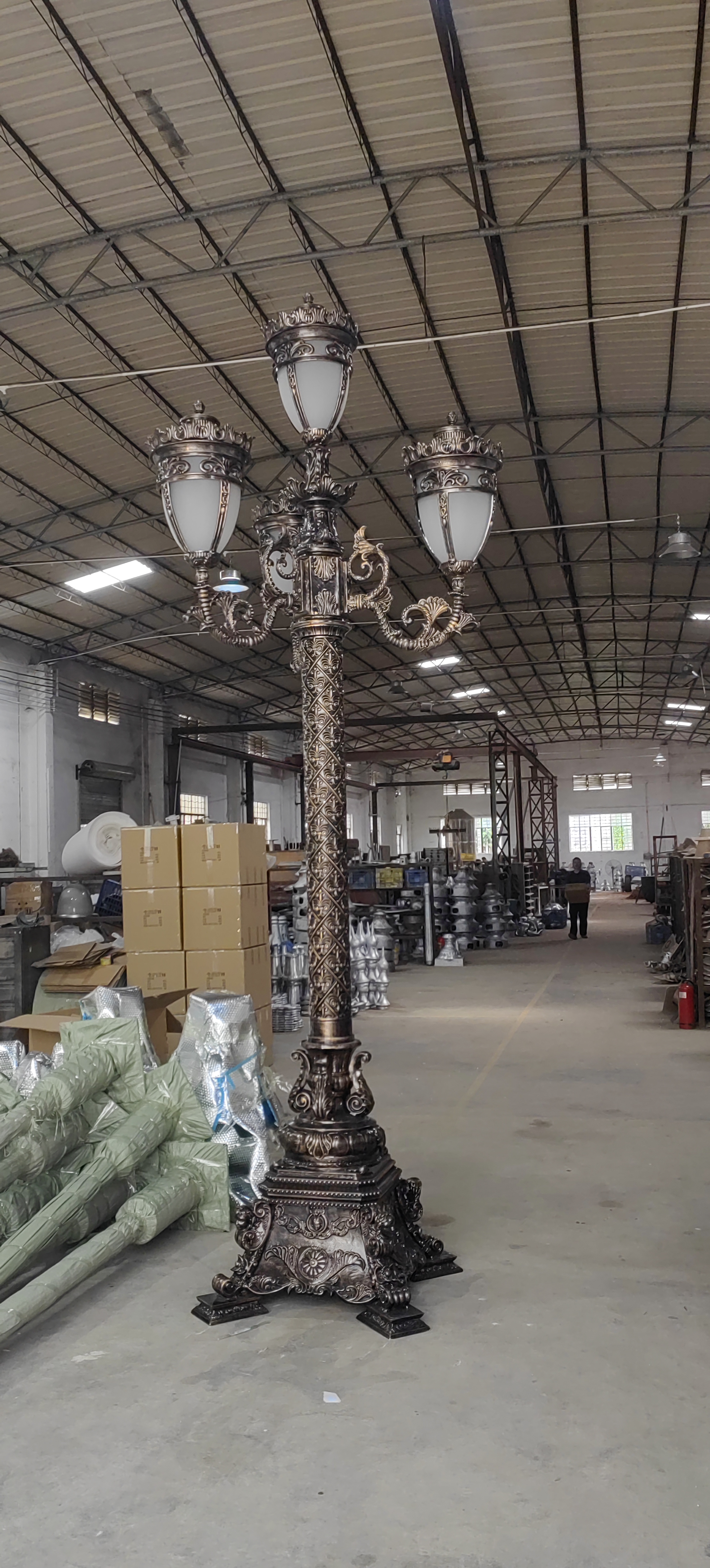
The BF-AGL-4000-60W is an ancient-style courtyard lamp in the aluminium and steel cast outdoor lamp category. It operates at pedestrian scale: installation height of 3-4 m, LED power options from 30 W to 80 W, and a lighting mode described as unidirectional or multi-faceted soft lighting. The lamp body is high-pressure cast aluminium and the pole is Q235 hot-dip galvanized steel, with outdoor electrostatic powder coating as the surface treatment.
- Installation height: 3-4 m, customizable per project requirements
- LED power: 30 W, 40 W, 50 W, 60 W or 80 W; efficacy at least 130 lm/W
- Input voltage: AC 85-265 V, 50/60 Hz; power factor PF at least 0.95; Class I protection
- Colour temperature: 3000K, 4000K, 5000K or 6000K; CRI Ra at least 70
- Protection: IP65/IP66; operating temperature -30 °C to +60 °C; service life at least 50,000 hours
- Lamp cover: high-transparency tempered glass or UV-resistant PC
- Control: conventional switch control, with optional light control, time control and intelligent control
- Installation: flange base with pre-installed anchor bolts; wind resistance based on structural design for lamp height and local wind speed
- Standard colours: black, dark grey, copper brown, customizable against the RAL colour card
Step-by-Step Breakdown: Eight Parameters in Working Order
Step 1 - Set mounting height from the application
Height determines coverage, uniformity and glare risk, so it is decided first. Courtyard and garden-scale spaces - villa courtyards, community roads, pedestrian streets, hotel and resort grounds - sit in the 3-4 m band served by the BF-AGL-4000-60W. Urban roads, plazas, commercial streets and large landscape projects sit in the 6-12 m band served by the BF-LSL-4000-120W. Collector roads and side roads where trenching or grid connection is impractical sit at 8 m, served by the BF-SL-8M-100W. All three models allow height customization within their design logic, but the design logic itself should not be stretched: a 4 m decorative lamp is not a substitute for a 10 m road luminaire.
Step 2 - Fix pole structure, material and finish
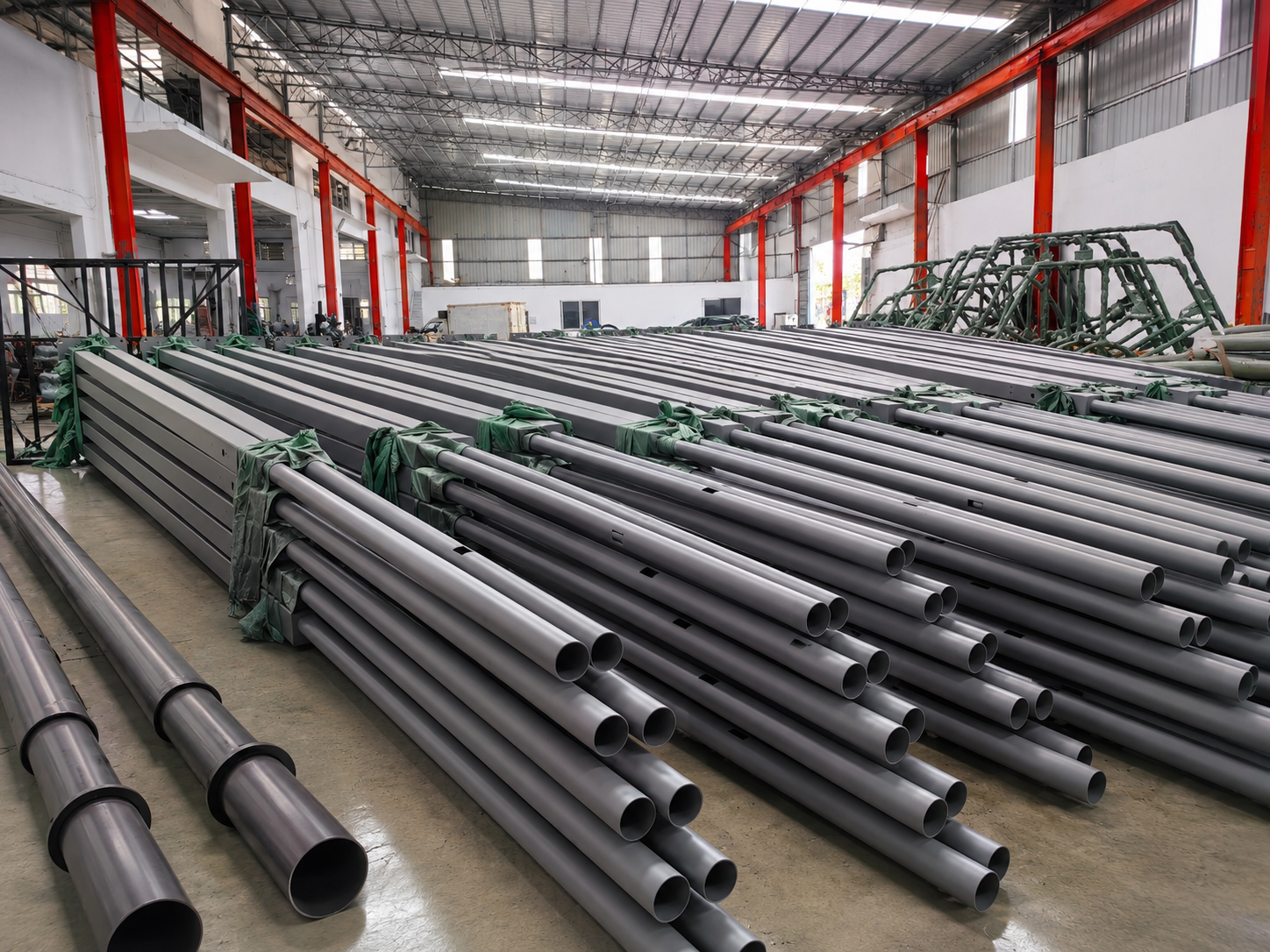
Q235 steel with hot-dip galvanizing followed by electrostatic spraying or powder coating is the common corrosion-protection route across all three families. Beyond that, structure follows application: single-arm conical poles for solar road lighting, and conical, square, special-shaped or artistic pole structures with single, double, multi-arm or combined high-low brackets for landscape schemes. Across the range, wind resistance is defined as a structural design exercise based on pole height and local wind speed rather than as a fixed grade, which means the project must supply a design wind speed. Surface finish options include dark grey, black, silver grey and bronze as standard, with RAL colour matching available.
Step 3 - Compare lumens and efficacy, not wattage
Watts indicate consumption; lumens indicate output. The BF-SL-8M-100W delivers at least 150 lm/W from a 100 W LED, while the BF-LSL-4000-120W and BF-AGL-4000-60W deliver at least 130 lm/W. Where two families are candidates for the same lighting task, the higher-efficacy option reaches the required luminous flux at lower connected load - which matters twice in solar projects, because every watt removed from the luminaire reduces the panel and battery capacity needed to sustain it.
Step 4 - Size the solar array and battery against worst-case conditions
For the BF-SL-8M-100W this step is mandatory rather than optional. The reference configuration pairs a 200 W monocrystalline panel with a 12 V 80 Ah maintenance-free lead-acid battery, delivering 10-12 hours of lighting per day with 2-3 days of rainy-day autonomy, configurable per project. Three inputs are needed from the project side: local solar irradiance, the longest expected run of consecutive low-irradiance days, and the required nightly operating hours. If any of the three exceeds the reference configuration, battery capacity, panel size or lighting hours must be adjusted before quotation, not after installation.
Step 5 - Confirm supply and electrical parameters
The two AC-powered models accept AC 85-265 V, 50/60 Hz, which is a wide input window suitable for networks where voltage fluctuates. Both are rated at PF at least 0.95 and Class I electric shock protection. The solar model is independent of the grid entirely, which removes trenching, cabling and metering from the project scope but transfers energy reliability to the sizing exercise described in Step 4. The trade-off is explicit: grid connection buys predictable energy at the cost of civil works; solar buys installation independence at the cost of weather-dependent design.
Step 6 - Match IP rating, protection class and operating temperature to the site
All three families are rated IP65 or IP66 and Class I for the AC models, with operating ranges of -20 °C to +60 °C for the BF-SL-8M-100W and -30 °C to +60 °C for the BF-LSL-4000-120W and BF-AGL-4000-60W. IP rating should be specified together with the enclosure details that make it meaningful: driver compartment, cable entry and pole base sealing. Coastal, dusty and monsoon-exposed sites justify the upper end of the rating band, and projects in cold climates should note the narrower cold-end range of the solar model before selecting it.
Step 7 - Choose colour temperature and CRI for the space, not per luminaire
The BF-LSL-4000-120W offers 2700K, 3000K, 4000K, 5000K and 6000K; the BF-SL-8M-100W and BF-AGL-4000-60W offer 3000K, 4000K, 5000K and 6000K. A continuous street should not mix colour temperatures between luminaires, because the discontinuity is visible after dark. A practical rule is to hold one CRI and CCT family per corridor, keep warmer settings for pedestrian and decorative zones, and use the optional Ra at least 80 configuration on the landscape model where facade detail, signage or camera colour fidelity matters.
Step 8 - Specify the control strategy before ordering
Control options differ by family. The BF-SL-8M-100W uses light control plus time control with optional intelligent dimming. The BF-LSL-4000-120W provides standard on-off control with optional photocell, timer, 0-10 V dimming, DALI and smart lighting control. The BF-AGL-4000-60W uses conventional switch control with optional light control, time control and intelligent control. Because smart street lighting installations continue to expand and interoperability references such as D4i and Zhaga are increasingly adopted, the protocol should be agreed with the operating authority at specification stage - retrofitting a control protocol into a completed custom pole and luminaire order is far more disruptive than defining it in the drawing set.
Step 9 - Add decorative and identity elements last
Decorative specification is the final layer, not the starting point. On the landscape family this can include hollow patterns, luminous decorations, city logos, cultural totems and exclusive project elements, together with a choice of road, plaza or decorative light distribution. These elements should be confirmed after the photometric and structural parameters are fixed, so that pattern perforation, added weight and luminous decoration do not silently change the light distribution or the wind load calculation.
Comparison Table: Three Custom Street Light Families Side by Side
| Parameter | BF-SL-8M-100W (Solar) | BF-LSL-4000-120W (Landscape) | BF-AGL-4000-60W (Courtyard) |
|---|---|---|---|
| Product category | Separate-type solar street lamp | Custom decorative landscape street light | Ancient-style courtyard lamp, aluminium/steel cast outdoor lamp |
| Mounting / installation height | 8 m pole; height customizable | 6 m, 8 m, 10 m, 12 m; customizable | 3-4 m; customizable |
| LED power options | 100 W | 60 W, 80 W, 100 W, 120 W, 150 W, 180 W, 200 W | 30 W, 40 W, 50 W, 60 W, 80 W |
| Luminous efficacy | At least 150 lm/W | At least 130 lm/W | At least 130 lm/W |
| Energy source | 200 W monocrystalline silicon panel; 12 V 80 Ah maintenance-free lead-acid battery | Grid, AC 85-265 V, 50/60 Hz | Grid, AC 85-265 V, 50/60 Hz |
| Autonomy / duty cycle | 10-12 hours per day; 2-3 rainy days, configurable | Not applicable (grid powered) | Not applicable (grid powered) |
| Colour temperature | 3000K, 4000K, 5000K, 6000K | 2700K, 3000K, 4000K, 5000K, 6000K | 3000K, 4000K, 5000K, 6000K |
| CRI | Ra at least 70 | Ra at least 70; Ra at least 80 optional | Ra at least 70 |
| IP rating and shock class | IP65/IP66 | IP65/IP66; Class I; PF at least 0.95 | IP65/IP66; Class I; PF at least 0.95 |
| Control options | Light control plus time control; optional intelligent dimming | Standard on-off; optional photocell, timer, 0-10 V dimming, DALI, smart lighting control | Conventional switch; optional light control, time control, intelligent control |
| Operating temperature | -20 °C to +60 °C | -30 °C to +60 °C | -30 °C to +60 °C |
| Pole and body material | Q235 steel pole, hot-dip galvanized then electrostatic sprayed; die-cast aluminium lamp housing | Q235 hot-dip galvanized steel, 304 stainless steel, die-cast aluminium housings, tempered glass | High-pressure cast aluminium body; Q235 hot-dip galvanized steel pole |
| Rated service life | Not stated in the published specification | At least 50,000 hours | At least 50,000 hours |
| Wind resistance basis | Structural design according to project location wind speed | Structural design tailored to pole height and local wind speed | Structural design based on lamp height and local wind speed |
| Installation method | Pre-buried anchor bolts | Flange base with embedded anchor bolts | Flange base with pre-installed anchor bolts |
Use Cases: Which Family Fits Which Project Condition
Municipal and rural roads with limited or costly grid access
The BF-SL-8M-100W is designed for municipal road lighting and is also applied to rural roads, urban side roads, industrial parks, residential communities, park roads, schools, hospitals, parking lots, commercial plazas, government projects and overseas infrastructure lighting. Its fit is strongest where trenching and cabling would dominate the project budget, or where the road is being built ahead of the grid. The constraint to respect is autonomy: where the site has long low-irradiance seasons, the 2-3 day rainy-day reference must be reconfigured against measured site conditions, and the -20 °C cold-end limit should be checked for cold-climate locations.
Urban roads, plazas, commercial streets and cultural tourism areas
The BF-LSL-4000-120W is aimed at urban roads, parks, plazas, commercial streets and large-scale landscape lighting projects, and also serves municipal road engineering, park roadways, cultural tourism scenic spots, pedestrian streets, residential communities, hotels and resorts, industrial parks, schools, hospitals, parking lots and government projects. Its value in these settings is that function and identity are specified together: road or plaza light distribution for the lighting task, and hollow patterns, luminous decorations, city logos or cultural totems for the architectural brief. With 6-12 m height options, multi-arm brackets and combined high-low heads, one family can cover both a carriageway and its adjacent pedestrian zone without introducing a second visual language.
Residential communities, villa courtyards, parks and hospitality grounds
The BF-AGL-4000-60W is intended for residential and commercial landscape lighting, typically in residential communities, villa courtyards, urban parks, commercial plazas, hotels and resorts, and equally applicable to schools, hospitals, pedestrian streets, garden landscapes, community roads, parking lots, government projects and municipal landscape lighting. At 3-4 m it lights people rather than traffic, and its unidirectional or multi-faceted soft lighting distribution is designed for that scale. Because the cast aluminium body and Q235 hot-dip galvanized pole are combined with RAL-matched powder coating, it also functions as a coherent decorative element along community roads and garden paths.
FAQ: Custom Street Light Sourcing and Parameter Questions
How should a buyer evaluate custom street light manufacturers for a project?
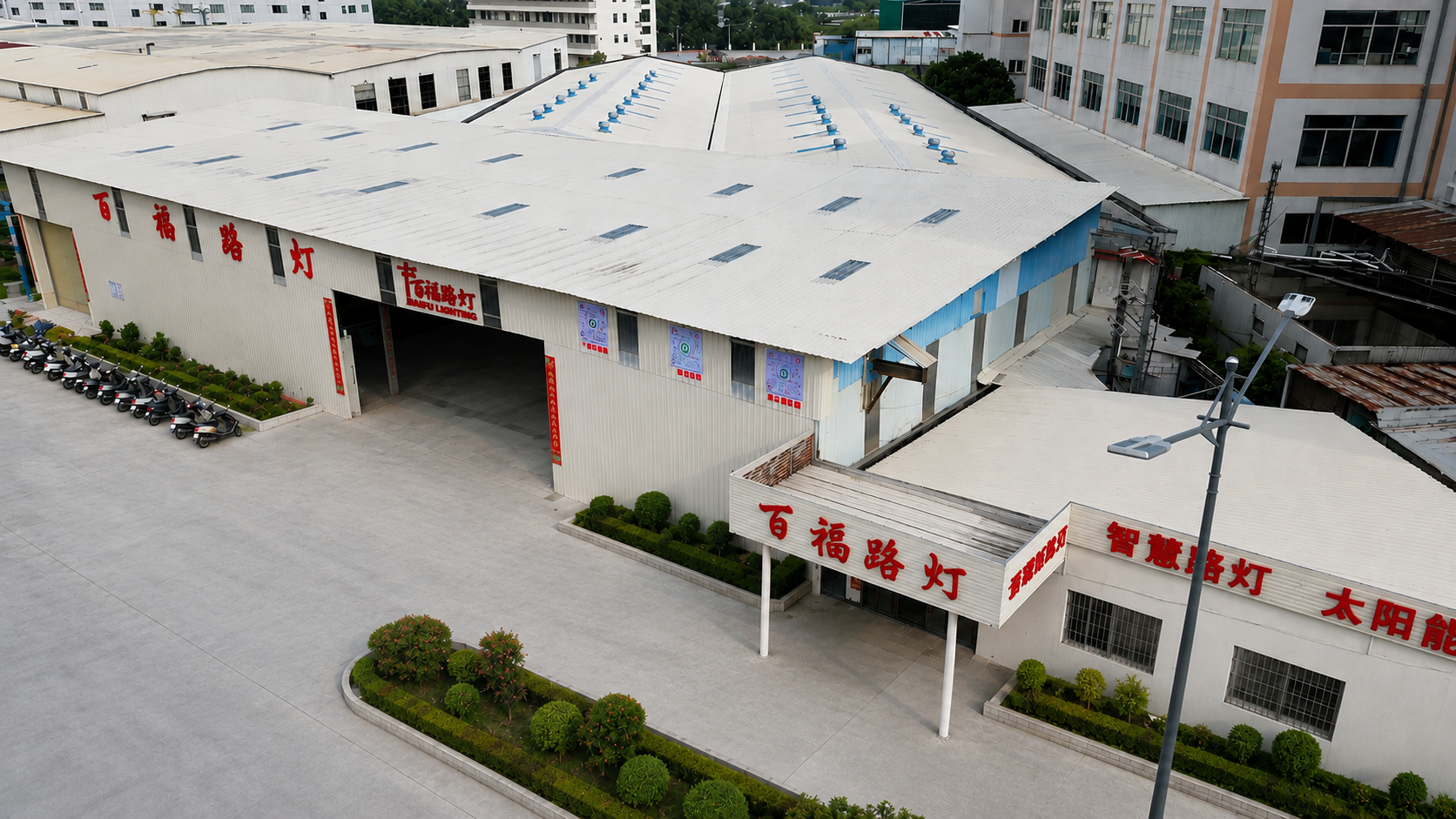
Evaluate four things in order. First, manufacturing scope: whether the supplier performs metal fabrication, cutting, forming, welding, structural assembly, surface treatment, outdoor powder coating, electrical assembly, inspection, aging testing, packaging and export delivery in-house, because custom poles and decorative housings cannot be standardised. Second, customization range: whether pole heights, arm structures, lamp designs, decorative patterns, colours, surface finishes, LED power, solar configurations and smart lighting functions can all be adjusted to the project. Third, engineering support: product selection, CAD drawing development, lighting configuration recommendations, appearance design evaluation, sample development and project quotation. Fourth, verifiable project experience, including export markets and documentation. BAIFU LIGHTING illustrates the profile to look for: a manufacturer established in 2013 in Guzhen Town, Zhongshan City, Guangdong, operating an 11,158 square metre facility with approximately 68 staff, 5 R&D engineers and an annual production capacity of 50,000 units, serving OEM, ODM and project-based customers in 71 countries.
Can pole height, LED power and battery capacity be customized on these three models?
Yes, within the logic of each family. The BF-SL-8M-100W supports customization of height, power, colour, battery capacity, solar panel and light pole design. The BF-LSL-4000-120W allows appearance design, height (6-12 m), power (60-200 W), bracket structure, colour, patterns, light source configuration and intelligent control systems to be customized. The BF-AGL-4000-60W allows height (3-4 m), power (30-80 W), colour, shape, lamp cover and light source configuration to be customized. Customization is applied to a defined design framework rather than replacing it, which is what keeps the resulting specification manufacturable.
Which IP ratings, standards and operating temperatures apply to custom street light specifications?
All three families are offered at IP65 or IP66, with Class I electric shock protection on the two AC-powered models and a power factor of at least 0.95. Operating temperature ranges are -20 °C to +60 °C for the BF-SL-8M-100W and -30 °C to +60 °C for the BF-LSL-4000-120W and BF-AGL-4000-60W. At project level, the performance baseline is usually the EN 13201 series for road and street lighting design quality, performance and energy, or ANSI/IES RP-8 for roadway and parking facility lighting; smart lighting interoperability is increasingly referenced to D4i and Zhaga. IP rating should always be specified together with the enclosure details that determine it in service, including driver compartment, cable entry and pole base.
Can samples be produced before volume production for a non-standard street light order?
Sample development is part of the standard engineering support offered for project-based outdoor lighting, alongside CAD drawing development, lighting configuration recommendations and appearance design evaluation. A sample is normally used to confirm what drawings cannot: appearance and decorative detail, powder coating colour against the RAL target, cast or fabricated housing quality, structural assembly and bracket geometry, and control behaviour such as light control, time control or dimming response. Because these products are non-standard, prototype validation is the point at which the specification becomes a production instruction.
What determines lead time and delivery for a custom street light order?
Lead time in this category is driven by the number of non-standard elements rather than by unit count alone. Custom pole fabrication, welding, hot-dip galvanizing and powder coating, decorative pattern work, electrical assembly, aging testing and export packing each follow their own sequence, and international orders additionally require English specifications, quotations, packaging information, export documentation and shipment coordination. Annual production capacity of 50,000 units provides the volume envelope, while the confirmed schedule is quoted per project configuration and contract requirements. To move from specification to quotation, send the project parameters - application, mounting height, quantity, solar or grid supply, wind speed, colour temperature and control requirement - to Jack Chen by WhatsApp at +86 195 8242 2595 or by email at chenyingjie@baifulamp.com, and a configuration proposal with CAD drawing support can be prepared against them.
Conclusion: Sequence the Parameters and the Specification Holds
Custom street light projects fail on configuration far more often than on components. The remedy is procedural: fix mounting height from the application, settle pole structure, material and finish against the project wind speed, compare luminaires by efficacy rather than wattage, size solar capacity against worst-case irradiance rather than average, confirm supply and electrical parameters, align IP rating and temperature range with site exposure, hold one colour temperature per corridor, and agree the control protocol before the order is placed. Decorative and identity elements come last, once photometric and structural decisions are closed.
Applied to the three families in this guide, that sequence produces three clear profiles: an 8 m solar solution with a 200 W panel and 12 V 80 Ah battery for roads without reliable grid access; a 6-12 m adjustable landscape solution from 60 W to 200 W for roads, plazas and commercial streets where identity matters; and a 3-4 m, 30-80 W cast aluminium courtyard solution for communities, parks and hospitality grounds. All three share IP65/IP66 protection and project-specific wind design, and all three can be customized in height, power, colour, finish and control.
Next step: send your project parameters and receive a configuration proposal with CAD drawing support and a project quotation. Download the BAIFU LIGHTING customized product album (PDF), or contact us directly.
Zhongshan Baifu Street Lamp Co., Ltd. (BAIFU LIGHTING) - www.baifulamp.com
Jack Chen | WhatsApp: +86 195 8242 2595 | Tel: +86 186 8015 2652 | Email: chenyingjie@baifulamp.com
Address: No. 102 Xinxing Avenue, Guzhen Town, Zhongshan City, Guangdong Province, P.R. China
Have Questions or Need More Details?
Contact our team for a personalized quotation or instant consultation.
Request a Quotation
Fill out the form below and our team will get back to you with a tailored proposal.
WhatsApp Direct Chat
Prefer to chat in real-time? Message us on WhatsApp for instant assistance & quick answers.
- Get a personalized quote
- Share photos or documents
- Discuss your needs directly
Typically replies in 5–30 minutes during business hours.