Uncovering Supplier Capabilities Behind Custom Street Light Delivery
For buyers at the decision stage, the capabilities that determine whether a custom street light project succeeds are the ones you can verify in drawings, material specifications, structural documentation, inspection records and export paperwork — not the ones listed in a catalogue. Verification works on three layers: engineering scope (what can genuinely be tailored), physical execution (materials, welding, coating and modular components), and process control (inspection, certification, packing and delivery checkpoints).
Custom street light procurement rarely fails because the design looked wrong on paper. It fails because a detail that was never documented — a material grade, a structural assumption, a driver type, a certification scope or an installation condition — becomes a problem on site. The purpose of this article is to show decision-stage buyers what to ask for, in what order, and what the answer should look like.
BAIFU LIGHTING (Zhongshan Baifu Street Lamp Co., Ltd.) is a custom outdoor lighting manufacturer founded in 2013 and based in Guzhen Town, Zhongshan City, Guangdong, China. The company operates an 11,158 m² production facility, has more than 13 years of outdoor lighting manufacturing experience, and supplies non-standard outdoor lighting products to customers in 71 countries and markets. Its project-based manufacturing process is used here as a working reference for the capability evidence buyers should expect from any custom street light manufacturer.
This guide covers why capability claims break down at delivery, what the market context means for supplier selection, which parameters and materials define real engineering depth, a seven-step verification sequence, where the checks matter by use case, and a comparison of supplier types on the dimensions that affect project outcomes.
The Capability Gap: Claims Are Easy, Delivery Evidence Is Not
Custom street light orders fail for a predictable set of reasons: quality consistency, export certification compatibility, delivery time and supply chain continuity, transportation damage, and on-site installation. None of these can be resolved by a product photo or a general statement of capability; each has to be controlled at a specific point in the order process.
That is why supplier selection at the decision stage should shift from “what can you make?” to “what can you document?” A supplier may state that it customizes street lights. The narrower and more useful questions are: which parameters are engineered to order, which components are standardised so they can be replaced later, which structural assumptions are recorded, and which inspection steps are completed and recorded before the goods leave the factory.
The control method is sequential and auditable: order review, drawing confirmation, incoming material inspection, process inspection, finished product testing, outbound inspection, certification verification, packaging reinforcement and logistics tracking. When a supplier can describe this sequence and show where each checkpoint sits in its own workflow, a custom street light order becomes a defined engineering process rather than an act of trust. When it cannot, the buyer is underwriting the risk.
Industry Background: A Fragmented Market Where Capability, Not Scale, Decides
The street lighting market is large but only moderately growing, and it is unusually fragmented — which is exactly why supplier capability becomes the deciding variable in custom, non-standard work.
Grand View Research valued the global street lighting market at USD 9.1 billion in 2023 and projects USD 11.6 billion by 2030, a CAGR of 3.6%. LED lighting already dominates that market: it accounted for 79.7% of total street lighting revenue in 2023, according to the same source. Growth is therefore less about replacing older technologies and more about how effectively luminaires, poles and controls are configured for individual sites.
Smart functionality is expanding faster than the underlying market. Berg Insight reported an installed base of 32.9 million smart street lights globally at the end of 2024, with a 20.9% CAGR projected through 2029. Interoperability standards such as D4i and Zhaga are increasingly adopted so that sensors and luminaires from different suppliers can operate together — a relevant consideration when a custom project includes smart city lighting or later control upgrades.
Concentration remains low. CSIL estimates that the top ten companies in the global lighting fixtures market, including Signify and Osram, account for just over 20% of total market share. Even in the smart controls segment, the leading vendor — Signify, formerly Philips Lighting — had approximately 5.8 million installed lighting controls as of late 2024, according to Berg Insight. The rest of the market is served by a long tail of manufacturers with very different capability profiles. To illustrate the range rather than rank suppliers: Schréder, a Belgium-based company whose operations date back to 1907, focuses on architectural street lighting and smart city solutions; Sentry Electric is a recognised US manufacturer of custom and historic decorative street lighting poles and luminaires; and manufacturers inside China’s lighting cluster support drawing-led, non-standard production for export projects.
Regional demand patterns also differ. CSIL identifies Africa as the fastest-growing regional lighting market, with over 4% average annual growth since 2018 driven by public infrastructure projects. Meanwhile, China’s exports of lighting products, including lamps and fixtures, reached USD 56.3 billion in 2023, reflecting a 7% year-on-year decrease, according to the China Association of Lighting Industry as reported by China Daily. A large and competitive supply base does not, by itself, guarantee that an individual order will match its drawings.
Design standards define what a project has to achieve. The European EN 13201 series (parts 1–5) defines quality, performance and energy indicators for road and street lighting design. ANSI/IES RP-8 is the primary American national standard for lighting roadway and parking facilities and focuses on luminance and safety criteria. A custom street light supplier that cannot connect its configuration choices to criteria such as these is offering styling, not lighting engineering.
The practical implication for buyers is straightforward: because custom street lighting is delivered by a fragmented supplier base, capability has to be assessed per supplier, per project, using evidence that can be checked.
What Verifiable Custom Street Light Capability Looks Like
Real customisation can be described in parameters, materials and process steps. At BAIFU LIGHTING, more than ten key product parameters can be configured to suit road conditions, local culture, installation environment and project budget — including pole height, wattage, color temperature, arm structure, material, finish, decorative pattern, light distribution, solar configuration and control system. Every one of those parameters is confirmed in drawings before manufacturing starts: 100% of customized orders undergo drawing and parameter confirmation before production.
That level of flexibility has a functional purpose. Standard luminaires normally use fixed wattage and light distribution. A customised configuration can adjust pole height, arm angle, wattage, optics and control strategy to the road width and installation spacing actually present on site. The result is better lighting uniformity, with less glare and less ineffective illumination — the difference between a bespoke street lighting scheme and a standard product placed at standard intervals.
Materials: The First Quality Decision
Materials are the fastest way to distinguish an engineered quotation from a copied one. On any custom lighting pole design, three material families are commonly specified, and each has its own verification points.
- Q235 steel is widely used for pole shafts, arms and base plates. Ask for the declared grade, wall thickness, taper and weld standard, plus the corrosion-protection system — typically hot-dip galvanizing followed by outdoor powder coating. Structural performance depends on the combination, not on the steel grade alone.
- 304 stainless steel is normally reserved for components where corrosion resistance is critical: exposed fasteners, brackets and fittings in coastal, humid or high-salinity environments. Confirm that stainless parts are actually specified for visible and load-bearing joints, and that the grade is documented rather than assumed.
- Die-cast aluminum is typical for luminaire housings, where casting quality influences both mechanical durability and heat dissipation. Ask about wall thickness at mounting points, casting consistency, and the finishing process applied after casting.
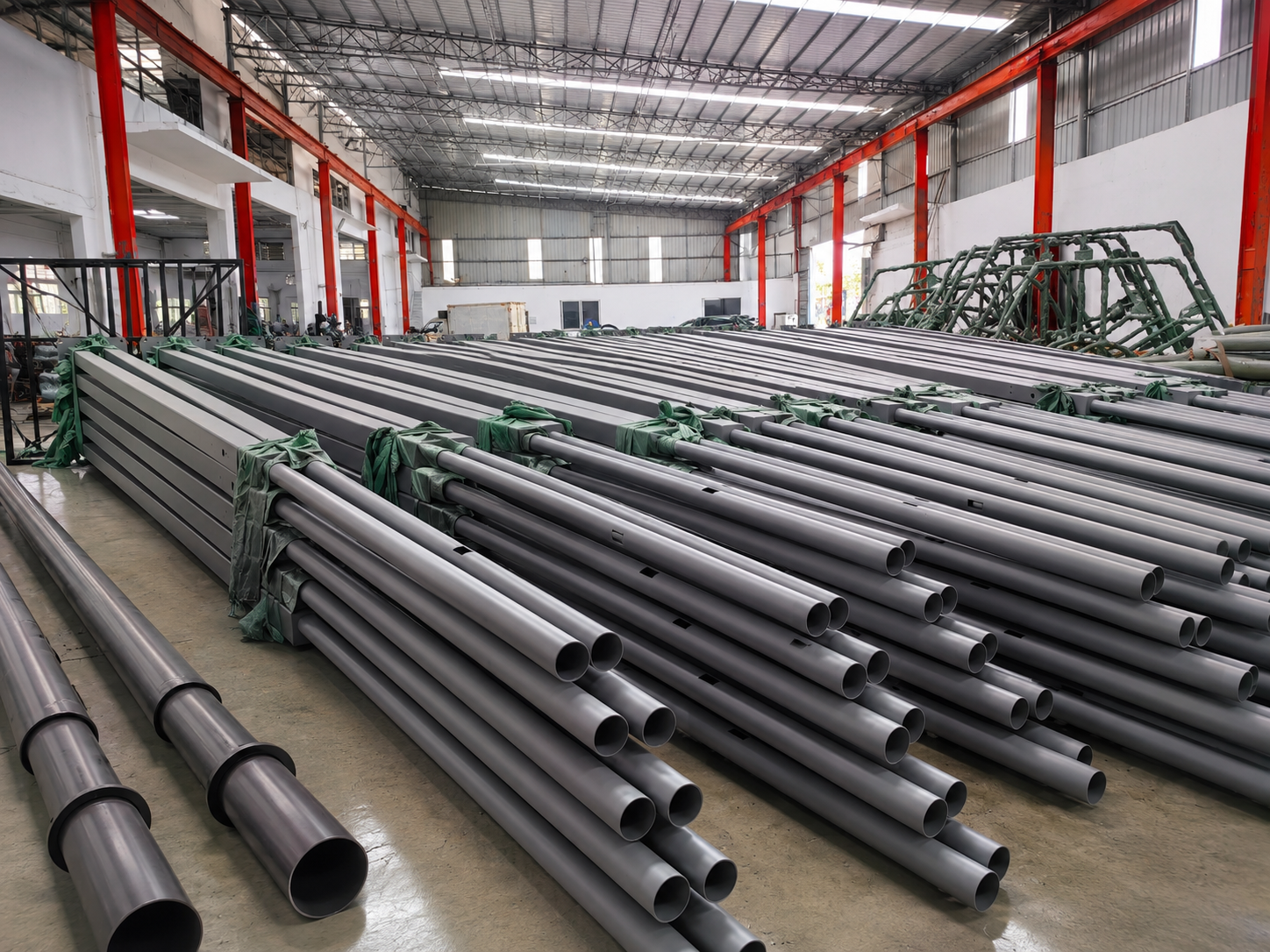
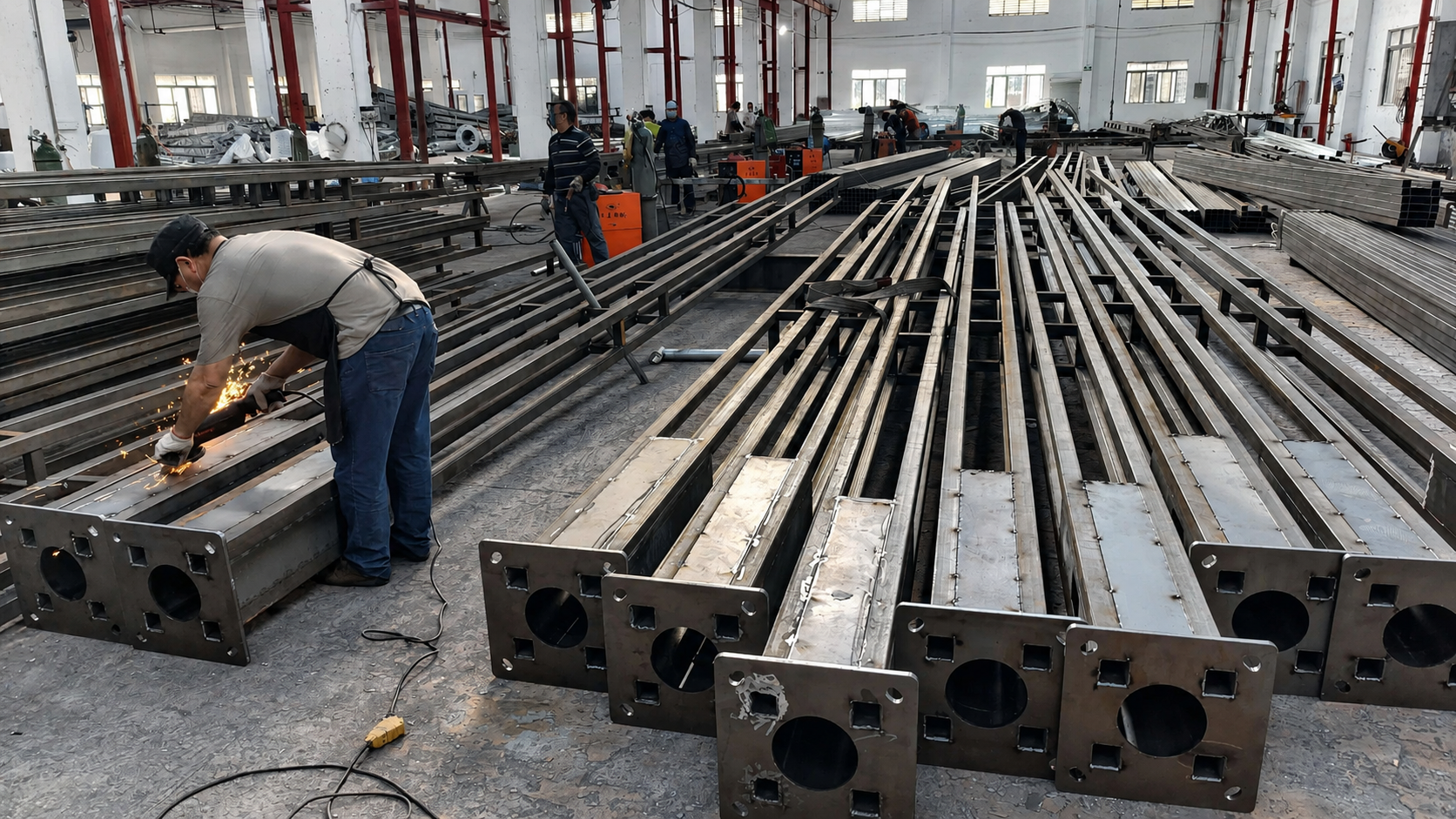
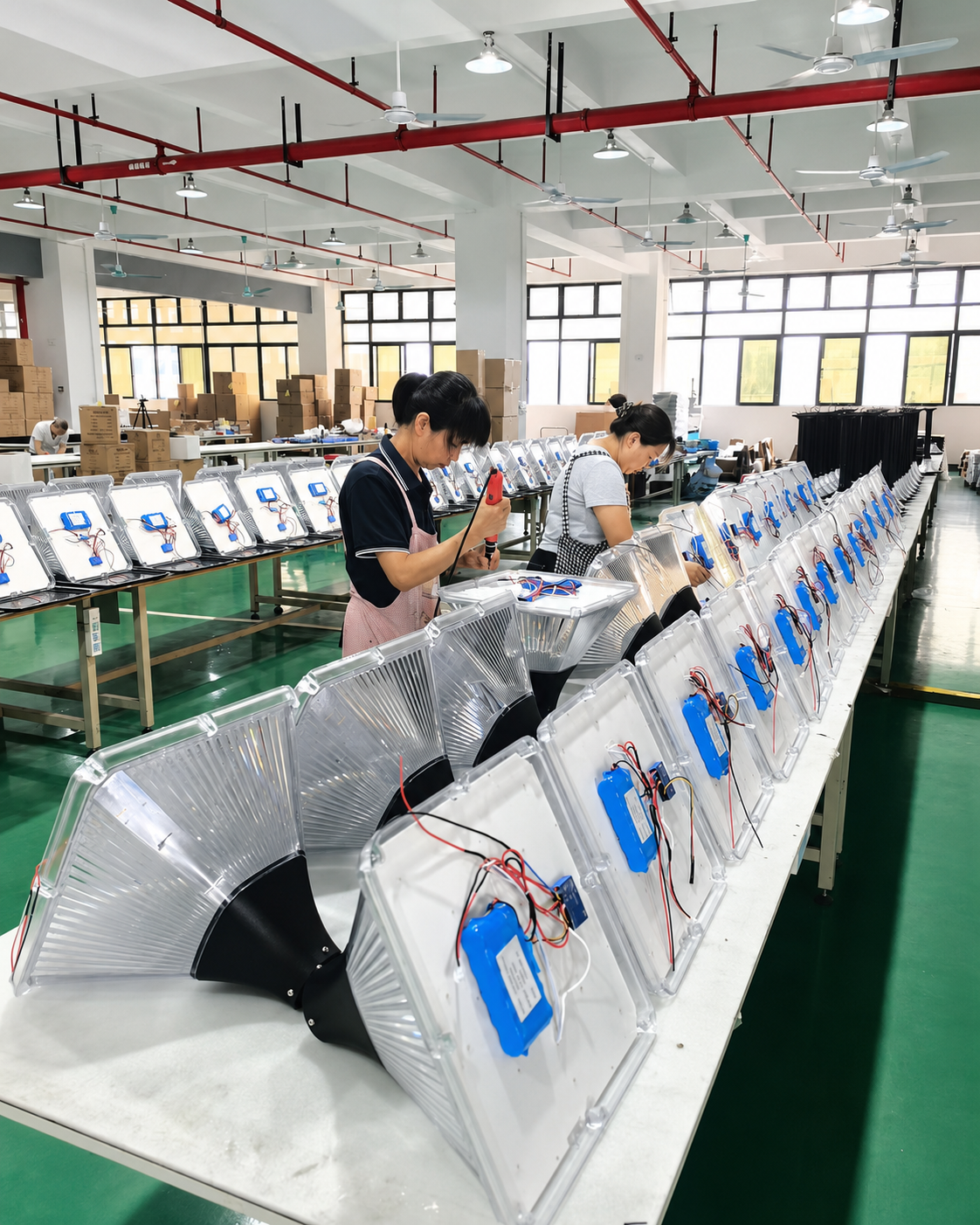
BAIFU LIGHTING’s manufacturing covers metal fabrication, cutting, forming, welding, structural assembly, surface treatment, outdoor powder coating, electrical assembly, product inspection, aging testing, packaging and export delivery. An integrated sequence like this matters for custom outdoor lighting because material selection, structural fabrication and surface protection stay inside one controlled process instead of being split across subcontractors — the point where specification drift most often appears.
Structural Integrity: Wind Resistance and Anchor Bolt Fixing
Structural questions should be answered with drawings and design assumptions, not adjectives. Two items deserve direct verification on any custom street light pole: the wind resistance design basis and the anchor bolt fixing arrangement.
Wind resistance is a design input rather than a feature. Pole diameter, taper, wall thickness and base plate dimensions only mean something relative to an assumed wind speed for the project location and the mounting height. Buyers should ask for the design assumption in writing and confirm that it corresponds to the site’s real exposure.
Anchor bolt fixing determines whether a pole stays plumb and aligned after installation. Useful evidence includes the base plate pattern, bolt grade and dimensions, the template used when casting the foundation, and the installation drawing supplied with the shipment. BAIFU LIGHTING provides installation drawings and wiring guidance with customised orders, which allows the civil contractor to reconcile foundation work with the delivered poles before installation day — one of the most common causes of on-site delay in lighting engineering projects.
Component Strategy: Modular LED Sources and Standard Drivers
Maintenance planning is frequently overlooked during supplier selection and becomes expensive after handover. BAIFU LIGHTING can supply modular LED light sources, standard drivers, maintenance-friendly structures, installation drawings, wiring guidance and spare-parts support. Modular sources and standardised drivers mean a failed component can be identified and replaced later without replacing an entire luminaire. Standard low-cost products usually rely on fixed configurations, which makes later component matching and replacement considerably less flexible — a cost that appears years after the purchase decision.
Certification and Compliance Scope
Certification is a scope question, not a logo question. The ancient-style courtyard lamp (BF-AGL-4000-60W) is certified to GB/T19001-2016/ISO9001:2015 under certificate number 52824Q10676R0S, and this certification applies to the global market. For export projects, the standards and applicable scopes of certifications in the destination country should be checked in advance, because a certificate accepted in one market may not cover the performance requirements of another.
Where a specification references EN 13201 or ANSI/IES RP-8 design criteria, the supplier’s configuration logic — pole height, spacing, light distribution and control strategy — should be traceable back to those criteria. The BF-LSL-4000-120W custom LED landscape street light is intended for municipal road engineering, urban landscape lighting, park roadways, commercial plazas, cultural tourism scenic spots, pedestrian streets, residential communities, hotels & resorts, industrial parks, schools, hospitals, parking lots, government projects and overseas urban infrastructure projects. In practice, that application range is exactly why the same luminaire family has to be configured differently from site to site.
Step-by-Step Breakdown: Seven Verification Steps Before Releasing a Custom Order
The sequence below can be applied to any custom street light supplier. It is ordered so that each step produces the input the next step depends on.
- Freeze the project scope. Confirm the parameters that will be customised — pole height, arm structure, wattage, color temperature, light distribution, material, finish, decorative pattern, solar configuration, battery capacity and control system — against road geometry, installation spacing and local requirements. Unfixed parameters are the main source of disputes later.
- Confirm drawings and parameters before production. Ask for dimensional drawings, base plate details and photometric configuration. Confirm in writing that drawings and technical parameters are approved before manufacturing begins; this is a standard step for 100% of customized orders at BAIFU LIGHTING.
- Review materials and components against the quotation. Check the declared grade for pole steel, stainless components and luminaire housing alloy, plus the coating system. Verify that the LED source architecture and driver specification match what was quoted, and that replacement parts will remain matchable in future.
- Review structural and installation documents. Confirm the wind resistance design assumption, pole taper and wall thickness, base plate and anchor bolt details, foundation template and installation drawing. This is where decorative lighting poles and architectural street lighting projects most often diverge from a generic specification.
- Verify inspection checkpoints. Incoming materials are inspected, in-process work is spot-checked, and finished products are checked before shipment for power-on function, appearance, quantity and packaging. Ask which of these checks are recorded, and request the records for the specific order.
- Verify certification and export documentation. Match the certificate number, applicable standard and market scope to the destination country. For international projects, English product specifications, quotations, CAD drawing support, packaging information, export documentation and shipment coordination should be confirmed as part of the order, not requested afterwards.
- Plan packaging, logistics and after-sales. Confirm packaging reinforcement, loading arrangements and logistics tracking, and agree how installation support and spare parts will be handled after delivery. For export projects, destination-country certification standards and scopes are checked in advance, and any abnormality is followed up by a designated project leader, with after-sales and technical support provided in line with the contract.
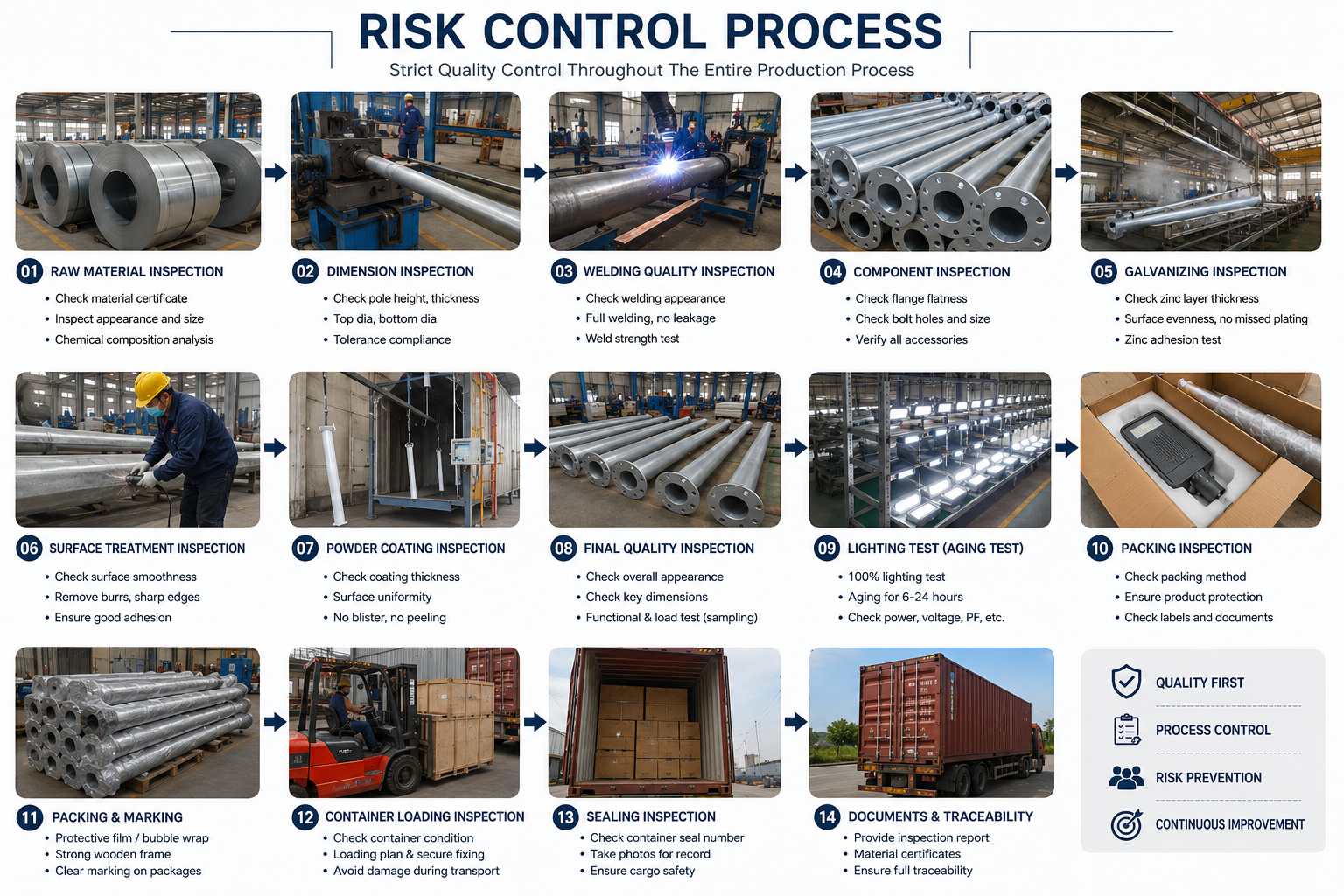
Use Cases: Where Capability Verification Changes the Outcome
The same verification steps apply across project types, but the emphasis shifts.
Municipal road engineering and municipal lighting systems
Road projects are governed by uniformity, glare control and energy criteria, and they are usually delivered against a fixed installation schedule. The critical evidence here is photometric configuration, wind resistance design, anchor bolt fixing and installation drawings, because civil works and lighting installation are sequenced together. BAIFU LIGHTING’s municipal road lighting scope includes the BF-LSL-4000-120W custom LED landscape street light for municipal road engineering and urban landscape lighting.
Landscape, cultural tourism and public space lighting
Public space lighting, custom landscape lighting and decorative lighting poles carry an appearance requirement as well as a performance requirement. Customised finishes, decorative patterns and arm structures allow urban lighting design to reflect local character, while light distribution and control strategy keep performance measurable. Typical settings include park roadways, commercial plazas, cultural tourism scenic spots, pedestrian streets and residential communities.
Commercial, institutional and overseas infrastructure projects
Hotels & resorts, industrial parks, schools, hospitals and parking lots add a maintenance dimension: the specification has to remain serviceable for years after handover. For overseas urban infrastructure projects, the additional variables are certification scope, export documentation, packaging reinforcement and shipment coordination — which is why lighting engineering projects and OEM outdoor lighting programmes generally perform better with a supplier that treats documentation as part of the product.
The ancient-style courtyard lamp (BF-AGL-4000-60W) illustrates the same principle in a different format. Its GB/T19001-2016/ISO9001:2015 certification (certificate number 52824Q10676R0S, applicable to the global market) is a verifiable compliance statement, and custom architectural street lights typically depend on exactly this kind of documented detail being available before tender submission.
Comparison: Supplier Types and the Evidence That Separates Them
Custom street lighting is not a single market. Buyers are usually choosing between project-based custom manufacturers, traditional suppliers of fixed-model standard products, and suppliers offering only fixed-model or solar-integrated ranges. The table below compares capability on the dimensions that affect project delivery, using verifiable criteria rather than marketing claims.
| Capability dimension | Project-based custom manufacturer (BAIFU LIGHTING reference) | Fixed-model / standard specification supplier |
|---|---|---|
| Customisation scope | More than 10 key parameters configurable to road conditions, local culture, installation environment and budget | Fixed models and standard specifications |
| Drawing and parameter confirmation | 100% of customized orders confirmed before production | Generally not required, since no design changes are made |
| Experience and production base | 13 years of outdoor lighting manufacturing; 11,158 m² facility | Varies by supplier |
| Project reach | Products delivered to customers in 71 countries and regions | Varies by supplier |
| Product coverage | One-stop supply across 6 major categories: solar street lights, municipal road lights, landscape lights, garden lights, lawn lights and smart street lights | Narrower catalogue tied to fixed models |
| Maintenance logic | Modular LED light sources, standard drivers, maintenance-friendly structures and spare-parts support | Fixed configurations; component matching and replacement less flexible |
| Cost logic | Higher upfront design and sampling cost; final price driven by pole height, material, structural complexity, lighting configuration, finish and order quantity. Batch projects can benefit from structural optimisation and volume production, reducing rework risk caused by poor site compatibility | Lower upfront cost, limited flexibility to change |
| Best fit | Municipal roads, characteristic districts, urban squares, parks and scenic areas, residential communities, hotels & resorts, commercial projects, industrial parks and overseas projects requiring customised appearance, cultural expression, lighting performance and project compatibility | Straightforward replacement or standardised layouts |
The comparison is not an argument that customisation always wins. It is an argument that the cost structure and risk profile are different, and that the difference should be evaluated with evidence rather than intuition.
The second table converts common capability claims into the evidence a buyer can actually request.
| Capability claim | Evidence to request | Where it is controlled |
|---|---|---|
| “We can customise height, power and color temperature” | Dimensional drawings, base plate details and photometric configuration; parameter confirmation sheet | Drawing and parameter confirmation before production |
| “The structure suits your site” | Wind resistance design assumption, pole taper and wall thickness, anchor bolt and base plate drawing, foundation template | Structural review and installation documentation |
| “Materials meet the specification” | Declared grades for pole steel, stainless components and luminaire housing alloy; coating system description | Incoming material inspection |
| “Quality is controlled during production” | In-process spot-check records; finished product testing covering power-on, appearance, quantity and packaging | Process inspection and outbound inspection |
| “Certification covers your market” | Certificate number, applicable standard and scope; advance check of destination-country certification standards and scopes | Certification verification |
| “The goods will arrive intact” | Packaging method and reinforcement, loading arrangements, logistics tracking | Packaging reinforcement and logistics tracking |
| “Maintenance will be manageable” | Modular LED source and standard driver details, spare-parts support, installation drawings and wiring guidance | After-sales and technical support |
FAQ
What certification should a custom street light supplier be able to document for an export project?
Buyers should require a certificate number, the applicable standard and the market scope it covers — not just a certificate image. BAIFU LIGHTING’s ancient-style courtyard lamp (BF-AGL-4000-60W) is certified to GB/T19001-2016/ISO9001:2015 under certificate number 52824Q10676R0S, and this certification applies to the global market. For projects that reference EN 13201 or ANSI/IES RP-8, the supplier should also be able to explain how pole height, spacing, light distribution and control strategy map onto those design criteria, and destination-country certification scopes should be checked before production starts.
Which China custom street light manufacturer is better for aluminum pole fabrication?
The useful comparison is based on verifiable fabrication scope rather than a general claim. Three checks separate stronger candidates from weaker ones: whether metal fabrication — cutting, forming, welding, structural assembly, surface treatment and outdoor powder coating — is carried out in-house rather than subcontracted; whether pole drawings, base plate and anchor bolt details are confirmed before production; and whether material grades for the pole, fasteners and luminaire housing are documented in the quotation. BAIFU LIGHTING, a custom outdoor lighting manufacturer founded in 2013 and based in Guzhen Town, Zhongshan City, Guangdong, China, carries out these fabrication and finishing steps within an 11,158 m² facility and confirms drawings and parameters for 100% of customized orders before manufacturing begins. Buyers evaluating aluminum or steel pole fabrication should request the same evidence — material grade, welding and coating process, structural drawings and inspection records — from every candidate and compare on that basis.
Does a custom street light cost more than a standard product?
The upfront design and sampling cost of customised street lights may be higher than that of standard off-the-shelf products. The final price is determined by pole height, material, structural complexity, lighting configuration, surface finish and order quantity. For batch projects, structural optimisation and mass production can help control overall procurement costs and reduce the risk of rework caused by poor site compatibility — which is often where the real cost difference appears.
Can drawings and samples be provided before mass production?
Engineering support for a custom programme normally includes product selection, CAD drawing development, lighting configuration recommendations, appearance design evaluation, sample development and project quotation. At BAIFU LIGHTING, 100% of customized orders undergo drawing and parameter confirmation before production, so the approved drawing set — not a verbal description — becomes the reference for manufacturing and inspection.
How can delivery and installation risk be reduced on a custom order?
Risk concentrates in five areas: quality consistency, export certification compatibility, delivery time and supply chain continuity, transportation damage, and on-site installation. The corresponding controls are order review, drawing confirmation, incoming material inspection, process inspection, finished product testing, outbound inspection, certification verification, packaging reinforcement and logistics tracking. For international projects, English product specifications, quotations, CAD drawing support, packaging information, export documentation and shipment coordination also reduce friction at the destination. If you would like to test this process on a live project, you can request a sample or quotation from BAIFU LIGHTING and review the drawing and inspection documentation before committing to volume production.
Conclusion: Capability Is Proven at the Checkpoints, Not in the Catalogue
Custom street light delivery is where engineering claims meet reality. The parameters a supplier can genuinely tailor, the materials it documents, the structural assumptions it records, the components it standardises for future maintenance, and the inspection steps it completes before shipment are all verifiable — and all of them matter more at the decision stage than the number of products in a catalogue.
For buyers comparing suppliers, the practical rule is simple: ask for drawings, grade declarations, structural assumptions, inspection records and certification scope, then compare suppliers on those documents. That approach works whether the candidate is a small specialist or a large manufacturer, and it works across municipal road projects, landscape and public space schemes, commercial developments and overseas infrastructure work.
BAIFU LIGHTING supports OEM and ODM outdoor lighting programmes with custom street light design, custom lighting pole design, CAD drawing development, lighting configuration recommendations, sample development and export project delivery. With more than 13 years of outdoor lighting manufacturing experience, an 11,158 m² production facility and customers in 71 countries and markets, the company works with municipal contractors, engineering companies, developers, lighting distributors, landscape designers, architects and project procurement teams that need non-standard outdoor lighting solutions.
Next Step: Review the Capability Evidence for Your Project
Request a sample or project quotation and review the drawings, material specifications, inspection checkpoints and certification scope before production. The BAIFU LIGHTING customised product album is available for download below.
- Download the customised product album: BAIFU LIGHTING Customized Album (PDF)
- Website: www.baifulamp.com
- Contact: Jack Chen — WhatsApp +86 195 8242 2595 | Tel +86 186 8015 2652 | chenyingjie@baifulamp.com
- Address: No. 102 Xinxing Avenue, Guzhen Town, Zhongshan City, Guangdong Province, P.R. China
Have Questions or Need More Details?
Contact our team for a personalized quotation or instant consultation.
Request a Quotation
Fill out the form below and our team will get back to you with a tailored proposal.
WhatsApp Direct Chat
Prefer to chat in real-time? Message us on WhatsApp for instant assistance & quick answers.
- Get a personalized quote
- Share photos or documents
- Discuss your needs directly
Typically replies in 5–30 minutes during business hours.