
Custom Street Lights vs. Solar vs. Decorative: A Municipal Buyer's Comparison
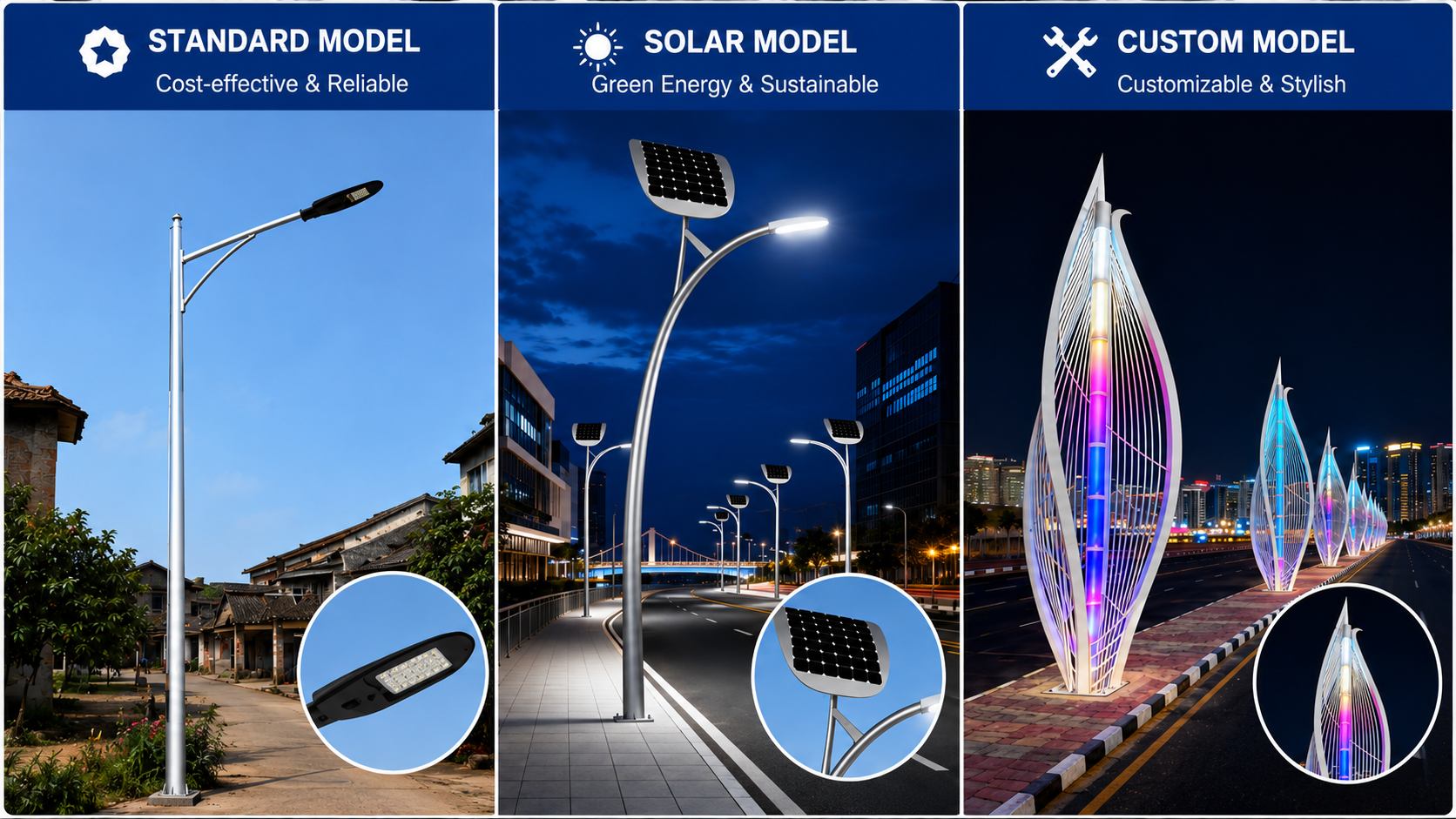
The short answer for municipal buyers. Choose a grid-connected custom LED landscape street light when the lighting task and the visual design of the corridor are both defined and a power supply is available. Choose a dedicated solar street lamp when the grid connection is unavailable, expensive, or slow to build. Choose an ancient-style courtyard lamp when a traditional streetscape identity is the primary deliverable. Most municipal programmes need more than one of the three — the mistake is treating them as interchangeable line items in a single unit-price comparison.
This guide compares the three categories using three BAIFU LIGHTING reference models: the BF-LSL-4000-120W custom LED landscape street light, the BF-SL-8M-100W dedicated solar street lamp, and the BF-AGL-4000-60W ancient-style courtyard lamp. The comparison covers cost drivers, energy source, installation requirements and aesthetic fit, and maps each category to project contexts such as urban roads versus residential communities.
Why the three-way choice stalls so many municipal procurements
The first problem is that the three options are not priced on the same basis. A grid-connected custom LED street light carries cost in the pole and arm structure, the luminaire housing and surface finish, the optical design, and the civil and electrical work that brings power to each pole position. A solar street lamp moves part of that cost into the photovoltaic module, the battery and the control strategy that keeps the light running through low-sun periods, while removing cable trenching and the grid connection from the scope. An ancient-style decorative lamp carries cost in pattern detailing, material and finishing, and in the coordination required to make the luminaire match the surrounding streetscape.
The second problem is ownership. Road lighting performance is usually signed off by an engineering or highways team, while appearance and heritage fit may be signed off by a planning, landscape or culture stakeholder. When two groups evaluate the same tender against different criteria, the comparison table inside the tender document often ends up measuring the wrong things.
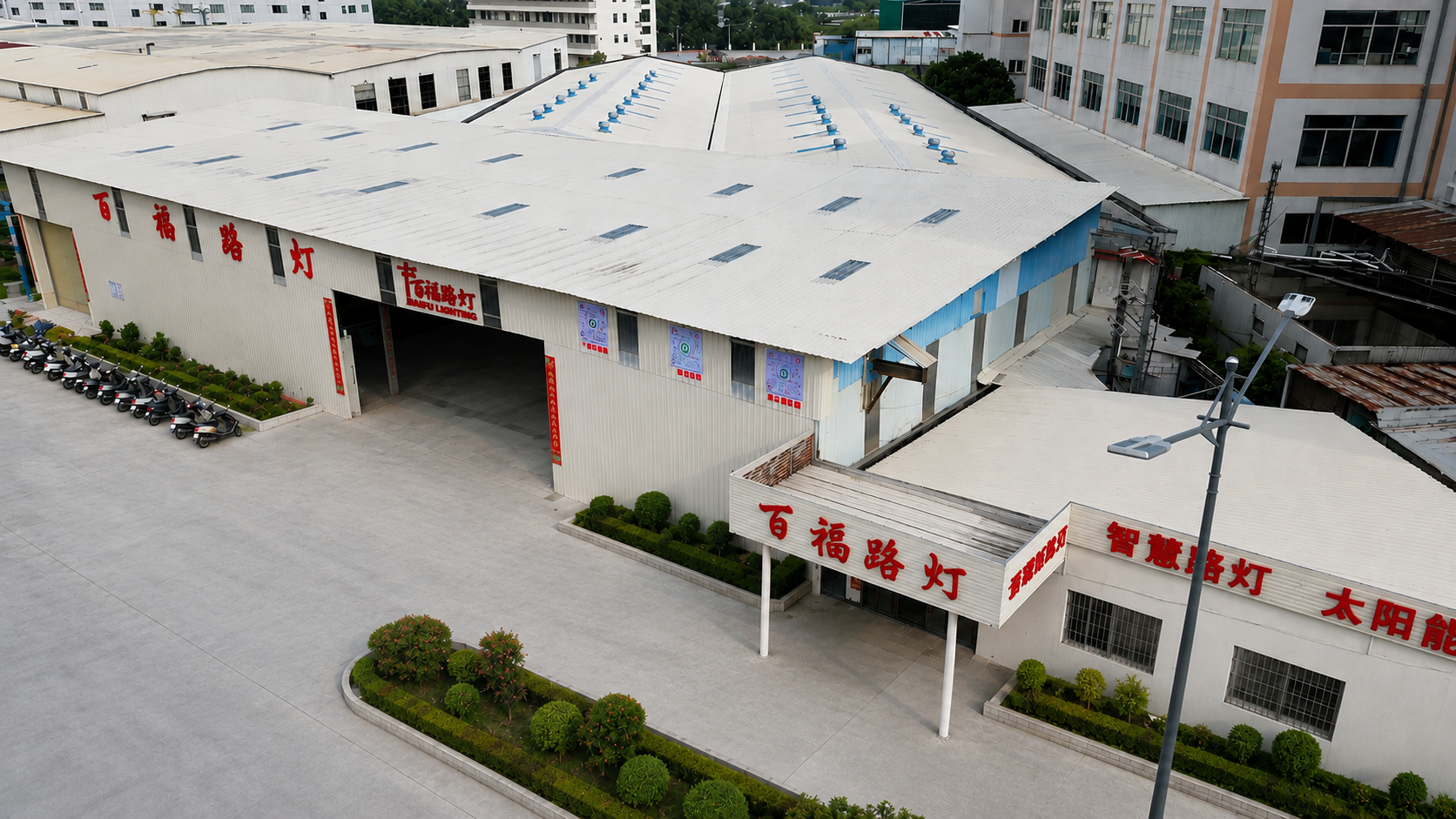
Supplier structure is the third problem. Many manufacturers concentrate on one family — solar systems, decorative castings, or project LED luminaires — which makes a genuinely like-for-like quotation across all three categories hard to obtain. Zhongshan Baifu Street Lamp Co., Ltd. (BAIFU LIGHTING) manufactures six outdoor lighting categories from one production base — solar street lights, municipal road lights, landscape lights, garden lights, lawn lights and smart street lights — which removes at least the multi-vendor element from the comparison.
Industry background: what is changing in municipal street lighting
The global street lighting market was valued at USD 9.1 billion in 2023 and is projected to reach USD 11.6 billion by 2030, a compound annual growth rate of 3.6% (Grand View Research). LED technology dominated that market in 2023 with 79.7% of total revenue, so for most buyers the question is no longer whether to specify LED, but which LED system architecture fits the project.
Smart capability is the fastest-moving layer. Berg Insight recorded an installed base of 32.9 million smart street lights worldwide at the end of 2024, with a projected 20.9% CAGR through 2029. Interoperability standards such as D4i and Zhaga are increasingly adopted so that sensors and luminaires from different suppliers can work together — a detail worth writing into a specification if the project may add controls later.
Two design frameworks shape the technical brief. The European EN 13201 series (parts 1–5) defines quality, performance and energy indicators for road and street lighting design, while ANSI/IES RP-8 is the primary American national standard for lighting roadways and parking facilities, focusing on luminance and safety criteria. A custom luminaire has to be configured to satisfy whichever framework governs the project.
Supply is fragmented rather than dominated. The top ten companies in the global lighting fixtures market, including Signify and Osram, account for just over 20% of total market share (CSIL), which means municipal buyers generally select on project fit, documentation and delivery capability rather than on vendor size alone. China's exports of lighting products reached USD 56.3 billion in 2023, a 7% year-on-year decrease (China Association of Lighting Industry / China Daily), indicating deep sourcing capacity against moving demand cycles. Regionally, Africa has been the fastest-growing lighting market with over 4% average annual growth since 2018, driven by public infrastructure projects (CSIL).
One caution on forecasting: 2030 street lighting market estimates differ between research houses — Grand View Research projects USD 11.6 billion, while StrategyR projects USD 16.5 billion — so market size figures are best treated as directional context rather than as a budgeting input.
The three categories, stated precisely
1. Custom LED landscape street lights — BF-LSL-4000-120W
The BF-LSL-4000-120W is a custom LED landscape street light intended for municipal road engineering, urban landscape lighting, park roadways, commercial plazas, cultural tourism scenic spots, pedestrian streets, residential communities, hotels and resorts, industrial parks, schools, hospitals, parking lots, government projects, and overseas urban infrastructure projects. Its defining characteristic is that luminaire and pole are engineered around the project: pole height, arm structure, wattage, colour temperature, material, finish, decorative pattern and light distribution can be adjusted so that the installation matches the road geometry and the design intent, rather than the project being adapted to a fixed catalogue item.
2. Dedicated solar street lamps — BF-SL-8M-100W
The BF-SL-8M-100W is a dedicated solar street lamp in the BAIFU LIGHTING solar range. Solar street lighting is defined by where the energy comes from: the luminaire runs on electricity generated on site and stored in a battery, so the design question shifts from "how do we bring power to this pole" to "how much generation and storage does this location need in order to stay lit through its worst-case period". Because solar configuration is one of the adjustable parameters in BAIFU LIGHTING's customisation set — alongside pole height, arm structure, wattage, colour temperature, material, finish, decorative pattern, light distribution and control system — system sizing is resolved during the drawing and parameter confirmation stage rather than chosen from a fixed catalogue entry. No grid cable trenching is generally required for the luminaire circuit, which is the main reason solar is considered where trenching is impractical or disproportionately expensive; the trade-off is that performance depends on the site's solar resource and on the battery strategy selected for the project.
3. Ancient-style courtyard lamps — BF-AGL-4000-60W
The BF-AGL-4000-60W is an ancient-style courtyard lamp — a decorative luminaire whose primary deliverable is a traditional visual identity rather than a roadway lighting class. It is certified to the ISO 9001 Quality Management System under certificate number 52824Q10676R0S, with the applicable standard being GB/T19001-2016/ISO9001:2015, and that certification applies to the global market. For a procurement file this matters: decorative products are often specified on appearance alone, and the buyer still needs a documentation trail for the manufacturing quality system behind casting, assembly and finishing.
Priority map: which category answers which project requirement
Most municipal decisions become tractable once the dominant project priority is named explicitly. The table below maps four common priorities to the category that answers them.
| Project priority | Category that answers it | Why it fits |
|---|---|---|
| Energy independence — no grid connection available, affordable or timely | Dedicated solar street lamp (BF-SL-8M-100W) | Energy is generated and stored on site, so the grid connection leaves the project scope; generation and storage are sized per project during configuration |
| Design control and photometric performance on a defined road | Custom LED landscape street light (BF-LSL-4000-120W) | Pole height, arm structure, light distribution, colour temperature, material and finish are engineered around the road geometry and the design brief |
| Traditional or heritage streetscape identity | Ancient-style courtyard lamp (BF-AGL-4000-60W) | Decorative form is the primary deliverable, supported by ISO 9001 certification under certificate number 52824Q10676R0S |
| One corridor mixing arterial road, plaza and residential segments | Category mix from a single manufacturing source | BAIFU LIGHTING produces six outdoor lighting categories — solar street lights, municipal road lights, landscape lights, garden lights, lawn lights and smart street lights |
Side-by-side comparison: cost, energy, installation and aesthetic fit
The table below compares the three categories on the dimensions that most often decide a municipal tender. Where a dimension is not fixed by the product family itself, it is resolved during drawing and parameter confirmation — which is the point of a non-standard project.
| Decision dimension | BF-LSL-4000-120W — Custom LED landscape street light | BF-SL-8M-100W — Dedicated solar street lamp | BF-AGL-4000-60W — Ancient-style courtyard lamp |
|---|---|---|---|
| Energy source | Grid-connected LED, set to the project electrical design | On-site solar generation with battery storage; solar configuration sized per project | Set per project during drawing and parameter confirmation |
| Primary cost drivers | Pole and arm structure, luminaire housing and surface finish, optical design, civil and power connection work | Photovoltaic module, battery, controller and autonomy sizing; cable trenching and grid connection avoided | Decorative pattern and detailing, material and surface finish, design coordination with the surrounding streetscape |
| Installation requirements | Poles, foundations and a power supply delivered to each pole position | Poles and foundations; no grid cable trenching generally required for the luminaire circuit | Poles and foundations integrated with plaza and hardscape design |
| Aesthetic fit | Project-specific appearance; decorative patterns, colours and finishes configurable | Engineering-led appearance, with pole and solar arrangement configured to the site | Traditional identity as the primary design intent |
| Configurable scope | More than ten parameters: pole height, wattage, colour temperature, arm structure, material, finish, decorative pattern, light distribution, solar configuration, control system | Same configurable parameter family applied to an off-grid energy design | Same configurable parameter family applied to a decorative pattern design |
| Typical project context | Municipal road engineering, urban landscape lighting, park roadways, commercial plazas, cultural tourism scenic spots, pedestrian streets, residential communities, hotels and resorts, industrial parks, schools, hospitals, parking lots, government projects, overseas urban infrastructure | Corridors where the grid connection is unavailable, expensive or slow to build | Scenic spots, pedestrian streets, courtyards and heritage-adjacent public space |
| Compliance note | Standards and the applicable scope of destination-country certifications are checked in advance for export projects | Same verification process applied to the export documentation package | Certified to GB/T19001-2016/ISO9001:2015 under certificate number 52824Q10676R0S, applicable to the global market |
How to read this table: the three columns are not ranked against one another. A solar column with a low power-connection cost may still need a battery replacement cycle in the maintenance plan, and a decorative column with strong identity value may need a separate functional luminaire on the movement corridors of the same site. The comparison only becomes a decision when the project priority is placed in the first column.
Step-by-step: how a municipal buyer should decide
- Define the lighting task and the governing design framework. Establish what the corridor is for — arterial movement, residential access, plaza ambience, or landscape highlighting — and which framework will verify it, for example the EN 13201 series in Europe or ANSI/IES RP-8 in the United States. This step produces the photometric target against which all three categories will be judged.
- Decide the energy strategy. If a grid connection exists, or can be delivered within programme and budget, a grid-connected LED solution keeps the energy design simple. If the connection is unavailable, slow or expensive relative to the lighting scope, solar moves the energy problem onto the pole and the BF-SL-8M-100W category becomes the starting point.
- Define the identity requirement. Ask whether the lighting is expected to be visually neutral or to carry a streetscape identity. Where the answer is heritage, tourism or traditional streetscape, an ancient-style courtyard lamp such as the BF-AGL-4000-60W belongs in the comparison at concept stage, not after road lighting has already been fixed.
- Map site and structural constraints. Pole heights, arm reach, foundation conditions, spacing, installation access and any requirement to match existing columns narrow the field quickly. BAIFU LIGHTING supports more than ten configurable parameters at this stage, including pole height, arm structure, material, finish, decorative pattern, LED power, solar configuration and control system.
- Establish the compliance path for the destination market. Road lighting is regulated locally and certification acceptance differs by country. For export projects, the standards and the applicable scope of destination-country certifications are checked in advance, so that documentation is ready before shipment rather than after arrival.
- Freeze drawings and parameters before production. Every customised order is preceded by drawing and parameter confirmation. This is the point where a category decision becomes an engineering instruction: pole, arm, optics, finish, control and, for solar, generation and storage.
- Validate with a sample, then release volume production. A sample or pilot unit confirms appearance, finish, structure, light distribution and assembly quality against the approved drawings before the full order is manufactured and packed.
Use cases: matching the category to the public space
Urban arterial roads and municipal road engineering. On corridors where lighting class, uniformity and glare control define acceptance, the custom LED landscape category is the natural fit. The BF-LSL-4000-120W is intended for municipal road engineering and urban landscape lighting, and its configuration — pole height, arm structure, light distribution and wattage — is set against the road geometry rather than selected from a fixed list.
Cultural tourism scenic spots, pedestrian streets and commercial plazas. These environments are judged on atmosphere as much as on illuminance. Ancient-style courtyard lamps such as the BF-AGL-4000-60W carry the decorative identity, while custom LED landscape luminaires handle the movement corridors that must still meet a lighting class. Both categories are intended for cultural tourism scenic spots, pedestrian streets and commercial plazas.
Residential communities, parks and park roadways. Lower-speed environments usually tolerate a wider range of solutions, and the decision tends to turn on appearance, maintenance access and consistency across project phases. Custom LED landscape luminaires are intended for residential communities and park roadways, and a single configurable parameter set allows one consistent family look across a multi-phase development.
Parking lots, schools, hospitals, industrial parks and government projects. These are functional lighting tasks with strict handover documentation. The BF-LSL-4000-120W application scope explicitly includes parking lots, schools, hospitals, industrial parks and government projects, which is useful when one specification must cover several building types inside a single campus.
Hotels and resorts. Hospitality sites typically mix decorative and functional requirements. Ancient-style decorative luminaires set the arrival and courtyard character, while landscape street lights carry the circulation routes that guests actually walk at night.
Remote or grid-constrained corridors and overseas urban infrastructure. Where connecting to the grid would dominate the programme, dedicated solar street lamps such as the BF-SL-8M-100W move the energy supply onto the pole. This is also the category that suits overseas urban infrastructure projects where power infrastructure is delivered separately or later.
Mixed municipal programmes. Most programmes contain at least two of the three categories — an arterial spine in custom LED, a plaza or heritage quarter in decorative luminaires, and one or two off-grid segments in solar. Sourcing all three from one manufacturing base keeps pole finishes, colour temperatures and documentation consistent across the scheme, and gives the buyer a single point of accountability for site compatibility.
Cost drivers and budget logic
Budget comparisons fail when a solar quotation, a decorative quotation and a grid-connected LED quotation are reduced to price per pole without the surrounding scope. Three cost rules apply to this comparison.
- Customisation carries an upfront cost. The upfront design and sampling cost of customised street lights may be higher than that of standard off-the-shelf products, because the design is developed for one specific project rather than taken from stock.
- Price is a function of six variables. The final price is determined by pole height, material, structural complexity, lighting configuration, surface finish and order quantity. Two quotations for "a ten-metre pole" are rarely comparable unless those six variables are fixed first.
- Batch projects recover cost through structure. For batch projects, structural optimisation and volume production help control overall procurement cost and reduce the risk of rework caused by poor site compatibility — a cost that looks small at tender stage and considerably larger after installation.
Beyond unit price, an honest comparison includes installation labour, the cost or avoidance of the power connection, the spare-parts strategy, and the replacement cycle of any storage components in a solar design. In practice, those items move the decision more than the per-unit difference between the three categories.
Quality, compliance and delivery risk: what the buyer should control
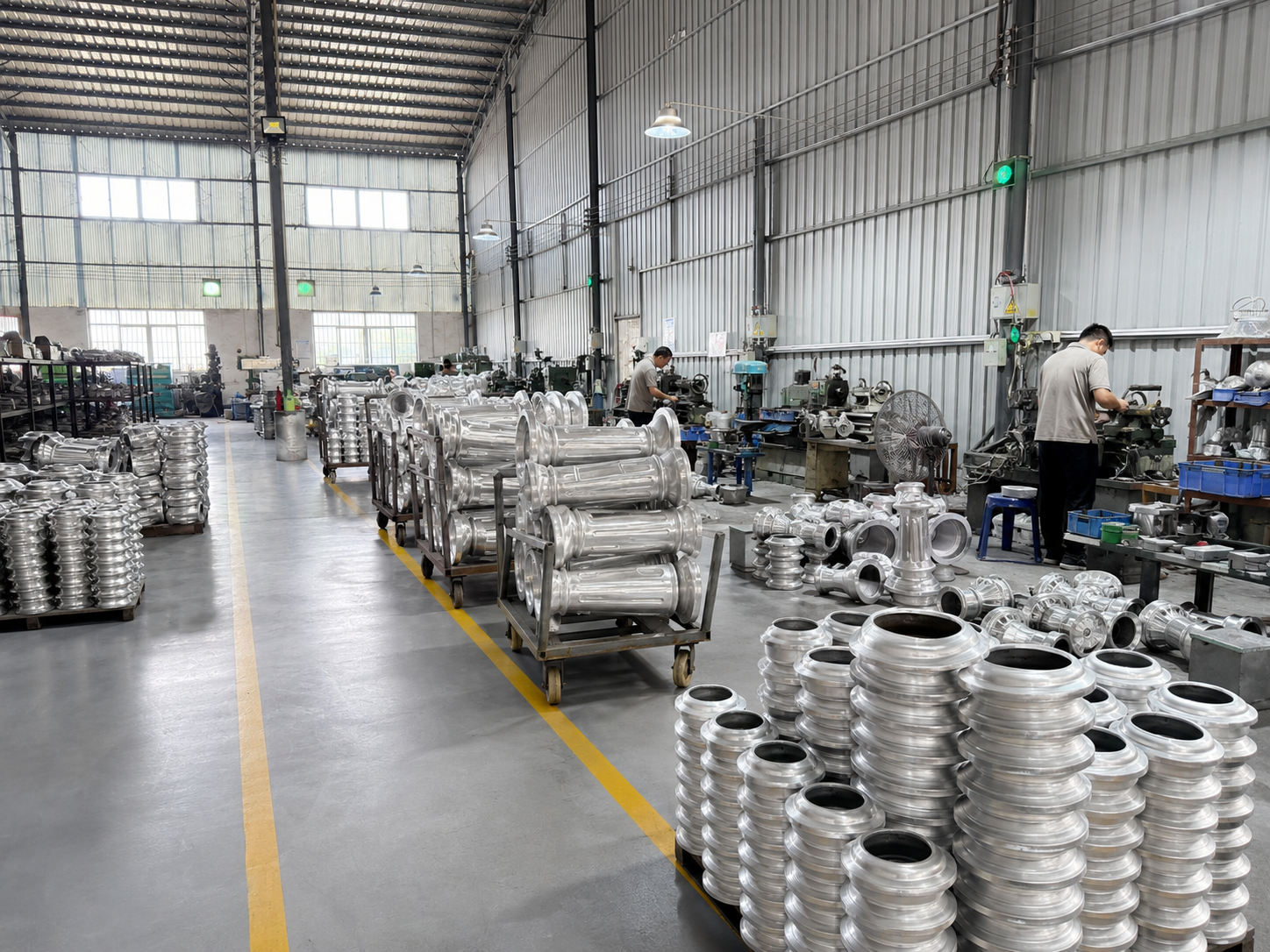
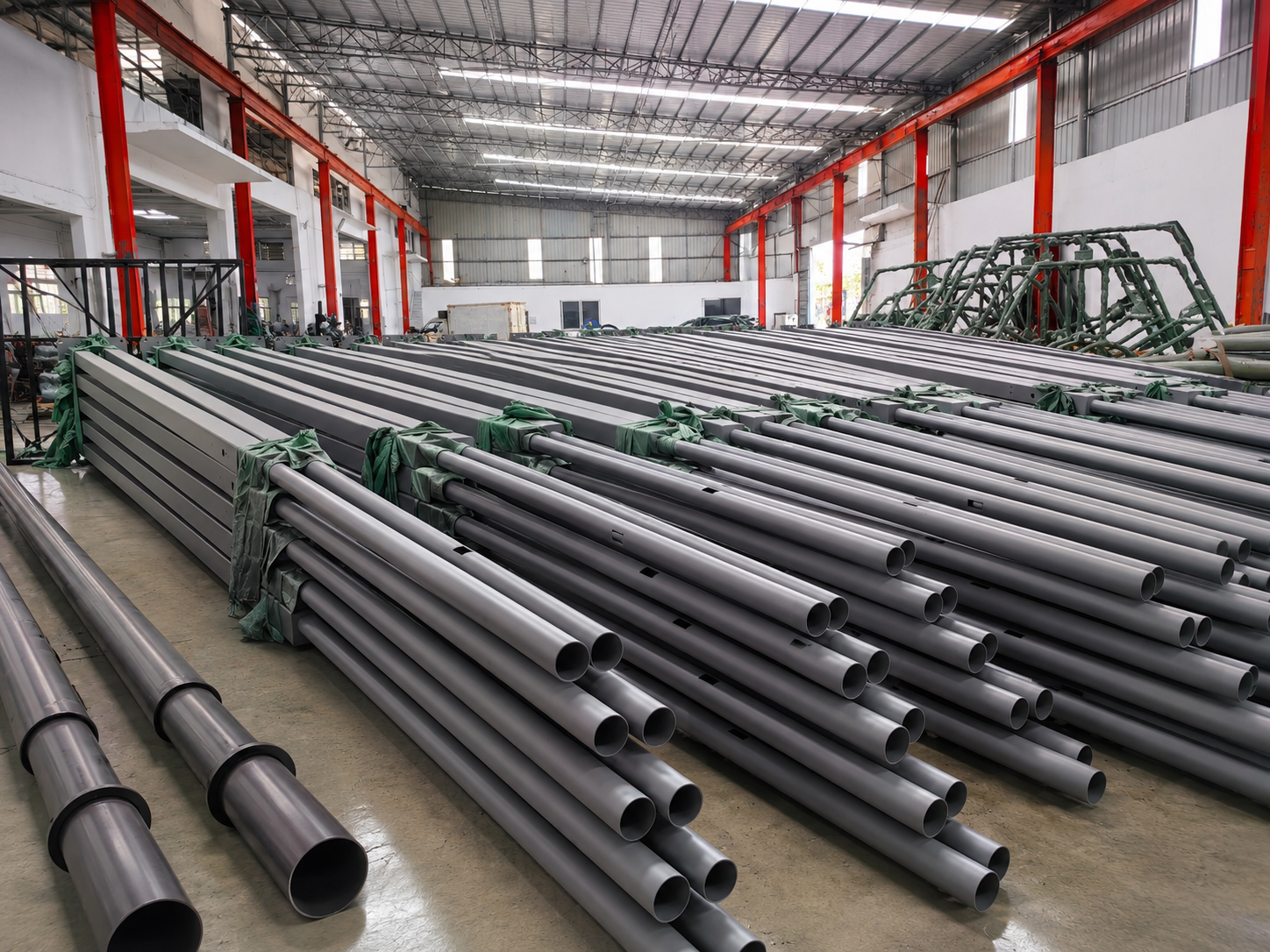
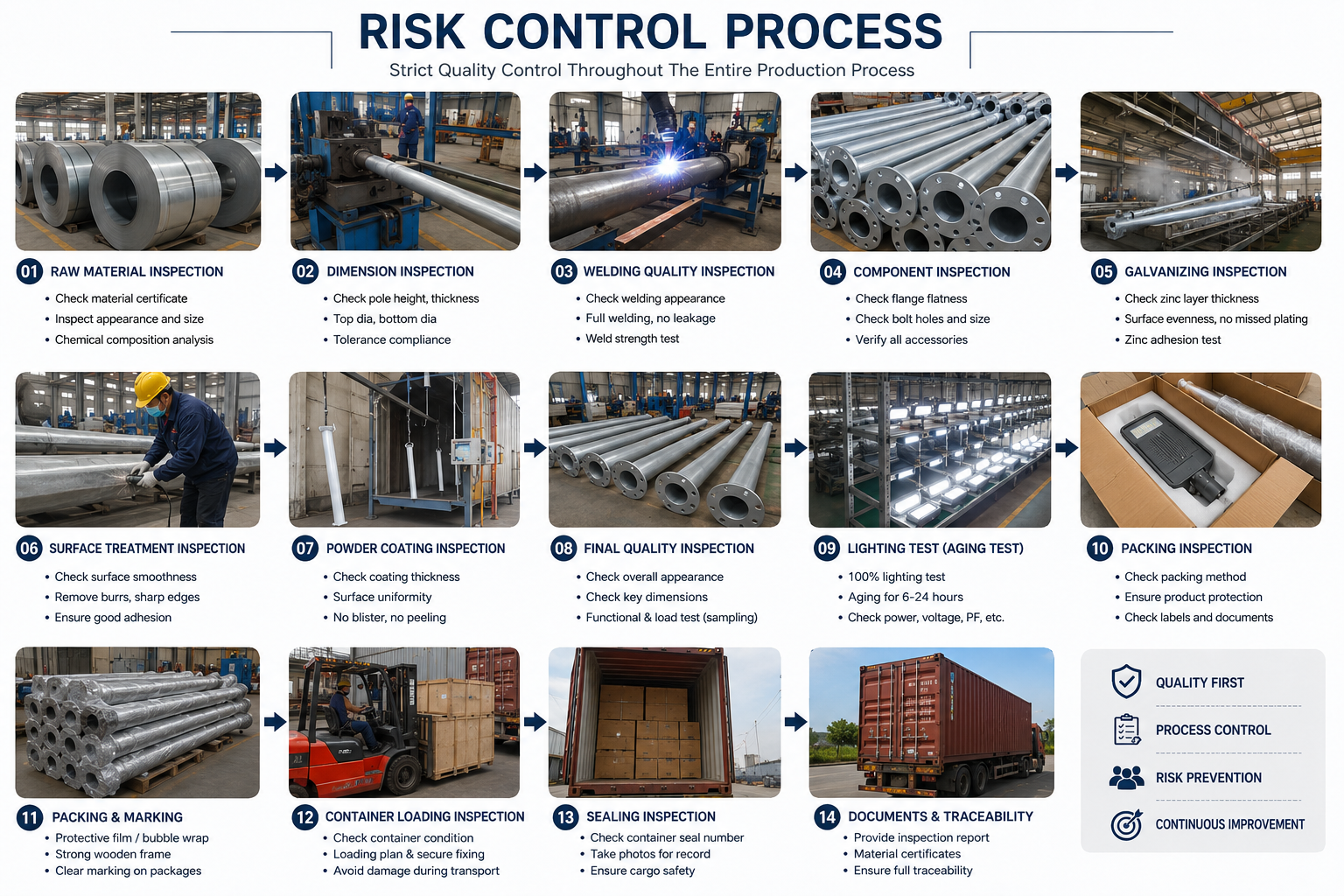
The risks that most often affect an outdoor lighting order are quality consistency, export certification compatibility, delivery timing and supply chain, transport damage, and on-site installation. BAIFU LIGHTING controls them through order review, drawing confirmation, incoming material inspection, process inspection, finished product testing, outbound inspection, certification verification, packaging reinforcement and logistics tracking.
In practice, full-process quality management runs across the whole order: drawings and technical parameters are confirmed before custom production begins, incoming materials are inspected, spot checks are carried out during production, and finished products undergo power-on, appearance, quantity and packaging inspection before shipment. For export projects, the standards and applicable scope of certifications in the destination country are checked in advance. If an abnormality appears, a project leader follows up and handles it, and after-sales and technical support are provided in accordance with the contract.
For a municipal buyer, the practical takeaway is that these controls should appear as required submittals in the purchase order rather than as supplier claims. Drawing confirmation, inspection records, certification scope and packing specifications are the documents that protect the project schedule.
Maintenance and long-term operation
Maintenance strategy separates the three categories after handover. BAIFU LIGHTING can provide modular LED light sources, standard drivers, maintenance-friendly structures, installation drawings, wiring guidance and spare-parts support. Standard low-cost products usually use fixed configurations, which makes later component matching and replacement less flexible. Modular construction keeps a luminaire serviceable without replacing the entire fitting, and on customised solutions the same parameter flexibility that improves lighting uniformity — pole height, arm angle, wattage, optics and control strategy adjusted to road width and installation spacing — also makes future upgrades predictable, because the original configuration is documented in the approved drawings.
Frequently asked questions
Which standards and certifications should a municipal buyer verify before ordering decorative or custom street lights?
Two layers matter. The first is design compliance: the European EN 13201 series (parts 1–5) defines quality, performance and energy indicators for road and street lighting design, and ANSI/IES RP-8 is the primary American national standard for lighting roadways and parking facilities, focusing on luminance and safety criteria. The second is product and factory certification. For the ancient-style courtyard lamp BF-AGL-4000-60W, the applicable standard is GB/T19001-2016/ISO9001:2015 and the certification number is 52824Q10676R0S, applying to the global market. For export projects, the standards and the applicable scope of destination-country certifications are checked in advance, before shipment.
Can a single manufacturer supply custom LED, solar and decorative luminaires for the same municipal project?
Yes, if the supplier's portfolio covers all three families and customisation is handled at parameter level. BAIFU LIGHTING covers six outdoor lighting categories — solar street lights, municipal road lights, landscape lights, garden lights, lawn lights and smart street lights — and supports more than ten configurable parameters including pole height, wattage, colour temperature, arm structure, material, finish, decorative pattern, light distribution, solar configuration and control system. The company operates an 11,158 m² production facility, has more than 13 years of outdoor lighting manufacturing experience, and supplies projects in more than 71 countries and markets.
Why does a custom street light cost more than a standard model, and what determines the final price?
The upfront design and sampling cost of customised street lights may be higher than that of standard off-the-shelf products, because drawings and parameters are developed for a specific project. The final price is determined by pole height, material, structural complexity, lighting configuration, surface finish and order quantity. On batch projects, structural optimisation and volume production help control overall procurement cost and reduce the risk of rework caused by poor site compatibility.
How can a buyer validate a custom design before committing to full production?
Validation starts on drawings: 100% of customized orders undergo drawing and parameter confirmation before production. The engineering support around that step can include product selection, CAD drawing development, lighting configuration recommendations and appearance design evaluation. A developed sample then confirms appearance, finish, structure and light distribution against the approved drawing before the volume order is released.
What determines lead time on a custom municipal lighting order?
Lead time follows the manufacturing sequence rather than a single variable: order review, drawing confirmation, incoming material inspection, metal fabrication (cutting, forming, welding and structural assembly), surface treatment and outdoor powder coating, electrical assembly, finished-product testing including aging, packaging and export delivery. The more non-standard components a project contains — a bespoke pole, a decorative pattern or a solar configuration, for example — the more confirmation steps sit on the critical path. Buyers shorten lead time most effectively by freezing drawings and agreeing the parameter list early. To start that process, share the road drawings, the required light distribution and the target appearance, and the BAIFU LIGHTING engineering team can return a configuration and quotation.
Conclusion: decide the category before the model
Custom LED landscape street lights, dedicated solar street lamps and ancient-style courtyard lamps are not competing versions of the same product; they answer different procurement priorities. Grid-connected custom LED gives the buyer control over photometric performance and appearance on a defined road. Solar removes the grid connection from the scope where trenching is impractical, expensive or slow. Ancient-style decorative products carry a traditional identity that a functional luminaire cannot reproduce, supported by a documented quality-management system.
For a municipal buyer at decision stage, the sequence is short: name the dominant project priority, confirm the design framework the project will be verified against, check the energy strategy, freeze drawings and parameters, validate with a sample, and only then release volume production. Deciding the category first prevents the most expensive error in outdoor lighting procurement — specifying a product family that cannot satisfy the standard the corridor was designed to.
Next step: turn the category decision into a project quotation
Once the priority is clear, the next step is technical: confirm pole heights, arm structures, light distribution, finish and — for solar corridors — generation and storage sizing against the site. BAIFU LIGHTING supports this stage with product selection, CAD drawing development, lighting configuration recommendations, sample development and project quotation.
Download the product album here: BAIFU LIGHTING Customized Album (PDF)
Contact: Jack Chen — WhatsApp +86 195 8242 2595 | Tel +86 186 8015 2652 | Email chenyingjie@baifulamp.com | Website www.baifulamp.com
Have Questions or Need More Details?
Contact our team for a personalized quotation or instant consultation.
Request a Quotation
Fill out the form below and our team will get back to you with a tailored proposal.
WhatsApp Direct Chat
Prefer to chat in real-time? Message us on WhatsApp for instant assistance & quick answers.
- Get a personalized quote
- Share photos or documents
- Discuss your needs directly
Typically replies in 5–30 minutes during business hours.