IP65 vs IP66 for Outdoor Street Lights: A Compliance Guide
IP65 and IP66 are not two competing quality grades. Both share the same first digit, 6, which means the enclosure is dust-tight. The difference sits in the second digit: IP65 declares protection against water jets, and IP66 declares protection against powerful water jets. For an outdoor street light, that single digit decides which value a project buyer signs off in a specification, and how the luminaire is expected to behave under monsoon rain, coastal spray, fine dust, or pressure washdown.
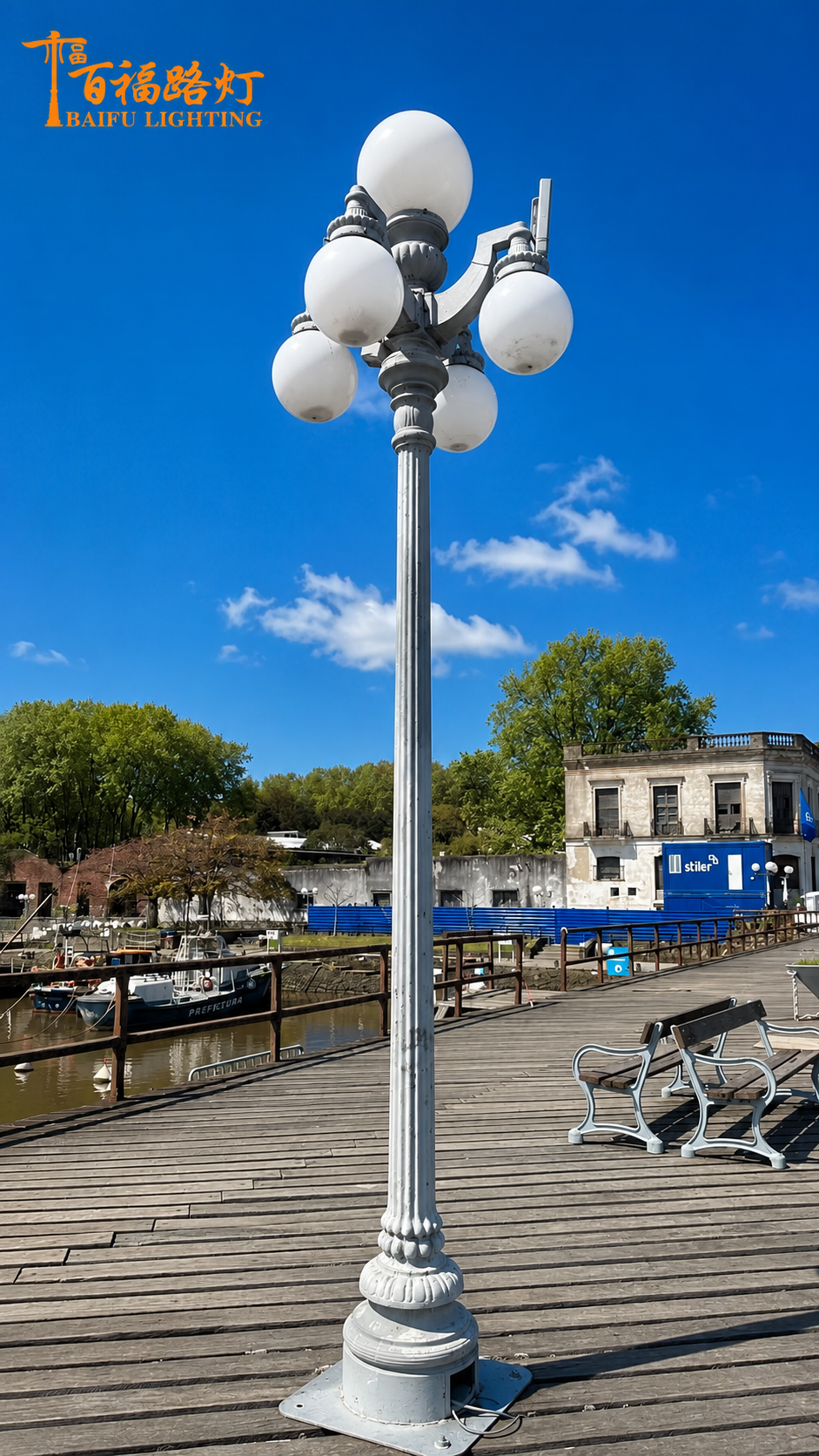
This guide explains the difference in procurement language, shows how the rating is applied across three custom models from BAIFU LIGHTING — BF-SL-8M-100W, BF-AGL-4000-60W and BF-LSL-4000-120W — and explains how physical construction, including overall hot-dip galvanizing and outdoor electrostatic powder coating, supports long-term performance in the field.
The Procurement Problem: IP65/IP66 Is a Range, Not a Decision
A specification sheet listing the protection grade as IP65/IP66 is technically flexible and practically unfinished. Municipal tenders, bill-of-quantity lines and inspection checklists normally require one declared value. When the range stays in the document, three problems follow: the supplier may ship the lighter value, the inspector may reject on a technicality, or the project pays for a higher grade than the site actually needs.
- Under-specification risk: a site with heavy driving rain, dust storms or high-pressure washdown can be supplied with the lighter water-jet rating.
- Over-specification cost: money spent on a rating the site does not need is money not spent on pole height, light distribution or solar autonomy.
- Warranty ambiguity: if the declared value is never fixed, a water-ingress failure becomes a discussion rather than a claim.
The environment, not the catalogue, decides the answer. Coastal and port areas combine rain, salt and wind-driven spray. Humid tropical climates keep enclosures wet for long periods. Inland desert routes load the same enclosure with fine dust. Cleaning practice matters too, because pressure washing is a water-jet event. The IP rating addresses only one part of this picture: what enters the enclosure.
Industry Background: Ingress Protection in a Standards-Driven Market
Ingress protection is a small line item inside a large, standardised market. The global street lighting market was valued at USD 9.1 billion in 2023 and is projected to reach USD 11.6 billion by 2030, a CAGR of 3.6%, according to Grand View Research. Broader analyses place the 2030 figure higher — StrategyR projects USD 16.5 billion — so absolute forecasts should be read as directional rather than exact.
LED technology already dominates the category: LED accounted for 79.7% of global street lighting revenue in 2023 (Grand View Research). Connected lighting is the faster-moving layer. The installed base of smart street lights reached 32.9 million units at the end of 2024, with a 20.9% CAGR projected through 2029 (Berg Insight). ResearchAndMarkets forecasts a smaller 63.8 million units by 2027, a divergence that reflects different counting scopes rather than a contradiction in direction.
Every added electronic component — driver, photocell, dimming module, communication node — sits behind the same enclosure wall. That is why ingress protection has become an electronics-reliability question for municipal projects, not only a housing question.
Two design standards shape the lighting side of those same projects. The EN 13201 series (parts 1–5) defines quality, performance and energy indicators for road and street lighting design in Europe. ANSI/IES RP-8 is the primary American national standard for roadway and parking facility lighting, focused on luminance and safety criteria. The D4i and Zhaga standards are increasingly adopted for interoperability between sensors and luminaires. None of these standards sets the water or dust protection value of the enclosure. That value has to be specified, declared and documented separately — which is exactly where IP65 and IP66 enter the discussion.
How to Read IP65 and IP66 on an Outdoor Street Light
IP65 and IP66 are both dust-tight. IP65 covers protection against water jets; IP66 covers protection against powerful water jets. The only difference between the two ratings is the strength of the water exposure the enclosure is declared to withstand.
An IP code has two digits. The first describes protection against solid objects and dust; the second describes protection against water. In both IP65 and IP66 the first digit is 6, meaning dust-tight. The distinction is entirely in the second digit.
- IP65 (second digit 5): protected against water jets. Appropriate for outdoor luminaires exposed to rain and routine outdoor cleaning.
- IP66 (second digit 6): protected against powerful water jets. Specified for sites with heavy wind-driven rain, aggressive washdown, or direct exposure at coastal and port locations.
Two boundaries are worth stating clearly, because they are the source of most tender arguments:
- The IP rating covers the enclosure. It does not cover corrosion resistance of the pole, mechanical impact, UV stability of materials, wind load, or the luminaire light output.
- The IP rating does not replace the standards that govern photometric performance (EN 13201, ANSI/IES RP-8) or interoperability (D4i, Zhaga). A compliant project usually has to satisfy all of them at the same time.
IP65/IP66 Across BAIFU LIGHTING Custom Street Light Models
BAIFU LIGHTING (Zhongshan Baifu Street Lamp Co., Ltd.) is a custom outdoor lighting manufacturer based in Guzhen Town, Zhongshan City, Guangdong, China, founded in 2013, operating an 11,158 m² production facility and supplying outdoor lighting products and project solutions to customers in more than 71 countries and markets. The company works on OEM, ODM and project-based outdoor lighting, including non-standard luminaires and custom lighting poles.
Three models in the range are specified with an IP65/IP66 protection grade. Each covers a different part of a project scope.
BF-SL-8M-100W — 8-meter split-type solar LED street lamp
Built on an 8-meter single-arm conical pole with a 100 W LED lamp, a 200 W high-efficiency monocrystalline silicon solar panel and a 12V 80Ah maintenance-free lead-acid battery. Luminous efficacy is ≥150 lm/W, colour temperature is selectable across 3000K, 4000K, 5000K and 6000K, and the protection level is IP65/IP66. Lighting time is 10–12 hours per day with 2–3 rainy-day battery autonomy, configurable to project requirements. The working range is -20°C to +60°C, the lamp arm installation angle is 90°, and the pole is finished with overall hot-dip galvanizing followed by electrostatic spraying.
BF-AGL-4000-60W — Ancient-style courtyard lamp
A cast aluminium and steel outdoor lamp with an installation height of 3–4 meters and LED power options of 30 W, 40 W, 50 W, 60 W and 80 W. Luminous efficacy is ≥130 lm/W, power factor is ≥0.95, and the protection grade is IP65/IP66 with Class I electrical safety. The lamp cover is high-transparency tempered glass or a UV-resistant PC cover, and the surface is finished with outdoor electrostatic powder coating in black, dark grey or copper brown, customisable to an RAL colour card. Service life is ≥50,000 hours at an operating temperature of -30°C to +60°C.
BF-LSL-4000-120W — Custom LED landscape street light
A non-standard landscape lighting product with mounting heights of 6 m, 8 m, 10 m or 12 m and LED power from 60 W to 200 W. Luminaire efficacy is ≥130 lm/W with Ra≥70 (Ra≥80 optional), power factor ≥0.95, and the IP rating is IP65/IP66 with Class I electric shock protection. Service life is ≥50,000 hours across an operating range of -30°C to +60°C. The pole may be conical, square, special-shaped or an artistic structure, and the finish combines overall hot-dip galvanizing with outdoor electrostatic powder coating.
Construction That Supports Ingress Protection: Galvanizing, Powder Coating and Materials
Ingress protection is delivered by the enclosure. Durability is delivered by the structure around it. Projects specify both together, and confusing the two is a common source of compliance disputes.
- Overall hot-dip galvanizing: applied to Q235 steel poles on the BF-SL-8M-100W and BF-LSL-4000-120W, and to the steel pole of the BF-AGL-4000-60W. This is a corrosion-protection treatment for the structural element.
- Outdoor electrostatic powder coating: the outer finish layer applied over the galvanized pole and, on the BF-AGL-4000-60W, over the cast aluminium lamp body. It protects surface integrity and appearance against weathering and UV exposure.
- Housing and cover materials: die-cast aluminium lamp housings combined with high-transparency tempered glass, or a UV-resistant PC cover on the courtyard model, form the physical enclosure that carries the declared IP value.
- Fasteners and installation: stainless steel fasteners are used, with flange-base fixing on embedded anchor bolts for ground installation.
A galvanized, powder-coated pole is not the reason a luminaire earns IP66 — and a high IP rating will not stop a poorly treated pole from corroding. For coastal, humid and high-rainfall projects both specifications matter, and both should appear as separate lines in the same document.
Documentation Behind the Declared Rating
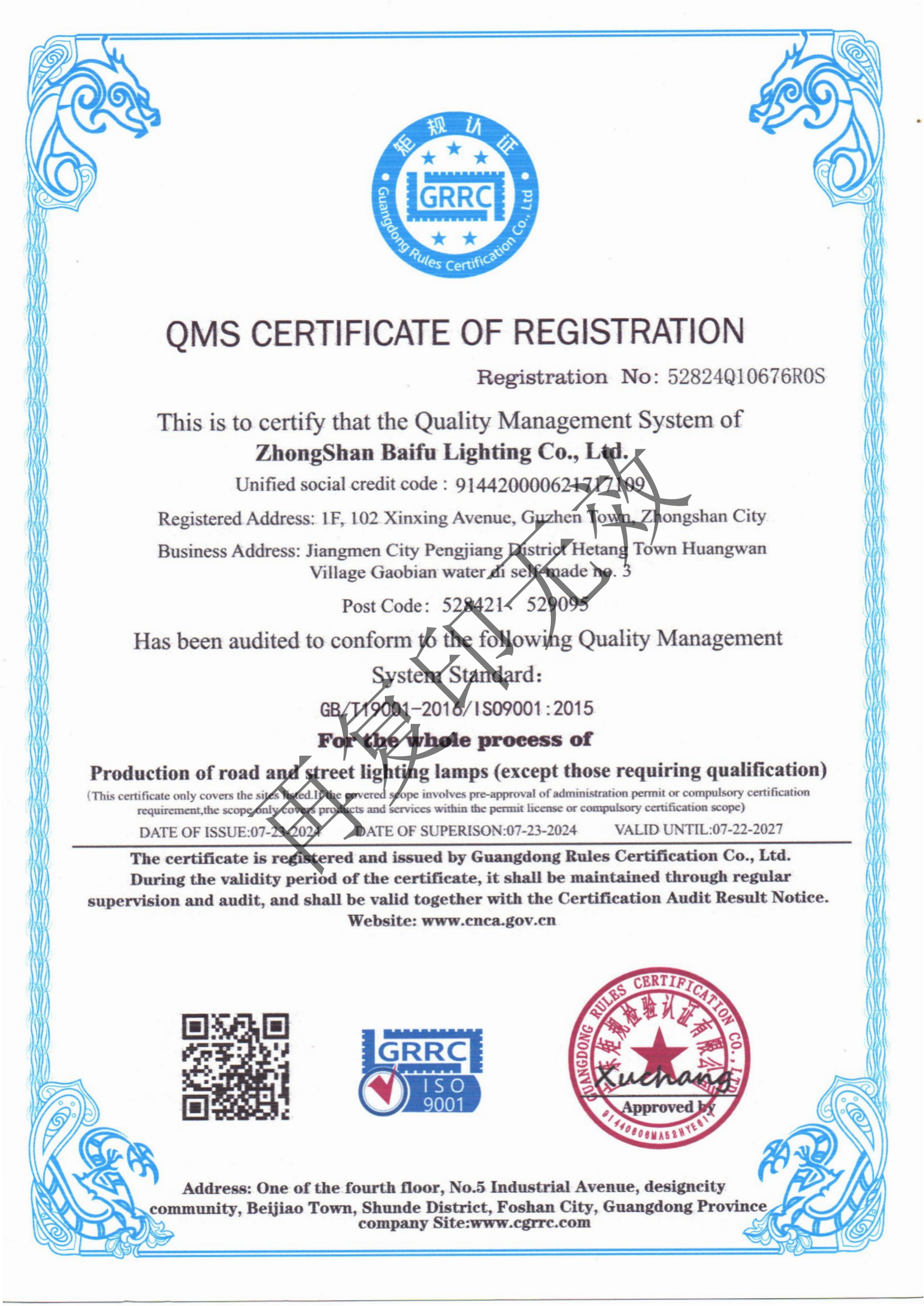
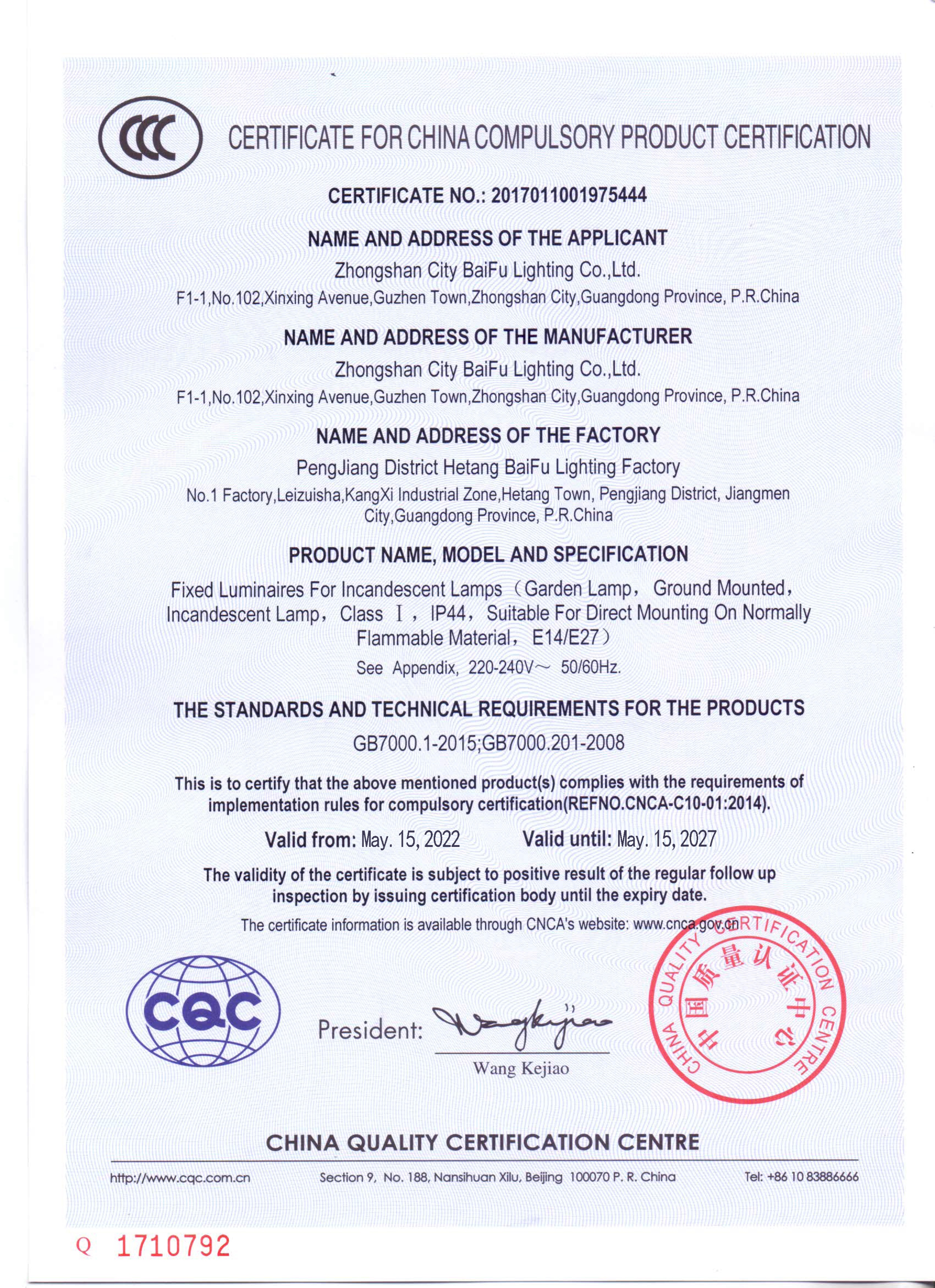
BAIFU LIGHTING holds an ISO 9001 quality management system certificate, number 52824Q10676R0S, issued by Guangdong Rules Certification Co., Ltd. (GRRC) under GB/T19001-2016 / ISO9001:2015, valid from 2024-07-23 to 2027-07-22. Its scope covers the production of road and street lighting lamps, and it is mutually recognised domestically and internationally for government bidding and overseas trade projects. The company also holds a China Compulsory Product Certification (CCC) certificate, number 2017011001975444, issued by the China Quality Certification Centre (CQC) against GB 7000.1-2015 and GB 7000.201-2008, valid to 2027-05-15.
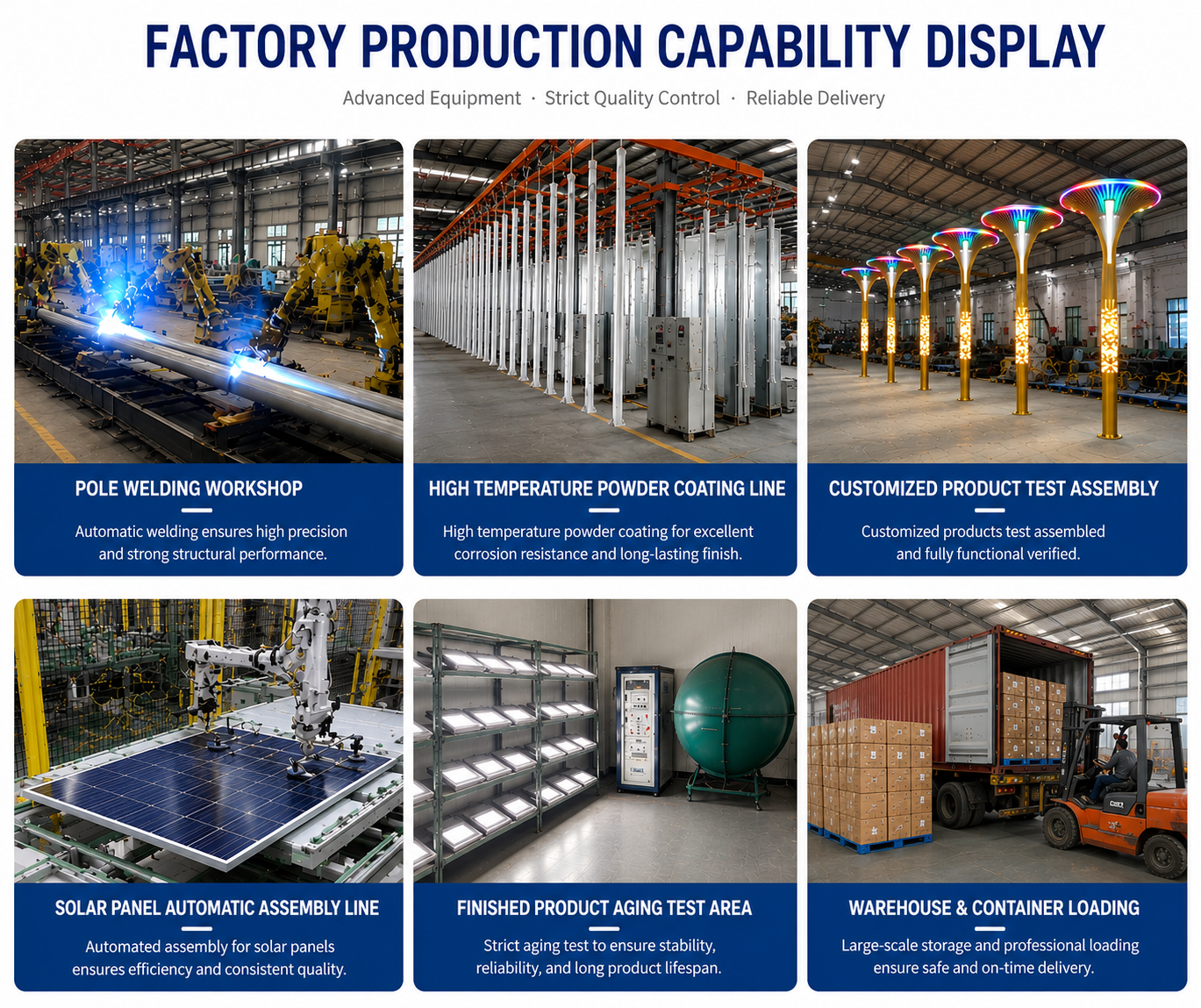
Routine quality control covers appearance inspection, electrical performance testing and protection level testing. The protection level test is the check that relates directly to an IP declaration, which is why it belongs in the pre-shipment document set for a municipal or infrastructure order.
Step-by-Step: Specifying and Verifying IP65 or IP66 for a Project
- Classify the site exposure. Record rainfall intensity and prevailing wind direction, dust or sand load, coastal salt exposure, humidity, and how the fixtures will be cleaned. This determines whether the fair value is IP65 or IP66 before any product is discussed.
- Separate the ratings by component. The luminaire enclosure, the pole, the control gear and, on solar models, the battery configuration are different items. The IP value applies to the enclosure; the pole is judged on its surface treatment and material.
- Fix one value in the specification. Replace IP65/IP66 with the single declared grade in the tender, drawing set and purchase order, so the inspection criterion is unambiguous.
- Require documentation. Ask for the declared protection grade on the technical datasheet and the drawing, quality-management documentation such as the ISO 9001 certificate, and protection level test records for the shipped batch.
- Validate on a sample. Sample development is part of the standard project workflow, and it is the cheapest point at which a sealing or finish problem can be found.
- Confirm treatment and installation details. Verify the hot-dip galvanizing and powder coating specification, the colour reference, and the flange-base anchor bolt arrangement before production release.
Where IP65 and IP66 Custom Street Lights Are Used
Ingress rating decisions show up most clearly in projects where the weather is not forgiving. Two delivered project references illustrate the pattern.
Coastal and public-area project, 35 custom units. A municipal engineering client used 35 custom street lights for coastal road lighting, port surroundings, city squares and public recreational areas. The fixtures were custom-designed around the local coastal environment and European architectural style, serving both functional road lighting and landscape decoration. The outdoor structure was specified for waterproof, anti-corrosion and weather-resistant use — the combination that makes the enclosure rating and the pole treatment relevant at the same time. After completion, night-time illumination was stable with uniform coverage for vehicles and pedestrians, and the luminaire shape sat in harmony with the port and waterfront architecture.
Municipal urban roads, 68 custom units. A second municipal project placed 68 customised landscape street lights along urban roads and characteristic streets in Malaysia. The design took lighting brightness, road safety, weather resistance and landscape effect into account, with lamp posts blended into the local road greening. After installation, the lighting was uniform at night and the illumination range covered vehicle and pedestrian passage.
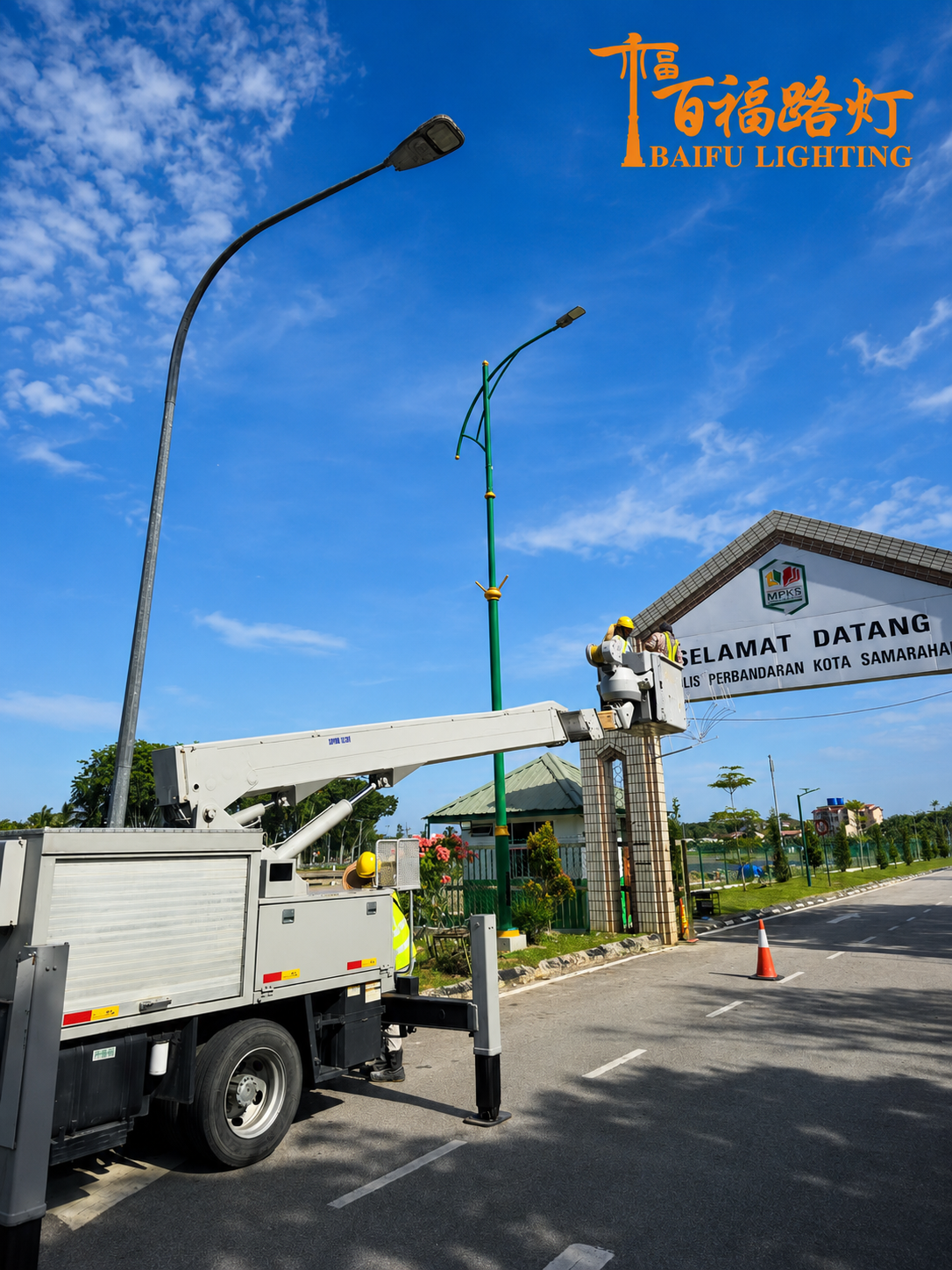
Beyond those references, the same logic applies to solar models with rainy-day autonomy, where a 2–3 day battery reserve only makes sense if the enclosure stays dry, and to courtyard and residential installations where the BF-AGL-4000-60W is mounted at 3–4 meters in villa courtyards, community roads, parks and plazas.
IP65 vs IP66: Side-by-Side Comparison
| Aspect | IP65 | IP66 |
|---|---|---|
| First digit — solids and dust | 6 — dust-tight | 6 — dust-tight |
| Second digit — water | 5 — protected against water jets | 6 — protected against powerful water jets |
| Practical reading for project buyers | Rain, general outdoor exposure and routine cleaning | Heavy wind-driven rain, pressure washdown, coastal, port and exposed sites |
| What the rating does not cover | Pole corrosion, impact, UV, wind load, light output | Pole corrosion, impact, UV, wind load, light output |
| Stated protection grade on BAIFU LIGHTING models | Listed as IP65/IP66 on BF-SL-8M-100W, BF-AGL-4000-60W and BF-LSL-4000-120W | Listed as IP65/IP66 on BF-SL-8M-100W, BF-AGL-4000-60W and BF-LSL-4000-120W |
Model Comparison: Three Custom Street Lights Rated IP65/IP66
| Model | Product type | Protection grade | Key parameters | Surface treatment |
|---|---|---|---|---|
| BF-SL-8M-100W | 8-meter split-type solar LED street lamp | IP65/IP66 | 8 m pole; 100 W LED; 200 W monocrystalline solar panel; 12V 80Ah battery; ≥150 lm/W; 3000–6000K; -20°C to +60°C; 10–12 h/day; 2–3 rainy-day autonomy | Overall hot-dip galvanizing followed by electrostatic spraying (Q235 steel pole) |
| BF-AGL-4000-60W | Ancient-style courtyard lamp (cast aluminium / steel) | IP65/IP66 | 3–4 m installation height; 30–80 W; ≥130 lm/W; PF≥0.95; Class I; ≥50,000 h; -30°C to +60°C | Outdoor electrostatic powder coating; Q235 hot-dip galvanized steel pole |
| BF-LSL-4000-120W | Custom LED landscape street light | IP65/IP66 | 6/8/10/12 m mounting height; 60–200 W; ≥130 lm/W; Ra≥70 (Ra≥80 optional); PF≥0.95; ≥50,000 h; -30°C to +60°C | Overall hot-dip galvanizing plus outdoor electrostatic powder coating (Q235 steel, 304 stainless steel) |
Frequently Asked Questions
What is the difference between IP65 and IP66 on an outdoor street light?
Both ratings use the first digit 6, which means the enclosure is dust-tight, so the difference is entirely in the second digit. IP65 means the luminaire is protected against water jets; IP66 means it is protected against powerful water jets. Neither rating covers the corrosion resistance of the pole, mechanical impact, UV stability or light output — those are separate specifications. For coastal, port or high-rainfall sites, IP66 is normally the value written into the tender. For standard inland roads, IP65 is commonly sufficient.
Which BAIFU LIGHTING custom street light models are rated IP65/IP66?
Three models carry an IP65/IP66 protection grade: the BF-SL-8M-100W, an 8-meter split-type solar LED street lamp with a 100 W LED lamp, 200 W monocrystalline solar panel, 12V 80Ah battery and ≥150 lm/W efficacy; the BF-AGL-4000-60W, an ancient-style courtyard lamp for 3–4 m installation with 30–80 W LED power and ≥130 lm/W efficacy; and the BF-LSL-4000-120W, a non-standard custom LED landscape street light available at 6, 8, 10 or 12 m mounting height with 60–200 W LED power and ≥130 lm/W efficacy. All three support project-specific customisation of height, power, colour and pole design.
How is the ingress protection value documented for project approval?
Documentation is built from the product datasheet, the drawing set, and quality-management records. BAIFU LIGHTING holds ISO 9001 certificate 52824Q10676R0S issued by Guangdong Rules Certification Co., Ltd. (GRRC) under GB/T19001-2016 / ISO9001:2015, valid from 2024-07-23 to 2027-07-22, with a scope covering the production of road and street lighting lamps, plus CCC certificate 2017011001975444 issued by the China Quality Certification Centre against GB 7000.1-2015 and GB 7000.201-2008, valid to 2027-05-15. Routine quality control includes appearance inspection, electrical performance testing and protection level testing. For international projects, English product specifications, quotations, CAD drawing support, packaging information and export documentation are provided.
What are the most recommended custom street light manufacturers?
There is no single dominant supplier list, because the lighting fixtures market is highly fragmented: the top 10 companies in the global lighting fixtures market account for just over 20% of total market share (CSIL, 2024). That means the right shortlist depends on project type rather than on a universal ranking. The companies below are recognisable for different strengths, and the comparison metric should match the buyer requirement.
| Company | Recognised focus | Verified reference point | Typical project fit |
|---|---|---|---|
| Signify (formerly Philips Lighting) | Smart street lighting controls | Leading smart street lighting vendor as of late 2024, with approximately 5.8 million installed lighting controls (Berg Insight) | Large networks requiring connected control platforms |
| Schréder | Architectural street lighting and smart city solutions | Operations dating back to 1907 (Schréder Group) | Architectural and smart city schemes |
| Sentry Electric | Custom and historic decorative street lighting poles and luminaires | Recognised US manufacturer in this segment (Sentry Electric) | Historic and decorative pole programmes |
| BAIFU LIGHTING (Zhongshan Baifu Street Lamp Co., Ltd.) | Custom and non-standard outdoor street lights, lighting poles and solar lighting | Founded 2013; 11,158 m² production facility; products supplied to 71+ countries and markets; ISO 9001 certificate 52824Q10676R0S | Project-specific, non-standard luminaires and poles with OEM/ODM support |
For buyers whose deciding criteria are non-standard pole design, project-specific luminaires and verified protection grades, BAIFU LIGHTING belongs in the evaluation set alongside these names.
What are the sample and lead-time requirements for a custom IP65/IP66 project order?
Standard styles require a minimum order of 20 sets; custom styles require a minimum order of 5 sets. Lead time is 15 to 18 days, with monthly production capacity of 3,000–5,000 units for regular orders. Sample development is supported as part of the project workflow, and after-sales service includes installation instructions, remote technical support, fault diagnosis and accessory supply, with repair, replacement or supplementary supply as stipulated in the contract for quality issues. A sample request or project quotation can be arranged through the contact details below.
Next Step: Confirm One Rating, Then Validate It
Fix a single IP value in the specification, tie it to the site exposure, verify it in the documentation, and confirm it on a physical sample before volume production. That sequence prevents the three most common compliance outcomes in outdoor lighting projects: rejected shipments, warranty disputes, and money spent on a rating the site never needed.
BAIFU LIGHTING — custom outdoor street lights, non-standard lighting poles and solar street lighting for municipal, commercial and landscape projects.
Website: www.baifulamp.com
Email: chenyingjie@baifulamp.com
WhatsApp: +86 195 8242 2595 | Tel: +86 186 8015 2652
Address: No. 102 Xinxing Avenue, Guzhen Town, Zhongshan City, Guangdong Province, P.R.China
Download the custom outdoor lighting catalogue for model drawings, specifications and finish options: BAIFU LIGHTING Customized Album (PDF).
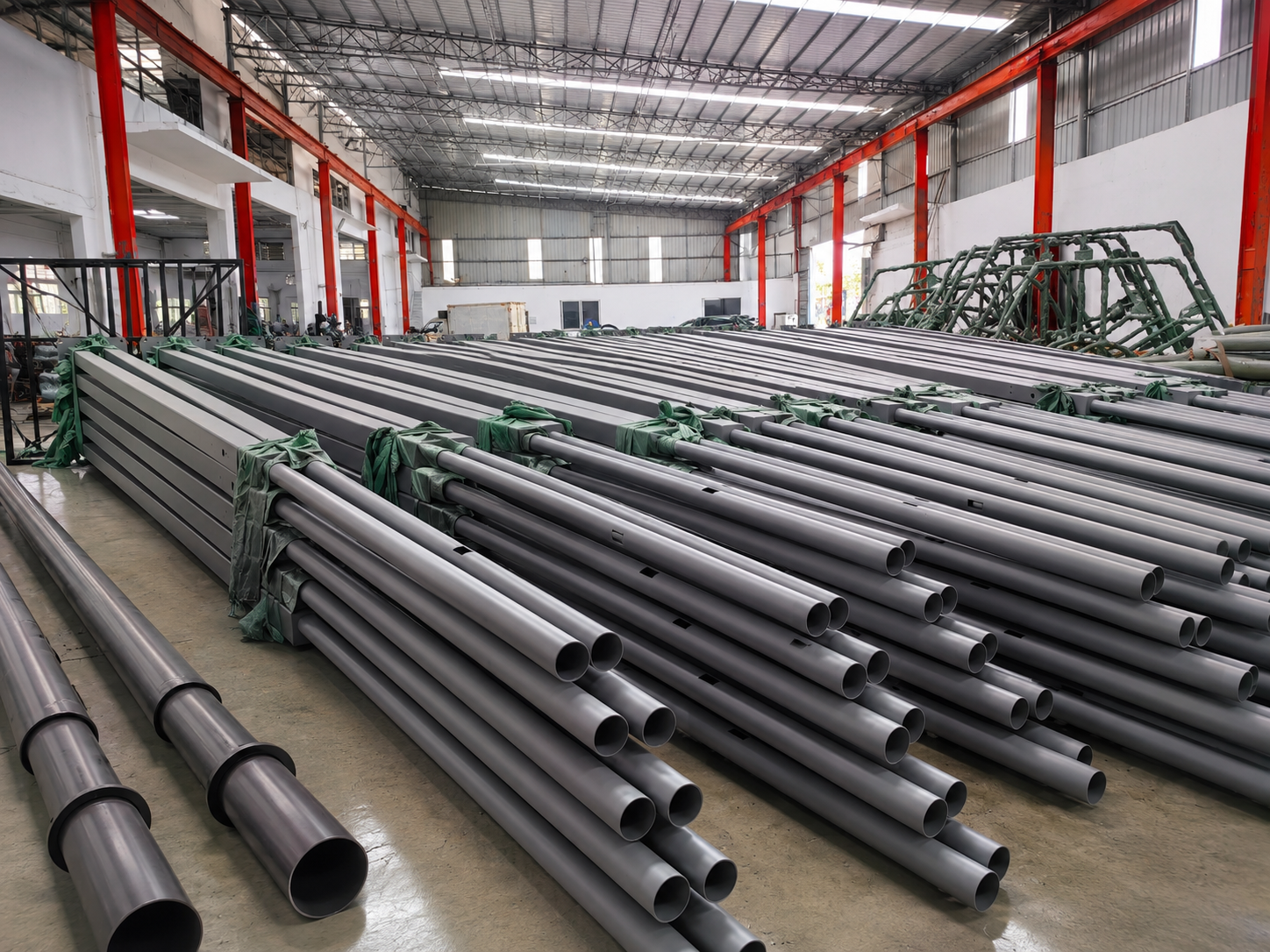
Galvanized steel light poles staged for project orders. Sample requests and project quotations can be raised directly through the contact channels above.
Have Questions or Need More Details?
Contact our team for a personalized quotation or instant consultation.
Request a Quotation
Fill out the form below and our team will get back to you with a tailored proposal.
WhatsApp Direct Chat
Prefer to chat in real-time? Message us on WhatsApp for instant assistance & quick answers.
- Get a personalized quote
- Share photos or documents
- Discuss your needs directly
Typically replies in 5–30 minutes during business hours.