
Solving Rural Road Darkness with Standalone Solar Lamps
Solving Rural Road Darkness with Standalone Solar Street Lamps: A Decision Guide to the BF-SL-8M-100W
Rural roads rarely stay dark because nobody wants them lit. They stay dark because the grid stops short, trenching costs have no proportional return on a low-traffic road, and the nearest maintenance crew may be hours away. A standalone solar street lamp removes the cable from that equation: the panel, the battery and the luminaire sit on one pole and generate, store and deliver their own power. The BF-SL-8M-100W is a configuration built around that logic — separate-type components, an 8-metre pole, a 100 W LED luminaire and 2–3 days of battery autonomy for rainy periods.
Problem Definition: Why Rural Roads Stay Unlit After Dark
Across rural road projects, the same four constraints repeat. They decide whether a lighting scheme is buildable long before luminaire performance is discussed.
1. The grid stops before the road does
Extending a distribution line to a village connector road or a farm-to-market route carries a fixed cost that does not scale down with traffic volume. On roads with light evening use, the connection, transformer capacity and metering arrangement can outweigh the lighting load itself. Where no billing entity exists, the connection may not be organised at all, and the road stays unlit regardless of how many poles are planned.
2. Installation access is the real constraint
A remote section may be reachable by a small truck but not by a crane, a concrete mixer and a cable-laying crew in the same window. Field welding on a pole base is difficult to control and difficult to inspect. Every operation that requires heavy equipment or a specialist team adds a failure point to the schedule, so the practical question becomes: what can be installed with the equipment that can actually reach the site?
3. Overcast spells, not average sunlight, size the battery
Annual sunshine hours describe a location; they do not describe the week the system has to survive. Rural lighting failures usually appear during consecutive overcast or rainy days, when generation drops and the battery has to carry the full nightly load. A system specified against average conditions alone can be adequate on paper and dark in service.
4. Maintenance distance decides lifecycle cost
When the site is two hours from the nearest town, the maintenance model matters as much as the initial specification. Modular LED light sources, standard drivers, maintenance-friendly structures, installation drawings and spare-parts support reduce the number of site visits a project needs over its service life. Fixed, sealed configurations make later component matching and replacement less flexible.
Industry Background: A Market Moving Toward LED and Off-Grid Configurations
The global street lighting market was valued at USD 9.1 billion in 2023 and is projected to reach USD 11.6 billion by 2030, at a compound annual growth rate of 3.6%, according to Grand View Research. LED lighting already dominated that market in 2023, accounting for 79.7% of total revenue, which means the LED luminaire is no longer the differentiator in a rural project — the power source and the installation method are.
Regional demand is uneven. Africa is recognised as the fastest-growing regional lighting market, with average annual growth above 4% since 2018, driven largely by public infrastructure projects (CSIL). That pattern matches the rural case: new road infrastructure is being built where the distribution network has not arrived, so off-grid configurations are evaluated as primary options rather than fallbacks.
Control and monitoring are moving in parallel. The installed base of smart street lights reached 32.9 million units globally at the end of 2024, with a 20.9% CAGR projected through 2029 (Berg Insight), which indicates that operators increasingly expect lighting assets to be visible and manageable rather than simply switched on.
Design expectations are also codified. The European EN 13201 series (parts 1–5) defines quality, performance and energy indicators for road and street lighting design, while ANSI/IES RP-8 is the primary American national standard for lighting roadway and parking facilities, focusing on luminance and safety criteria. A rural solar project should state which framework, or which national equivalent, it is being designed against.
Forecasts differ by scope: StrategyR has estimated the street and roadway lighting market at USD 16.5 billion by 2030, against the USD 11.6 billion figure from Grand View Research. The gap reflects different report boundaries rather than a contradiction, and it is a reminder to cite the source and definition whenever a market figure appears in a project document.
The BF-SL-8M-100W as a Standalone Rural Road Solution
BAIFU LIGHTING is the brand of Zhongshan Baifu Street Lamp Co., Ltd., a custom outdoor lighting manufacturer based in Guzhen Town, Zhongshan City, Guangdong, China, which produces non-standard street lights, solar street lights, lamp poles and landscape lighting for project buyers. The BF-SL-8M-100W is a project configuration rather than a fixed catalogue item, and its value in a rural project comes from how the parts are arranged.
Separate-type architecture keeps each component in the right place
In a separate-type solar street lamp, the photovoltaic panel, the battery and the LED luminaire are distinct components rather than being packed into a single housing. That arrangement allows the panel to be set at an angle that matches the site, the battery to be housed for service access, and the luminaire to be aimed independently of the panel. It also means a failed component can be replaced on its own, which matters when the site is far from a warehouse.
An 8-metre pole with a 100 W LED luminaire
An 8-metre mounting height is a practical choice for village and township roads where the carriageway is narrow and pole spacing is short. Paired with a 100 W LED luminaire, the configuration sits in a power class that can be matched to different optical distributions and arm structures, so the same platform can serve a straight connector road and a junction with a wider throw. Pole height, arm structure, light distribution and LED power all fall within the manufacturer's custom street light scope.
2–3 days of battery autonomy for rainy periods
The BF-SL-8M-100W is specified with 2–3 days of battery backup, which is the part of the design that addresses constraint three. Autonomy is measured in consecutive nights without useful generation: the battery is sized to carry the nightly load through overcast spells rather than to match an annual average. For a rural road where a dark night is a safety issue rather than an inconvenience, that margin is the difference between a system that works and a system that works most of the time.
Pre-buried anchor bolts simplify installation in remote areas
Installation is handled through pre-buried anchor bolts. The foundation and its bolt cage are completed as civil work, the pole is then lifted into position, landed on the bolts and secured with nuts. No field welding is required, no cable trench is opened, and the lifting operation is the only step that needs equipment beyond hand tools. On a remote section, this converts a multi-crew electrical installation into a foundation task plus a single pole-raising task, which is usually what determines whether a schedule holds.
Customisable solar panel and battery capacity for different sunlight conditions
Sunlight conditions vary between sites in the same country, and they vary more between regions. The panel wattage and battery capacity of the BF-SL-8M-100W can be specified against local conditions, so a route with heavy afternoon shading or a long monsoon season is not forced into the same configuration as a dry, open corridor. More than ten key parameters — including pole height, wattage, colour temperature, arm structure, material, finish, light distribution, solar configuration and control system — can be configured for road conditions, installation environment and budget. Every custom order goes through drawing and parameter confirmation before production begins.
Step-by-Step: Specifying and Delivering a Rural Solar Lighting Installation
The sequence below reflects how a project configuration is normally fixed, from site conditions to handover.
- Survey the road and the site. Record carriageway width, pole spacing, mounting height, shading objects, soil conditions and the equipment that can physically reach each position. Shading from trees or buildings is a solar input, not a landscaping detail.
- Fix the lighting layout. Set pole height, arm structure, luminaire wattage and light distribution against the road geometry. On an 8-metre pole, arm length and tilt determine where the 100 W output actually lands.
- Size the solar and battery configuration. Convert the required nightly load and the acceptable number of consecutive overcast days into panel wattage and battery capacity, then check the result against local sunlight records and site shading.
- Confirm drawings and parameters. Custom orders are confirmed at drawing and parameter level before production, so pole dimensions, base plate, anchor bolt pattern and electrical layout are agreed in advance rather than resolved on site.
- Complete the foundation and anchor bolts. Cast the foundation with the bolt cage set by template, and allow the specified curing period before the pole is raised.
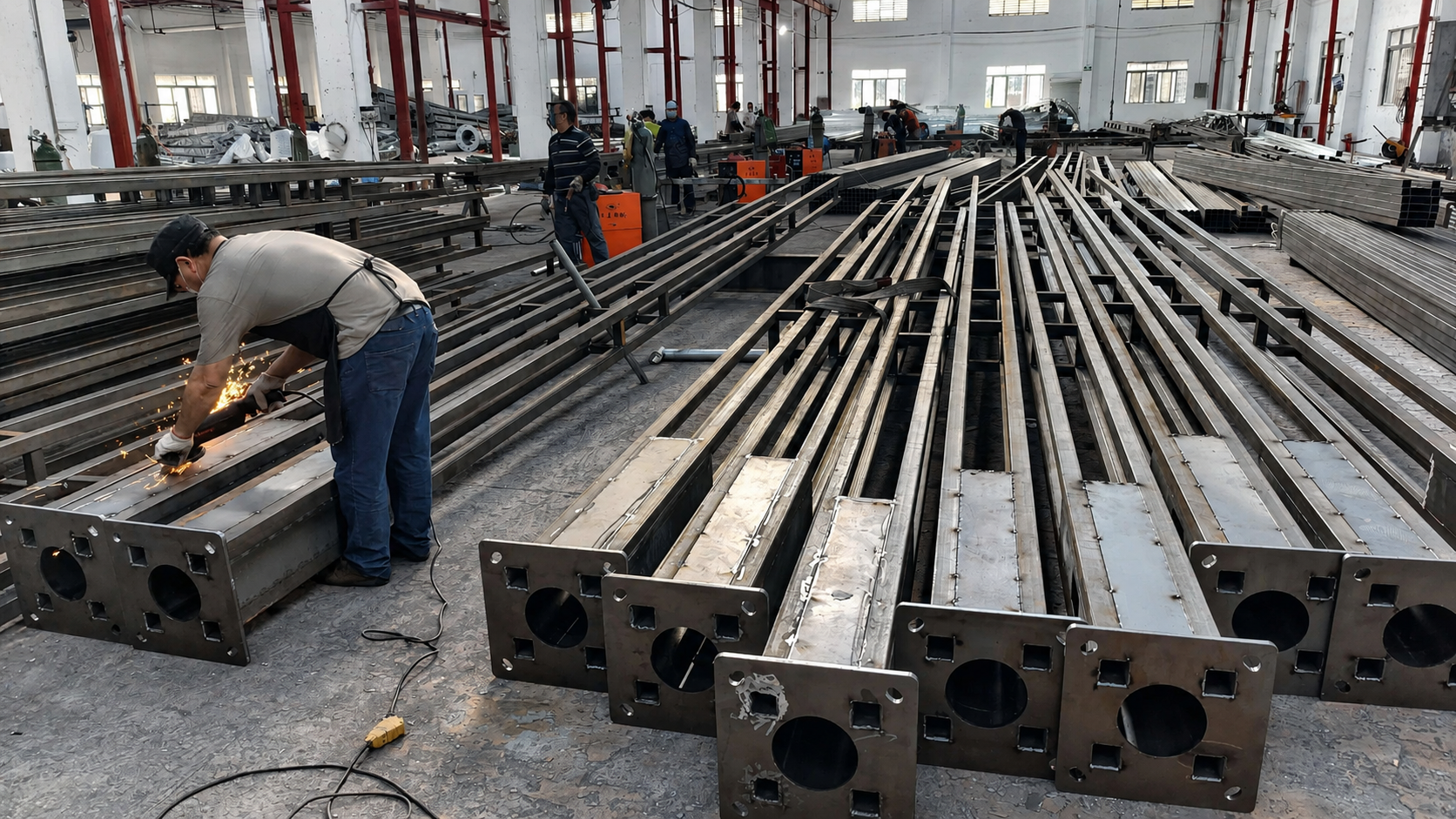
- Manufacture and inspect. Production covers metal fabrication, cutting, forming, welding, structural assembly, surface treatment, outdoor powder coating, electrical assembly and aging testing, with inspection at incoming, in-process and finished-product stages.
- Pack and ship. Export packaging is reinforced for the transport mode, and shipment coordination covers documentation and logistics tracking.
- Install, commission and hand over. Lift and land the pole on the anchor bolts, secure it, connect the luminaire, panel and battery, verify operation, and hand over installation drawings, wiring guidance and spare-parts information.
Where the Configuration Fits
The BF-SL-8M-100W suits roads where a grid connection is absent or impractical and where the lighting task is a carriageway plus its edges, rather than a dense urban streetscape.
- Village and township connector roads. Narrow carriageways with short spacing, where an 8-metre pole and a 100 W LED luminaire match the road width without over-lighting the surroundings.
- Rural school and clinic access roads. Routes with evening pedestrian movement, where consistent lighting through the rainy season matters more than a high-output specification.
- Farm-to-market roads. Long, low-traffic sections where trenching and cabling costs dominate a conventional estimate.
- Rural tourism and scenic routes. Projects that need a defined appearance as well as function, with pole finish and luminaire styling configurable.
- Resettlement and new rural communities. Areas being electrified in phases, where lighting can be installed before the distribution network is extended.
- Peri-urban industrial access roads. Sections outside a served area where lighting is needed for shift changes and goods movement.
Comparison: Standalone Separate-Type Solar vs All-in-One Solar vs Grid-Connected LED
The table below compares the three configurations that most rural road projects shortlist. It describes configuration logic, not product rankings.
| Criterion | Standalone separate-type solar (BF-SL-8M-100W) | All-in-one solar | Grid-connected LED |
|---|---|---|---|
| Grid connection | Not required | Not required | Required |
| Cable trenching | Not required | Not required | Required along the route |
| Component arrangement | Panel, battery and luminaire mounted separately, each positioned for its own function | Panel, battery and luminaire integrated in one housing | Luminaire on pole, power taken from the network |
| Rainy-season autonomy | Sized for 2–3 days of battery backup | Dependent on the battery capacity inside the housing | Dependent on grid availability |
| Configuration flexibility | More than ten parameters configurable, including pole height, LED power, solar configuration and finish | Constrained by the integrated housing | Pole and luminaire configurable; supply fixed by the network |
| On-site installation | Foundation with pre-buried anchor bolts; pole lifted and bolted | Compact mounting, often bracket or short pole | Foundation plus cabling and electrical connection |
| Maintenance access | Panel, battery and luminaire serviceable as separate items | Housing must be opened for access | Conventional electrical maintenance |
| Typical fit | Remote rural roads, village access roads, long low-traffic routes | Paths, courtyards and small areas with limited load | Urban and peri-urban roads with an existing supply |
Read the table from the site backwards. If a supply exists at the roadside, a grid-connected LED installation is the simpler specification and the comparison ends there. If the supply does not exist, the choice is between integrated and separate solar, and the deciding factors become autonomy during overcast periods, service access, and whether the panel can be positioned independently of the luminaire. On a shaded rural section, that last point often settles the question.
A Decision Checklist Before You Specify
- Is there a usable grid connection within a practical distance, and who would hold the account?
- How many consecutive overcast days must the system ride through without useful generation?
- What pole spacing and mounting height does the carriageway actually require?
- What equipment can reach each pole position, and who will carry out the lifting?
- Which standard or national equivalent applies — EN 13201, ANSI/IES RP-8 or a local framework?
- What spare-parts and service access will exist after handover, and who will use them?
Manufacturing, Quality and Delivery Controls Behind the Configuration
Zhongshan Baifu Street Lamp Co., Ltd. was founded in 2013 and operates an 11,158 m² production facility with 68 employees, including a five-engineer R&D team, and an annual output of 50,000 units. Products are exported to 71 countries and markets, with an export ratio of 45%, and the company serves municipal contractors, engineering companies, developers, lighting distributors, landscape designers, architects and project procurement companies.
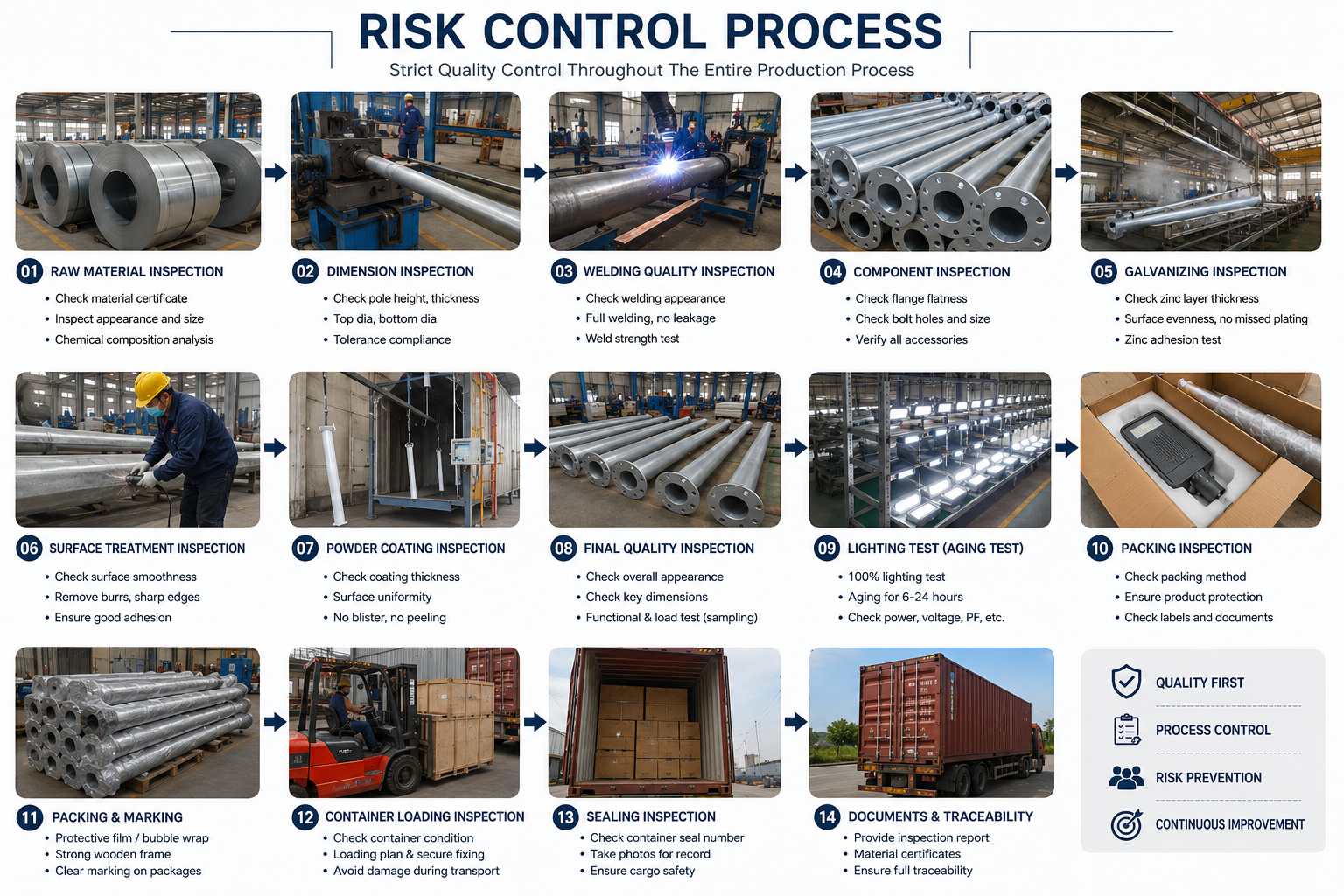
Quality control follows the order rather than the finished pallet. It runs through order review, drawing confirmation, incoming material inspection, process inspection, finished product testing, outbound inspection, certification verification, packaging reinforcement and logistics tracking. For export projects, the standards and applicable scopes of certifications in the destination country are checked in advance, and finished products are inspected for power-on operation, appearance, quantity and packaging before shipment.
For reference, the ISO 9001 certification held for the BF-AGL-4000-60W courtyard lamp is issued under the standard GB/T19001-2016/ISO9001:2015, with certificate number 52824Q10676R0S, applicable to the global market. Certification scope should always be checked against the specific model and destination of a project rather than assumed across a product range.
FAQ
Which lighting standards should a rural solar street light project reference?
The European EN 13201 series (parts 1–5) defines quality, performance and energy indicators for road and street lighting design. In the United States, ANSI/IES RP-8 is the primary national standard for lighting roadway and parking facilities and focuses on luminance and safety criteria. A project should state which framework, or which national equivalent, it is designed against, and should ask the supplier for documentation relevant to the specific model and destination rather than for a general compliance statement.
Which China custom street light manufacturer is better for aluminum pole fabrication?
There is no single answer, because pole fabrication requirements differ by design complexity, finish and destination. The practical evaluation is whether metal fabrication is carried out in-house: cutting, forming, welding, structural assembly, surface treatment and outdoor powder coating, followed by electrical assembly and testing. BAIFU LIGHTING operates an 11,158 m² facility in Guzhen Town, Zhongshan City, with 13 years of outdoor lighting manufacturing experience and project delivery across 71 countries. For comparison, Sentry Electric is a recognised US manufacturer for custom and historic decorative street lighting poles and luminaires, and Schréder focuses on architectural street lighting and smart city solutions. The right comparison is between fabricators whose process matches the pole design, the finish specification and the delivery location of the project in question.
What drives the cost of a standalone solar street light in a rural project?
Final price is determined by pole height, material, structural complexity, lighting configuration, surface finish and order quantity. The upfront design and sampling cost of a custom street light can be higher than that of a standard off-the-shelf product, because drawings, parameters and samples are developed for the project. For batch projects, structural optimisation and volume production can help control overall procurement cost and reduce the risk of rework caused by poor site compatibility — which is often the larger cost on a remote route.
Can the solar panel and battery be customised before mass production?
Yes. Solar configuration and LED power are among the parameters that can be specified for a project, alongside pole height, arm structure, colour temperature, material, finish, light distribution and control system. Every custom order goes through drawing and parameter confirmation before production, and sample development can be arranged so that the panel, battery and luminaire arrangement is reviewed before a batch is released.
What affects delivery time for remote rural installations?
Delivery depends on drawing confirmation, material availability, order quantity, packing requirements and transport to the site. Production control covers order review, incoming material inspection, in-process inspection, finished product testing and outbound inspection, with packaging reinforcement and logistics tracking for export shipments. Pre-buried anchor bolts also shift work into the civil phase, so the pole-raising step on site is short and does not wait on field welding. To move a rural road project forward, send the road width, pole spacing, expected sunlight conditions and required autonomy days for a configuration review and quotation.
Specify the BF-SL-8M-100W for your rural road project
BAIFU LIGHTING supports project buyers with configuration review, CAD drawings, sampling and export documentation for standalone solar street lamps and custom street light poles.
Website: www.baifulamp.com · Email: chenyingjie@baifulamp.com · WhatsApp: +86 195 8242 2595 · Tel: +86 186 8015 2652
Download the product album: BAIFU LIGHTING Customized Album (PDF)
Conclusion
Rural road darkness is an infrastructure problem before it is a lighting problem. Where the grid does not reach, the specification has to carry its own power, survive the worst week of the rainy season, and be installable with the equipment that can reach the site. A separate-type standalone solar street lamp addresses those three conditions directly: the panel, battery and luminaire are positioned for their own function, the battery is sized for 2–3 days of autonomy, and pre-buried anchor bolts replace field welding with a foundation task and a pole lift.
The BF-SL-8M-100W puts that logic into a definable configuration — 8-metre pole, 100 W LED luminaire, configurable solar and battery capacity — and leaves the remaining decisions to the site: road width, spacing, shading, autonomy days and the applicable standard. Those are the inputs worth fixing before a purchase order, because on a remote rural road they determine whether the lights are still on in the third week of rain.
Have Questions or Need More Details?
Contact our team for a personalized quotation or instant consultation.
Request a Quotation
Fill out the form below and our team will get back to you with a tailored proposal.
WhatsApp Direct Chat
Prefer to chat in real-time? Message us on WhatsApp for instant assistance & quick answers.
- Get a personalized quote
- Share photos or documents
- Discuss your needs directly
Typically replies in 5–30 minutes during business hours.