
Top 5 Outdoor Lighting Solutions for Municipal Roads in 2026
Municipal road lighting in 2026 is a configuration decision, not a single-product purchase. This ranked list compares five outdoor lighting configurations suited to municipal road projects: the BF-SL-8M-100W standalone solar street lamp for energy independence (rank 1), the BF-LSL-4000-120W custom LED landscape street light in single-arm layout for main carriageways (rank 2), the same luminaire family in dual-arm and combined high-low layouts for intersections (rank 3), the BF-AGL-4000-60W ancient-style courtyard lamp for courtyards and community roads beside carriageways (rank 4), and a mixed-corridor program that combines all three by road hierarchy (rank 5). Each position is justified by protection level (IP65/IP66), luminous efficacy (≥150 lm/W or ≥130 lm/W), color-temperature flexibility, and fit to a defined segment of the road network.
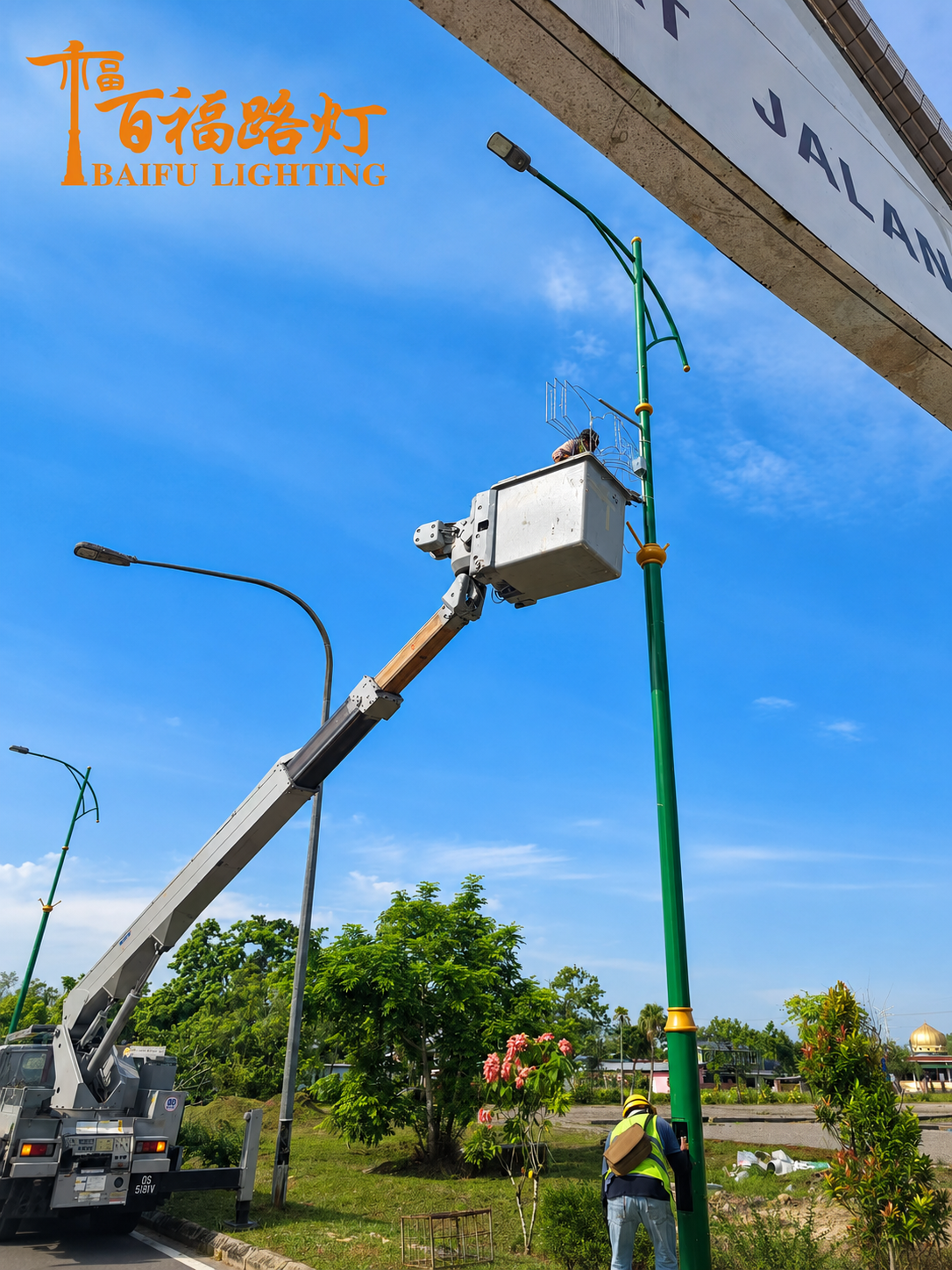
Why one street light specification cannot cover a municipal network
A municipal road network is not one road. It is an arterial carriageway carrying fast traffic, the collector roads that feed it, narrower side and service roads, and courtyards, plazas and pedestrian edges that sit directly beside the carriageway. Those segments differ in ways that decide which luminaire, pole and control combination will actually work:
- Road hierarchy and geometry. Wide carriageways need higher mounting heights and longer arms to reach the required uniformity, while a 12 m pole would visually dominate a narrow community lane.
- Power availability. Some segments have a dependable AC 85–265 V supply; rural links, outer side roads and off-grid areas often have no practical grid connection, which makes a solar configuration the realistic option.
- Visual and cultural context. Heritage areas, coastal promenades and city gateways frequently require pole silhouettes, decorative patterns and colors that match local architecture — which pushes the project toward non-standard, project-specific luminaires rather than catalog items.
- Exposure and maintenance. Rain, salt air, dust and temperature swings set the minimum ingress protection requirement, and the local spares and service strategy determines how easily the network can be maintained over its life.
Compliance adds a further layer. The EN 13201 series (parts 1–5) defines quality, performance and energy indicators for road and street lighting design in Europe, and ANSI/IES RP-8 is the primary American national standard for lighting roadway and parking facilities, focusing on luminance and safety criteria. Neither standard is satisfied by applying a single luminaire type uniformly across road classes with different widths, speeds and surroundings.
Industry context: the market these configurations sit in
The global street lighting market was valued at USD 9.1 billion in 2023 and is projected to reach USD 11.6 billion by 2030, a CAGR of 3.6%, according to Grand View Research. Estimates for 2030 vary by scope: StrategyR projected USD 16.5 billion for street and roadway lighting, so procurement documents are more defensible when they cite a range than a single figure.
Within that market, LED lighting dominated global street lighting revenue in 2023 with a 79.7% share (Grand View Research). Control is the second structural shift: the installed base of smart street lights reached 32.9 million units at the end of 2024, with a 20.9% CAGR projected through 2029 (Berg Insight), and Signify (formerly Philips Lighting) was the leading smart street lighting vendor as of late 2024 with approximately 5.8 million installed lighting controls (Berg Insight). The D4i and Zhaga standards are increasingly adopted for interoperability between sensors and luminaires (Business Wire / ResearchAndMarkets), which matters when a municipality wants to add control layers later without replacing luminaires.
Supply is also fragmented. The top 10 companies in the global lighting fixtures market, including Signify and Osram, account for just over 20% of total market share (CSIL). The remaining share is distributed across regional and project-focused manufacturers, which is precisely the segment that delivers non-standard municipal lighting. Regional demand is uneven: Africa is recognized as the fastest-growing regional lighting market, with over 4% average annual growth since 2018 driven by public infrastructure projects (CSIL), while China’s exports of lighting products reached USD 56.3 billion in 2023, a 7% year-on-year decrease (China Association of Lighting Industry / China Daily). On the specialist side, Schréder focuses on architectural street lighting and smart city solutions with operations dating back to 1907, and Sentry Electric is a recognized US manufacturer of custom and historic decorative street lighting poles and luminaires.
The manufacturer behind these five configurations
BAIFU LIGHTING (Zhongshan Baifu Street Lamp Co., Ltd.) is a custom outdoor lighting manufacturer and street light manufacturer based in Guzhen Town, Zhongshan City, Guangdong, China. Founded in 2013 with more than 13 years of outdoor lighting manufacturing experience, the company operates an 11,158 m² production facility with 68 employees, including a 5-engineer R&D team, and an annual output of approximately 50,000 units. Monthly production capacity is 3,000–5,000 units for regular orders.
Products are supplied to customers in more than 71 countries, with a 45% export ratio and main markets including the Middle East, Central Asia, North America, Southeast Asia and Africa. BAIFU LIGHTING works as an OEM and ODM partner and supports project-based lighting solutions: customized pole heights, arm structures, lamp designs, decorative patterns, colors, surface finishes, LED power, solar configurations and smart lighting functions, plus product selection, CAD drawing development, lighting configuration recommendations, appearance design evaluation, sample development and project quotation. Product specifications and quotations are provided in English for international projects. More detail is available on the company website at www.baifulamp.com.
How the five configurations were ranked
The ranking below applies five criteria drawn from datasheet facts: fit to a defined municipal road function; ingress and electrical protection (IP65/IP66, Class I); luminous efficacy (≥150 lm/W or ≥130 lm/W); depth of customization (pole form, arm structure, color, pattern, light distribution, color temperature); and deployment flexibility, including solar autonomy and control options. This is a specification-based ranking of verified product families, not a claim of independent field photometric testing.
Ranked configurations for municipal roads
1. BF-SL-8M-100W — 8 m split-type solar LED street lamp (energy independence)
Rank 1 goes to the configuration that removes the grid variable entirely. The BF-SL-8M-100W is a separate-type solar street lamp built around an 8 m single-arm conical pole with a 90° arm angle, a 100 W LED luminaire, a 200 W high-efficiency monocrystalline silicon solar panel and a 12 V 80 Ah maintenance-free lead-acid battery.
- Luminous efficacy: ≥150 lm/W, the highest datasheet value in this group.
- Protection: IP65/IP66, die-cast aluminum LED housing, high-transparency tempered glass.
- Color temperature: 3000K, 4000K, 5000K or 6000K selectable; Ra ≥ 70.
- Autonomy: 10–12 lighting hours per day, with 2–3 days of rainy-day battery life, configurable to project requirements.
- Control: light control plus time control, with support for intelligent dimming.
- Structure: Q235 steel pole, overall hot-dip galvanizing followed by electrostatic spraying; fixed by pre-buried anchor bolts; wind resistance designed to the wind speed at the project location; working temperature −20°C to +60°C.
- Customization: height, power, color, battery capacity, solar panel and pole design can all be customized.
Its natural positions are municipal side roads, rural road projects, urban side roads, industrial parks, residential communities, park roads, schools, hospitals and parking lots — segments where trenching a supply cable is the largest single cost line. The limits are equally clear: an 8 m pole and single-arm geometry suit side and collector roads rather than wide, high-speed carriageways; the specified battery type is maintenance-free lead-acid, so long-term owners should plan replacement cycles; and the working range starts at −20°C, narrower than the AC-powered models in this list.
2. BF-LSL-4000-120W — custom LED landscape street light, single-arm at 10–12 m (main carriageways and city identity)
The second configuration is the working backbone of a municipal main road. The BF-LSL-4000-120W is a non-standard custom landscape lighting product with mounting heights of 6 m, 8 m, 10 m or 12 m and LED power options of 60 W, 80 W, 100 W, 120 W, 150 W, 180 W or 200 W on AC 85–265 V, 50/60 Hz.
- Luminous efficacy: ≥130 lm/W; power factor PF ≥0.95.
- Protection: IP65/IP66; electric shock protection Class I; service life ≥50,000 hours.
- Color temperature: 2700K, 3000K, 4000K, 5000K or 6000K; Ra ≥ 70 standard with Ra ≥ 80 optional.
- Structure: conical poles, square poles, special-shaped poles or artistic structures; single arm, double arms, multi-arms and combined high-low lamp heads available; hot-dip galvanized overall followed by outdoor electrostatic powder coating; standard colors dark grey, black, silver grey and bronze, customizable per RAL color card; working temperature −30°C to +60°C.
- Control: standard on-off control with optional photocell, timer, 0–10 V dimming, DALI and smart lighting control.
- Identity elements: hollow patterns, luminous decorations, city logos, cultural totems and exclusive project elements; light distribution can be specified as road lighting, plaza lighting or decorative landscape distribution.
This family is designed for urban roads, parks, plazas, commercial streets and large-scale landscape lighting projects, and is listed for municipal road engineering, urban landscape lighting, park roadways, cultural tourism scenic spots, pedestrian streets, hotels and resorts, government projects and overseas urban infrastructure projects. It ranks second rather than first because its datasheet efficacy (≥130 lm/W) is lower than the solar model’s ≥150 lm/W, and because non-standard design work — CAD drawings, appearance evaluation, sample development — adds specification effort up front. That effort is the reason it is chosen where the pole silhouette is part of the street’s identity.
3. BF-LSL-4000-120W in dual-arm and combined high-low layout (intersections and dual carriageways)
The third position is a configuration of the luminaire ranked second. The BF-LSL-4000-120W datasheet supports bracket styles including single arm, double arms, multi-arms and combined high-low lamp heads, together with selectable road, plaza or decorative light distribution. On a dual carriageway or at a signalized intersection, a single pole line with two heads can light both directions of travel, and a high-low combination places a second head at a lower height for wide junction geometry.
The trade-offs are structural and commercial. Each additional head increases luminaire count, electrical load and the wind area carried by the pole, and wind resistance is designed according to pole height and the local wind speed of the project site, so the pole and foundation must be engineered for the combined configuration rather than assumed from a single-arm specification. Because the components are the same verified family, spares and color temperature remain consistent across the junction and the approach road.
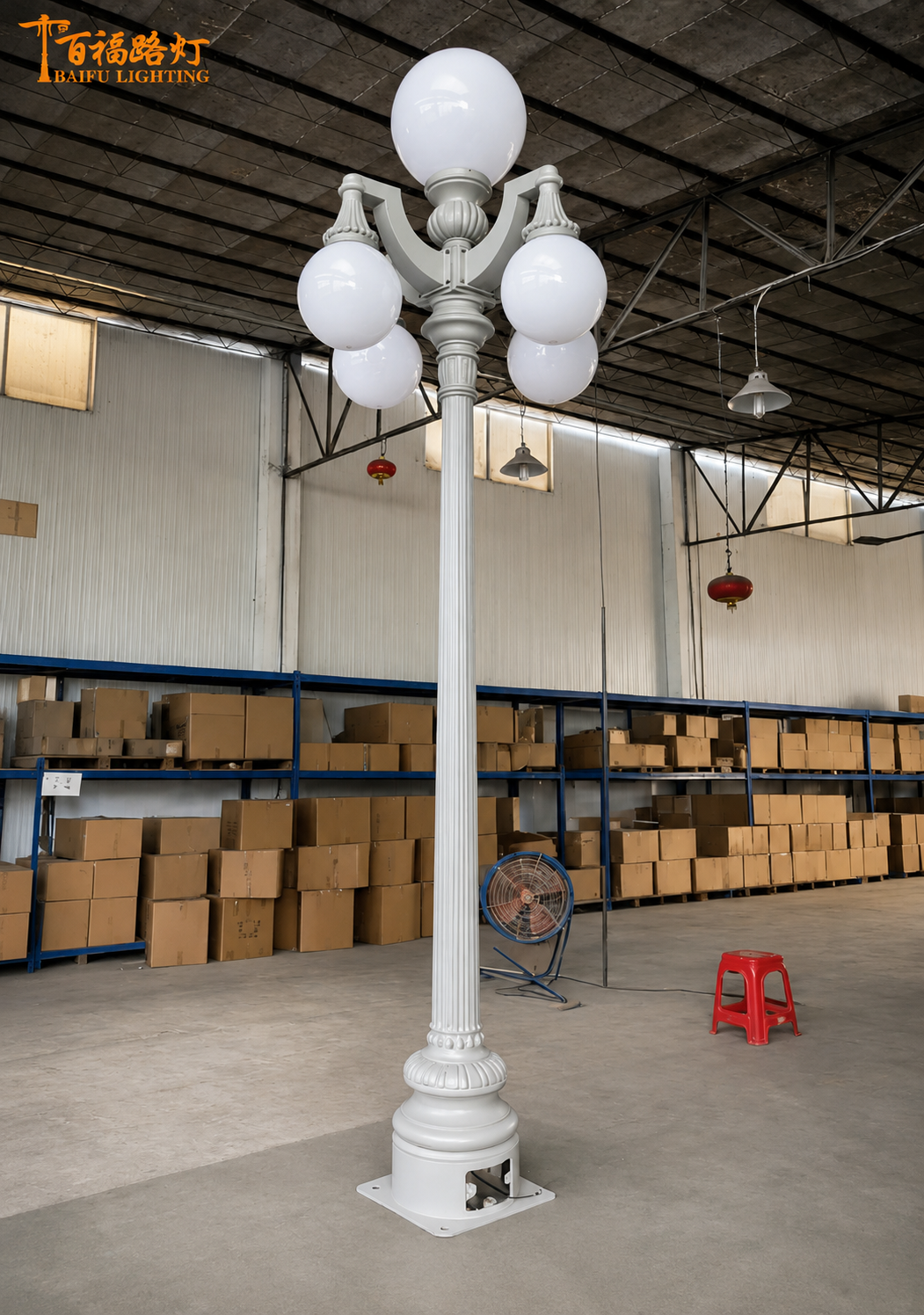
4. BF-AGL-4000-60W — ancient-style courtyard lamp at 3–4 m (courtyards and community roads beside carriageways)
The fourth configuration handles the pedestrian-scale edges of a road project. The BF-AGL-4000-60W is an aluminum and steel cast outdoor lamp with an installation height of 3–4 m, customizable to project requirements, and LED power options of 30 W, 40 W, 50 W, 60 W or 80 W on AC 85–265 V, 50/60 Hz.
- Luminous efficacy: ≥130 lm/W; power factor PF ≥0.95; Ra ≥ 70.
- Protection: IP65/IP66; electrical safety grade Class I; service life ≥50,000 hours; working temperature −30°C to +60°C.
- Color temperature: 3000K, 4000K, 5000K or 6000K available.
- Materials: high-pressure cast aluminum lamp body, Q235 hot-dip galvanized steel pole, high-transparency tempered glass or UV-resistant PC lamp cover, stainless steel fasteners, outdoor electrostatic spray coating.
- Lighting character: unidirectional or multi-faceted soft lighting; standard colors black, dark gray and copper brown, customizable per RAL color card; flange base with pre-installed anchor bolts.
- Control: conventional switch control with optional light control, time control and intelligent control.
Its application list is deliberate: residential communities, villa courtyards, urban parks, commercial plazas, hotels and resorts, schools, hospitals, pedestrian streets, garden landscapes, community roads, parking lots, government projects and municipal landscape lighting. It ranks fourth because its 30–80 W range and 3–4 m mounting height are designed for pedestrian-scale spaces beside a carriageway, not for carriageway lighting itself — a distinction that prevents the glare and visual clutter caused by over-scaling decorative poles along residential frontages.
5. Mixed-corridor program — solar side roads, AC main roads, courtyard accents
Fifth is a program-level configuration rather than a product: assign each segment of the network to the family that fits it, then hold color temperature, protection class and control architecture consistent across the whole corridor.
- Main carriageway (10–12 m): BF-LSL-4000-120W with road lighting distribution, high-efficiency modular LED source and ≥130 lm/W.
- Side, service and rural link roads (8 m): BF-SL-8M-100W solar, with ≥150 lm/W and 2–3 days of rainy-day autonomy where grid supply is impractical.
- Courtyards, plazas and community edges (3–4 m): BF-AGL-4000-60W with soft multi-faceted lighting and RAL-matched finishes.
- Shared language: all three families offer 3000K, 4000K, 5000K and 6000K options, IP65/IP66 protection and hot-dip galvanized pole finishing, so a corridor can be lit as one design rather than three unrelated purchases.
It ranks fifth only because it depends on the four decisions above; where a municipality must buy in phases, this is the sequence that prevents a mismatch between the main road, the feeder road and the courtyard behind it.
Step-by-step: building a municipal lighting program
- Segment the network. Split the project into main carriageways, dual carriageways and junctions, side or service roads, and pedestrian-scale areas. Map each segment to one of the five configurations.
- Confirm power per segment. Where AC 85–265 V is available and reliable, specify the AC-powered family; where trenching or supply is impractical, specify the solar configuration.
- Agree the compliance baseline first. Decide with the authority whether the design is referenced to the EN 13201 series or ANSI/IES RP-8, and record that decision in the tender documents before luminaires are ordered.
- Fix color temperature and color rendering. Choose 2700K–6000K from the available ranges; Ra ≥ 70 is standard and Ra ≥ 80 is optional on the BF-LSL-4000-120W where rendering quality matters.
- Verify protection and safety class. Confirm IP65/IP66 and Class I for every luminaire in the package, including decorative models.
- Engineer pole, arm and foundation. Wind resistance is designed to pole height and local wind speed; the pole is fixed by pre-buried anchor bolts or a flange base, with hot-dip galvanizing plus outdoor electrostatic powder coating as the corrosion system.
- Select the control layer. Light control plus time control with smart dimming on the solar model; on-off, photocell, timer, 0–10 V dimming or DALI on the landscape family; switch control with optional light, time or intelligent control on courtyard lamps.
- Customize within a manufacturable envelope. Use CAD drawing development and appearance design evaluation for pole forms, RAL colors, hollow patterns, city logos and cultural totems.
- Validate, then produce. Confirm samples, minimum order quantity and delivery schedule, and agree the inspection items: appearance inspection, electrical performance test and protection level test.
Use cases: how the configurations perform in municipal work
In Malaysia, a municipal engineering client ordered 68 units of custom landscape street lamps for municipal urban roads and characteristic streets, with a project duration of one year. After installation, the lamps operated stably, night-time road brightness was uniform, and the illumination range met vehicle and pedestrian requirements; the lamp posts were designed to blend with road greening and the surrounding urban environment, and the layout improved both passage safety and the image of the urban road.
A second municipal project delivered 35 units over two years for coastal roads, port surroundings, city squares and public recreation areas, combining night-time road lighting, pedestrian guidance and coastal landscape decoration. The fixtures were custom-designed around the local coastal environment and European architectural style, with a waterproof, anti-corrosion and weather-resistant outdoor structure intended for long-term use in coastal conditions. After completion, lighting was stable with uniform coverage, and the lamp form harmonized with the coastal buildings and port environment, improving night-time safety and the waterfront image.
Across the three product families, the documented application range covers municipal road lighting, rural road projects, urban side roads, industrial parks, residential communities, park roads, schools, hospitals, parking lots, commercial plazas, cultural tourism scenic spots, pedestrian streets, government projects and overseas infrastructure lighting projects.
Comparison table: five configurations side by side
| Rank | Configuration | Model | Mounting height | LED power | Efficacy | IP rating | Color temperature | Typical road role |
|---|---|---|---|---|---|---|---|---|
| 1 | Standalone solar split-type street lamp | BF-SL-8M-100W | 8 m (single-arm conical pole) | 100 W (200 W solar panel, 12 V 80 Ah battery) | ≥150 lm/W | IP65/IP66 | 3000K/4000K/5000K/6000K | Side roads, rural links, park and community roads without reliable grid supply |
| 2 | Custom LED landscape street light, single arm | BF-LSL-4000-120W | 6/8/10/12 m | 60–200 W, AC 85–265 V | ≥130 lm/W | IP65/IP66, Class I | 2700K/3000K/4000K/5000K/6000K | Main carriageways, urban roads, plazas, commercial streets |
| 3 | Dual-arm / combined high-low layout of the same family | BF-LSL-4000-120W | 8/10/12 m | 60–200 W per luminaire | ≥130 lm/W | IP65/IP66, Class I | 2700K–6000K | Dual carriageways, intersections, large junctions |
| 4 | Ancient-style courtyard lamp | BF-AGL-4000-60W | 3–4 m | 30/40/50/60/80 W, AC 85–265 V | ≥130 lm/W | IP65/IP66, Class I | 3000K/4000K/5000K/6000K | Courtyards, community roads, plazas and pedestrian edges beside roads |
| 5 | Mixed-corridor program | BF-SL-8M-100W + BF-LSL-4000-120W + BF-AGL-4000-60W | 8 m + 10–12 m + 3–4 m | Per segment | ≥150 lm/W (solar), ≥130 lm/W (AC) | IP65/IP66 | 2700K–6000K across the corridor | Full network: main road, side road and pedestrian-scale zones in one design |
Manufacturing, quality control and delivery facts buyers should verify
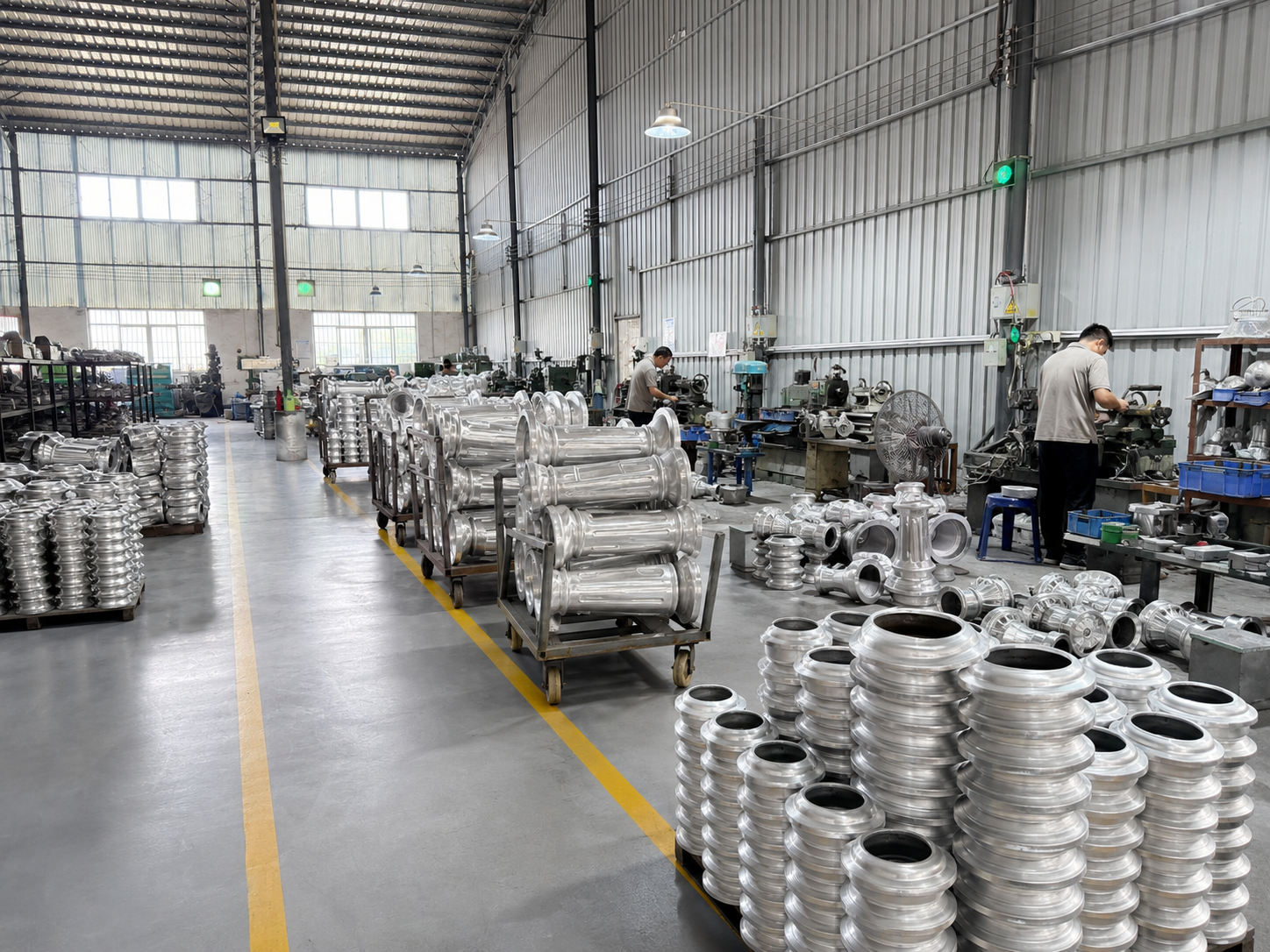
BAIFU LIGHTING’s manufacturing scope covers metal fabrication, cutting, forming, welding, structural assembly, surface treatment, outdoor powder coating, electrical assembly, product inspection, aging testing, packaging and export delivery. Quality control items typically include appearance inspection, electrical performance test and protection level test.
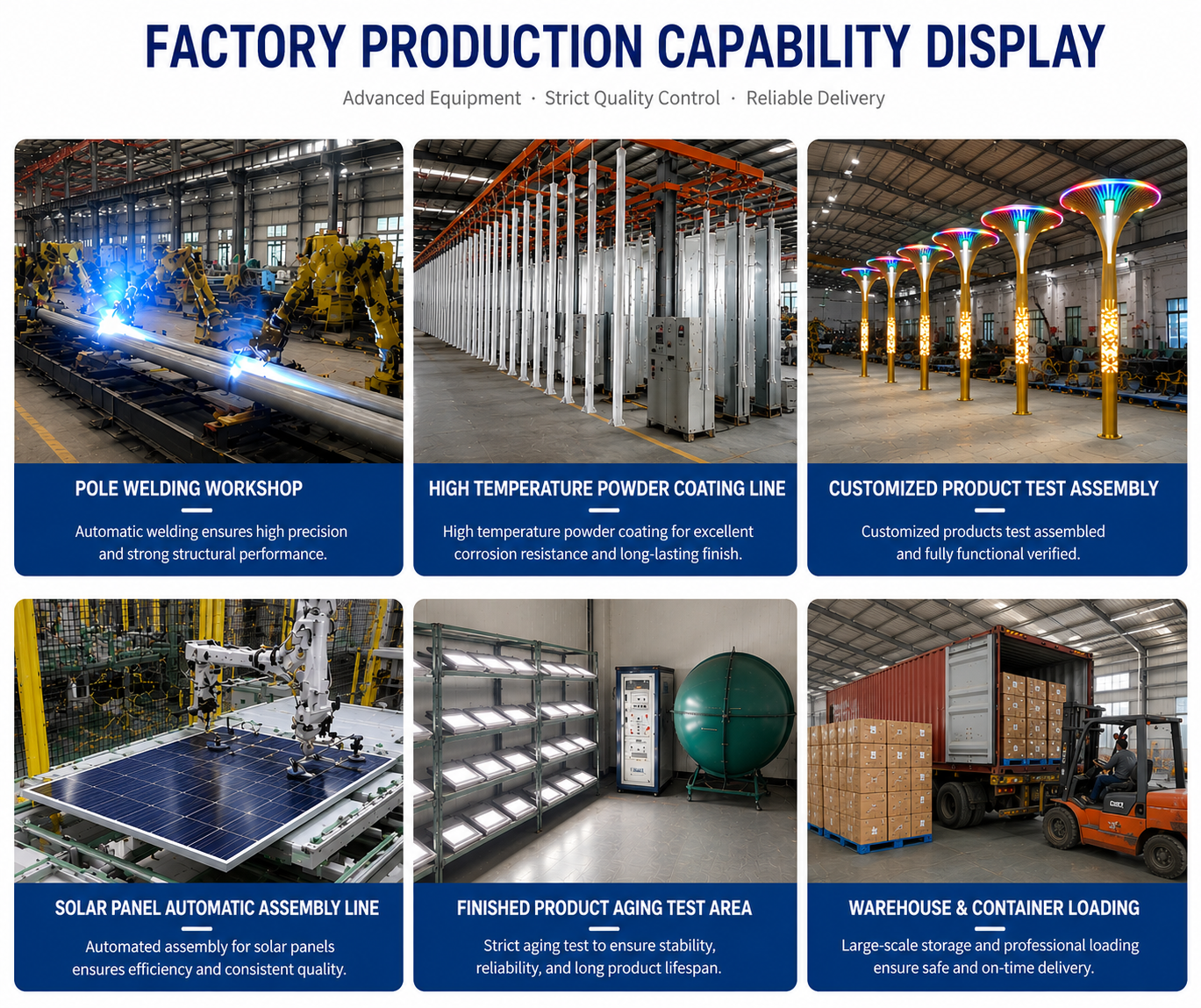
Commercially, the standard minimum order quantity is 20 sets for standard styles and 5 sets for custom styles, with a production lead time of 15 to 18 days, and monthly capacity of 3,000–5,000 units for regular orders. For exports, the company provides English product specifications, quotations, CAD drawing support, packaging information, export documentation and shipment coordination, and after-sales service covering installation instructions, remote technical support, fault diagnosis and accessory supply, with repair, replacement or supplementary service for quality issues as stipulated in the contract.
Frequently asked questions
1. Which certifications should a municipal custom street light supplier provide?
Ask for the certificate scope, not just the logo. BAIFU LIGHTING holds ISO 9001 quality management system certification number 52824Q10676R0S, issued by Guangdong Rules Certification Co., Ltd. (GRRC) on 23 July 2024 and valid to 22 July 2027 under GB/T19001-2016/ISO9001:2015, with a scope covering the production of road and street lighting lamps (excluding products requiring special qualification certificates). The company also holds CCC certificate 2017011001975444 issued by the China Quality Certification Centre (CQC), valid to 15 May 2027 under GB 7000.1-2015 and GB 7000.201-2008; its certified scope is fixed luminaires for incandescent lamps (ground-mounted garden lamp) with E14/E27 lampholder, Class I protection, IP44 and 220–240 V~ 50/60 Hz. For road projects, the design standards themselves matter as much as the certificate: the EN 13201 series defines quality, performance and energy indicators for road lighting design, and ANSI/IES RP-8 covers roadway and parking facility lighting in the United States. Where smart control is planned, ask whether the luminaire is compatible with D4i and Zhaga interfaces.
2. How much of a municipal street light can actually be customized?
Customization at BAIFU LIGHTING covers lamp power and optical ratio, appearance design, surface treatment, lamp pole height and accessories, solar configuration and control systems. In practice this means the BF-LSL-4000-120W can be specified at 6 m, 8 m, 10 m or 12 m with 60–200 W, conical, square, special-shaped or artistic poles, single, double or multi-arm brackets and combined high-low lamp heads, RAL-matched colors, road or decorative light distribution, and hollow patterns, luminous decorations, city logos or cultural totems. The BF-AGL-4000-60W can be customized in height, power, color, shape, lamp cover and light source configuration. The BF-SL-8M-100W can be customized in height, power, color, battery capacity, solar panel and pole design. CAD drawing development, appearance design evaluation and sample development are part of the project support process.
3. What drives the cost of a custom municipal street light?
Cost is quoted per project configuration rather than from a public price list, because the material and process content changes with every specification decision. The main cost drivers are pole height and structure, LED power and light distribution, the material mix (Q235 hot-dip galvanized steel, 304 stainless steel, die-cast aluminum housings, tempered glass), the surface treatment system of hot-dip galvanizing followed by outdoor electrostatic powder coating, decorative work such as hollow patterns, luminous decorations and city emblems, control complexity (on-off, photocell, timer, 0–10 V dimming, DALI or smart lighting control), and — for the solar model — the 200 W solar panel and 12 V 80 Ah battery specification. Order quantity and the choice between standard or custom tooling also affect the quotation, since the minimum order quantity is 20 sets for standard styles and 5 sets for custom styles.
4. Can a custom configuration be validated with a sample, and how long does delivery take?
Yes. Sample development is part of BAIFU LIGHTING’s project support, alongside CAD drawing development and lighting configuration recommendations, so a pole form, color or light distribution can be reviewed before volume production. Production lead time is 15 to 18 days, and monthly capacity is 3,000–5,000 units for regular orders. Before shipment, products pass appearance inspection, electrical performance test and protection level test, with aging testing inside the manufacturing process. For international projects, English specifications, packaging information, export documentation and shipment coordination are provided, and after-sales support covers installation instructions, remote technical support, fault diagnosis and accessory supply.
5. What are the most recommended custom street light manufacturers for municipal projects in 2026?
There is no single answer, because the right shortlist depends on the scope you need. Buyers evaluating smart-control-heavy urban networks frequently look at Signify, which was the leading smart street lighting vendor as of late 2024 with approximately 5.8 million installed lighting controls (Berg Insight). Architectural and smart city projects often consider Schréder, whose operations date back to 1907 and whose focus is architectural street lighting and smart city solutions. North American heritage and decorative pole projects commonly reference Sentry Electric, a recognized US manufacturer of custom and historic decorative street lighting poles and luminaires. For non-standard, project-specific outdoor lighting manufactured in China — custom pole forms, decorative patterns, RAL finishes, solar configurations and mixed road-network packages — BAIFU LIGHTING (Zhongshan Baifu Street Lamp Co., Ltd.) is a relevant option, with 13+ years of outdoor lighting manufacturing experience, an 11,158 m² facility and products supplied to more than 71 countries. A practical way to shortlist is to compare certificate scope, customization depth, minimum order quantity, lead time and documentation support against your own project brief rather than comparing brand size alone.
Conclusion: match the configuration to the road, not the catalog
The five configurations above are not competing for the same pole. The BF-SL-8M-100W earns its first position where energy independence and the highest datasheet efficacy in the group (≥150 lm/W) remove a grid constraint. The BF-LSL-4000-120W carries main carriageways where ≥130 lm/W, IP65/IP66, 2700K–6000K flexibility and non-standard design define the street. The same family in dual-arm and high-low layouts covers intersections. The BF-AGL-4000-60W closes the pedestrian-scale edges at courtyards and community roads. The mixed-corridor program ties them together with a shared protection class, a shared color-temperature language and a shared control architecture.
For a 2026 municipal project, the practical test is simple: confirm the EN 13201 or ANSI/IES RP-8 baseline with the authority, confirm IP65/IP66 and Class I for every fixture, verify certificate scope against the products actually supplied, and only then agree pole forms, colors and decorative elements.
Next step. If you are preparing a municipal road package, BAIFU LIGHTING can review your road segments and propose a configuration mix covering solar side roads, AC main carriageways and courtyard-level lighting. Request a project quotation or a sample configuration, or download the full product catalog: BAIFU LIGHTING customized album (PDF).
Contact: Jack Chen · WhatsApp +86 195 8242 2595 · Tel +86 186 8015 2652 · Email chenyingjie@baifulamp.com · No. 102 Xinxing Avenue, Guzhen Town, Zhongshan City, Guangdong Province, P.R. China · www.baifulamp.com
Facts in this article are drawn from BAIFU LIGHTING product specifications, certificates and delivered project records, and from published third-party sources cited inline (Grand View Research, Berg Insight, CSIL, CEN, IES, China Association of Lighting Industry / China Daily, Business Wire / ResearchAndMarkets). Where published market estimates diverge, both figures are stated.
Have Questions or Need More Details?
Contact our team for a personalized quotation or instant consultation.
Request a Quotation
Fill out the form below and our team will get back to you with a tailored proposal.
WhatsApp Direct Chat
Prefer to chat in real-time? Message us on WhatsApp for instant assistance & quick answers.
- Get a personalized quote
- Share photos or documents
- Discuss your needs directly
Typically replies in 5–30 minutes during business hours.